
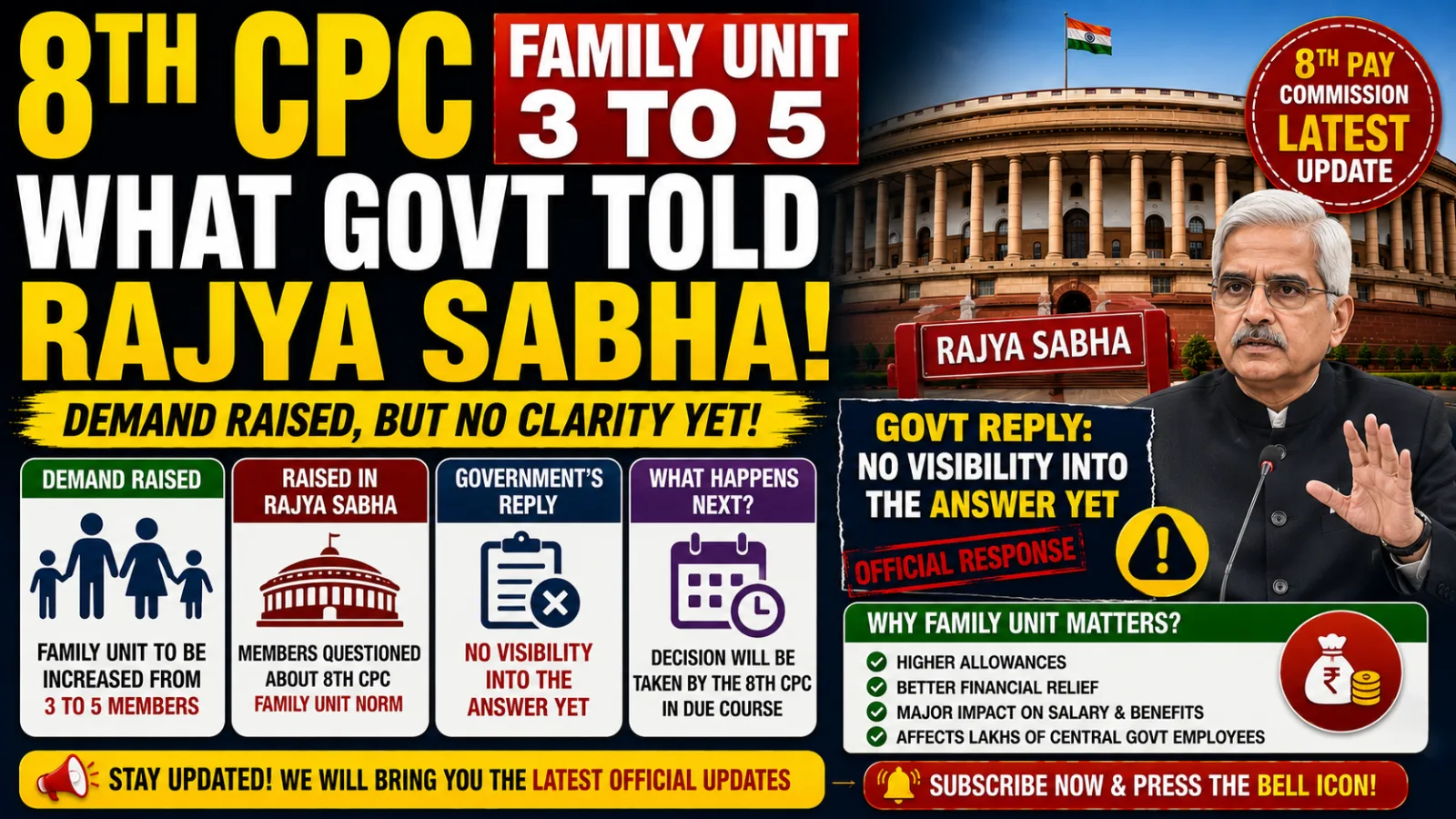
The 8th CPC family unit 3 to 5 question went to Rajya Sabha this week, and the government's answer is more revealing for what it doesn't say than for what it does. If you've been wondering whether unions actually got a hearing on raising the family unit used to calculate your minimum pay, here's the honest state of play, straight from the official reply.
This is Rajya Sabha Unstarred Question No. 1036, answered on 28 July 2026 by Shri Pankaj Chaudhary, Minister of State for Finance, in response to a question by Shri Javed Ali Khan.
What Was Actually Asked
The question had five parts, and they build on each other:
- How many meetings has the 8th Central Pay Commission held so far?
- Which employee unions has it consulted, union by union?
- Have employee unions demanded raising the family unit used to calculate the fitment factor from 3 to 5, including employees' parents?
- If so, what's the detail, and how have the Commission or the government responded?
- By when is the Commission likely to submit its report?
The Government's Answer — Parts (a) Through (d)
Here's where it gets interesting. For parts (a), (b), (c), and (d) — the meeting count, the union-wise consultation list, the family-unit demand, and any response to it — the government gave a single combined answer, and it isn't really an answer to any of them individually.
The reply states that the Resolution dated 3 November 2025, which constituted the 8th CPC and laid out its Terms of Reference, provides that the Commission will devise its own procedure. Critically, the Terms of Reference do not require the Commission to keep the government updated on the progress it has made, the nature of recommendations under consideration, or its consultation process during its deliberations.
In plain terms: the government isn't withholding this information from Parliament out of caution — it says it genuinely doesn't have it, because the Commission isn't obligated to report back on any of this while it's still working.
What This Means for the Family Unit Demand Specifically
So has the family-unit-from-3-to-5 demand actually been raised with the Commission? Almost certainly yes — employee federations have submitted this demand in their memoranda, and it's been discussed publicly by unions for months. But whether the Commission is seriously considering it, has pushed back on it, or hasn't addressed it at all — none of that is something the government can currently confirm, because the Commission simply hasn't reported back on its internal deliberations.
Why the Family Unit Number Actually Matters
If you haven't followed this part of the debate, it's worth thirty seconds. When a Pay Commission calculates minimum pay, it doesn't just guess — it uses a need-based formula tracing back to the 15th Indian Labour Conference in 1957, built on nutritional and consumption research by Dr. Wallace Aykroyd. The formula estimates how much income a family needs for food, clothing, housing, and other essentials, based on an assumed family size called the family unit or consumption unit.
The 7th CPC used a family unit of 3.0, built as:
- Employee: 1.0
- Spouse: 0.8
- First child: 0.6
- Second child: 0.6
- Total: 3.0
Dependent parents weren't counted at all. That's exactly what unions are pushing back on — their argument is that most government employees also financially support ageing parents, and a formula that ignores that entirely understates real household costs. Raising the family unit to 5 would include parents in the calculation, which pushes up the estimated minimum living cost — and since minimum pay and the fitment factor are directly derived from that figure, a higher family unit number means a higher fitment factor across the board, not just a symbolic change.
Some estimates built on a 5-unit family have put minimum basic pay as high as ₹69,000, with a fitment factor around 3.83 — though this remains a union proposal, not anything the Commission has confirmed or endorsed.
The One Thing the Government Did Confirm
Part (e) got a direct, useful answer: as per the Resolution dated 3 November 2025, the 8th Central Pay Commission will submit its recommendations within 18 months of the date of its constitution. Counting from 3 November 2025, that puts the outer deadline at roughly early May 2027.
This matches what's been reported elsewhere and gives you the one concrete date to actually plan around — everything else in this reply is either confirmed-but-vague (the Commission sets its own process) or simply unknown to the government at this stage.
What You Should Take From This
- Don't expect official updates on meeting counts or which unions have been consulted — the government has confirmed it doesn't track this and isn't entitled to it under the Commission's Terms of Reference
- Treat the family-unit-to-5 demand as an active, unresolved ask, not a rejected one and not an accepted one — there's simply no confirmation either way yet
- The only hard date to hold onto is the 18-month deadline from 3 November 2025, putting the report roughly around May 2027
- Any fitment factor number tied to a 5-unit family calculation, including the ₹69,000/3.83 figures circulating, is a union projection — not a Commission-confirmed outcome
For the current state of fitment factor estimates more broadly, our fitment factor guide and 8th CPC pay matrix calculator are worth checking, and our piece on the realistic fitment factor range covers where independent estimates currently sit. For the latest on where the Commission's process stands overall, see our 8th Pay Commission latest updates roundup, and if you're planning around a possible delayed implementation, our piece on 8th CPC arrears and tax covers what that could mean for your return filing.
For more official Parliament replies like this, follow our government news section.