
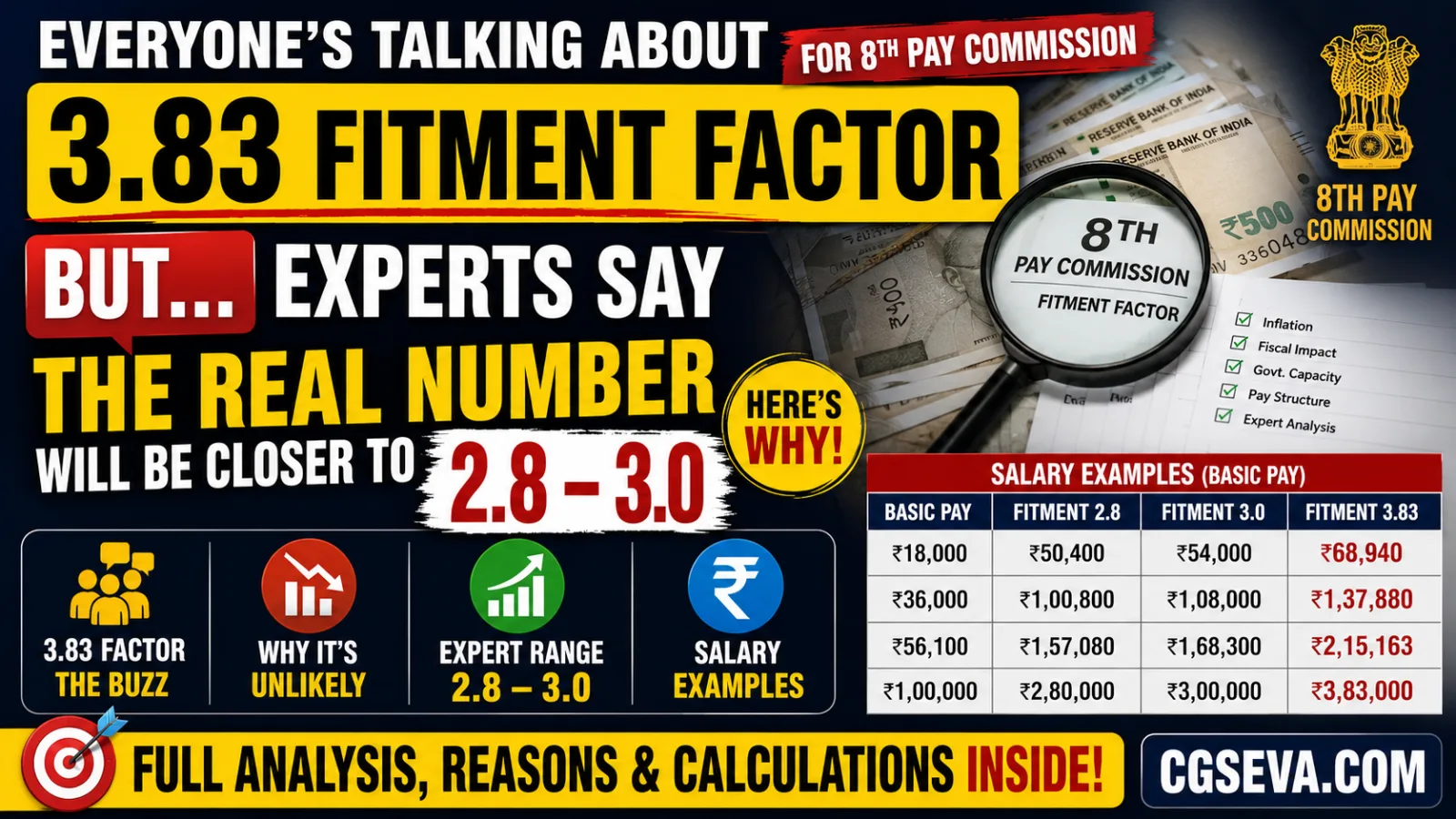
Everyone's Hoping for a 3.83 Fitment Factor. Here's Why That Number Might Not Happen
If you're a central government employee, you've probably seen the number 3.83 floating around every WhatsApp group and news channel lately. It's the fitment factor employee unions are pushing for under the 8th Pay Commission, and if it actually goes through, it would mean the biggest salary jump government staff have seen in decades.
But here's the part most forwards leave out: financial experts don't think 3.83 is realistic. Most are pointing to a much narrower range — somewhere around 2.8 to 3.0.
First, What Does "Fitment Factor" Even Mean?
In plain terms, it's the number your current basic pay gets multiplied by to arrive at your new basic pay under a fresh pay commission. Simple as that.
For context, the 7th Pay Commission used 2.57. That's the number that took a ₹18,000 basic pay to roughly ₹46,260 back then. So when people talk about 3.83 this time, they're talking about a jump far bigger than what happened last time around.
Not Everyone Is Asking for the Same Number
This is where it gets interesting — different employee groups have put in different demands:
- Defence employee unions are pushing hardest, at 3.83
- Postal employee bodies are asking for around 3.25
- Several staff associations have settled on a more modest 2.86 to 3.0
- A few other unions have gone as high as 3.80
So even among employees themselves, there's no single agreed figure. The government has to weigh all of these before finalising anything.
What the Experts Are Actually Saying
Economist Dr. Sharad Kohli, whose views have been widely quoted on this topic, says a fitment factor of 3.83 would be a dream outcome — but not a financially realistic one. His estimate lands in the 2.8 to 3.0 range, which he considers achievable without putting too much strain on government finances.
It's not that 3.83 is impossible on paper. It's that giving every central government employee and pensioner nearly four times their current basic pay would be an enormous one-time cost, and that's the part governments tend to be cautious about.
Show Me the Actual Numbers
Numbers make this easier to picture. Take someone on a basic pay of ₹18,000:
| Fitment Factor | New Basic Pay |
|---|---|
| 2.57 (7th CPC, for comparison) | ₹46,260 |
| 2.86 (likely 8th CPC estimate) | ₹51,480 |
| 3.83 (union demand, if approved) | ₹68,940 |
That's a difference of nearly ₹17,500 a month between the "likely" number and the "hoped-for" number. It's easy to see why employees aren't giving up on 3.83 without a fight — but it's also easy to see why the government might not land there.
Why the Higher Number Is a Tough Ask
A few real-world pressures are working against the bigger figure:
- The government's fiscal deficit is already something it has to watch closely
- Global inflation and supply chain costs haven't fully settled down
- Ongoing geopolitical tensions add uncertainty to budget planning
- Subsidy spending keeps climbing year on year
- Maintaining overall financial stability matters more to the government than any single announcement
None of this means employees won't get a raise — it just means the final number will likely be a compromise rather than the top-end ask.
Inflation Is Doing a Lot of the Math Here
Pay commissions don't pick a fitment factor out of thin air. They look closely at the Consumer Price Index, how the cost of living has shifted, how salaries compare with the private sector, and how purchasing power has changed over the years. The 2016-2026 window has been unusually bumpy — a pandemic, global conflicts, and multiple inflation spikes — which makes this calculation trickier than it was for past commissions.
It's Not Just About Basic Pay
Salary revision under a Pay Commission isn't only about the number on your payslip. The government also looks at the total cost of employing someone — housing, medical benefits, pension liabilities, and various allowances all get factored in. So even if the fitment factor lands on the lower side, some of the gap may show up as improved benefits elsewhere.
The Political Angle Nobody Ignores
This pay revision touches close to 50 lakh central government employees, plus a huge number of pensioners and their families. That's a massive number of voters and households with a direct stake in the outcome — which is exactly why many analysts expect the government to try and land on a number that feels generous, even if it's not the full 3.83.
When Will This Actually Kick In?
The new pay structure is expected to take effect from 1 January 2026, though the full rollout could take longer once the commission submits its recommendations. If there's a gap between the effective date and actual implementation, employees would typically get arrears to cover the difference.
The Bottom Line
3.83 makes for an exciting headline, but most financial experts are betting on something between 2.8 and 3.0 as the number that actually gets approved. It's still a solid raise — just not the dream figure some unions are pushing for.
Until the government makes an official announcement, treat every number you see — including the ones in this article — as an informed estimate, not a confirmed decision.
This article reflects expert opinions and employee union demands reported publicly as of July 2026. The Government of India has not yet announced an official fitment factor for the 8th Pay Commission.