
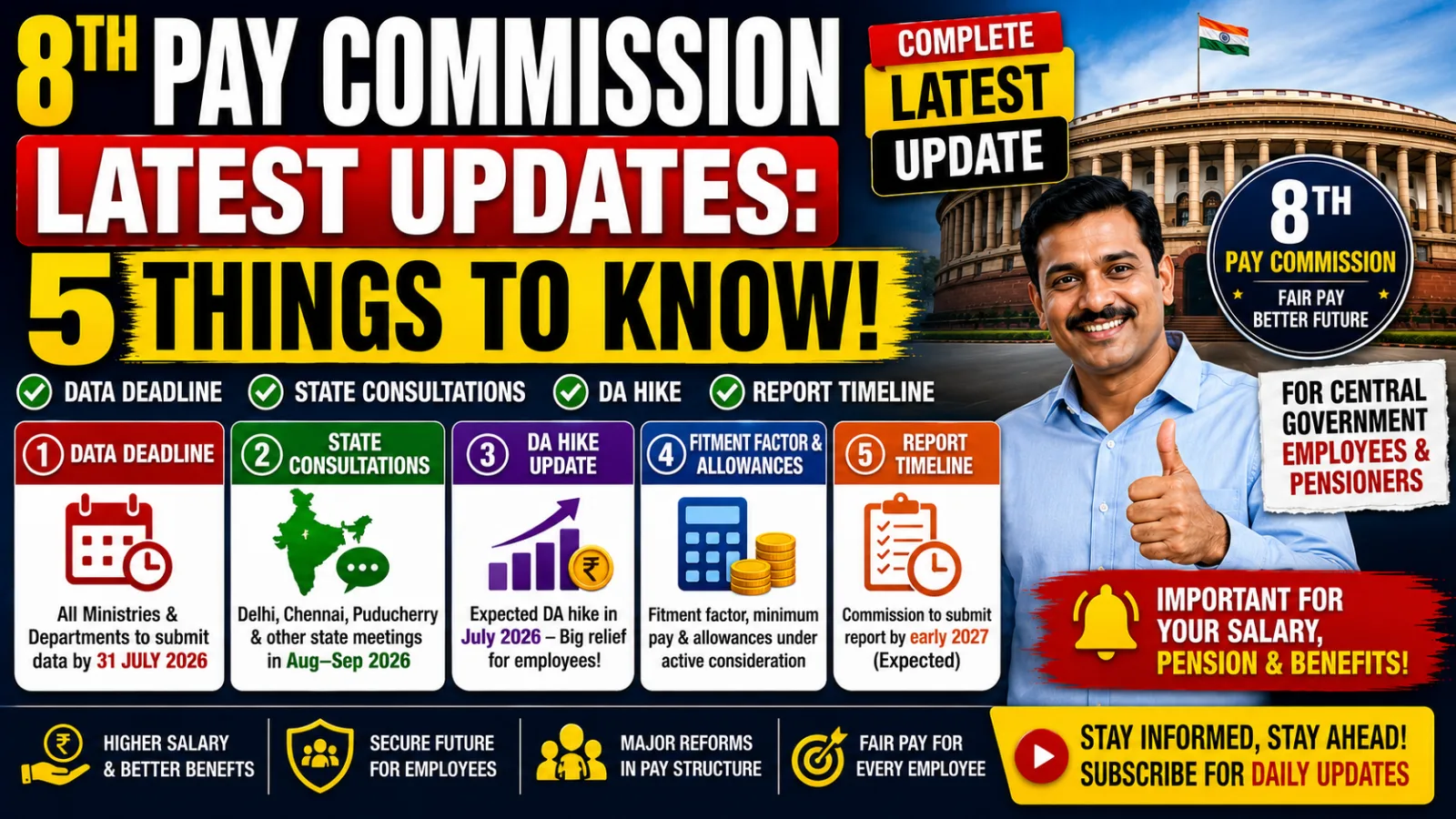
8th Pay Commission latest updates as of late July 2026 show a Commission deep in its data-gathering and consultation phase, with no salary or pension numbers finalised yet — but several concrete, official developments worth tracking if you're a Central Government employee or pensioner. Here are the five that actually matter right now.
1. Workforce Data Submission Deadline Extended to 31 July 2026
The Commission extended the deadline for Ministries, Departments, Union Territories, and other government organisations to submit employee and workforce data through its official Data Collection Portal to 31 July 2026. This covers detailed workforce information — including contractual and outsourced manpower — for the previous three financial years, and it's meant to feed directly into the Commission's salary revision exercise.
The Commission has been explicit that this data must come only through the official online portal, not through informal channels. If your department hasn't submitted its data yet, this is the deadline that's currently live.
2. Public Consultation Window Has Closed — Analysis Phase Has Begun
The online window for employee unions, pensioners' associations, and other stakeholders to submit memoranda and suggestions officially closed on 15 June 2026. Submissions covered the expected ground — minimum pay, fitment factor, pension revision, and allowances.
With that window shut, the Commission has moved into what's effectively its detailed assessment phase: going through the submitted recommendations to shape a balanced, practical set of proposals before anything goes to the government. This is a meaningful shift — the Commission is no longer just collecting input, it's actively working through it.
3. Regional Stakeholder Meetings Are Still Rolling Out
The Commission has been holding city-by-city consultation rounds with employee organisations, pensioners' groups, and government departments. As of late July 2026, it has completed nine rounds of regional consultations, including stops in Lucknow, Hyderabad, Srinagar, Ladakh, Bhubaneswar, and a Kolkata round held on 9–10 July 2026.
More are scheduled. Notices issued in the last week of July 2026 confirm the Commission will visit Delhi on 7 and 10 August, Chennai on 7 and 8 September, Puducherry on 9 September, and — most recently notified, on 28 July 2026 — Chandigarh on 16, 17, and 18 September, covering stakeholders from Punjab, Haryana, Himachal Pradesh, and the UT of Chandigarh. Each notice carries its own application deadline and eligibility conditions for local stakeholder associations. If your organisation is based in one of these locations and hasn't met the Commission yet, our Delhi, Chennai, and Puducherry meeting guide and our Chandigarh visit guide cover exact dates and how to apply. For a sense of what unions have been raising in these sessions, our coverage of the Kolkata meeting and the demands raised there is a useful reference.
For context, the Commission is chaired by former Supreme Court judge Justice Ranjana Prakash Desai, with Prof. Pulak Ghosh as part-time member and Shri Pankaj Jain as Member-Secretary, and its recommendations are expected to benefit roughly 1.1 crore people — around 50 lakh serving Central Government employees, including defence personnel, and about 65-69 lakh pensioners.
4. DA/DR Has Already Been Hiked — Separately From the 8th CPC
This is worth flagging because people sometimes conflate the two: the Union Cabinet approved an additional 2% Dearness Allowance and Dearness Relief, effective from 1 January 2026, taking the DA rate from 58% to 60% of Basic Pay/Pension. This DA hike happened through the normal twice-yearly revision cycle and is independent of the 8th Pay Commission's work — it's not a preview of what the Commission will eventually recommend. When the 8th CPC's revised pay structure does get implemented, DA typically resets to zero and starts accumulating again from the new base.
5. Report Timeline Remains Projected, Not Confirmed
The Commission was constituted on 3 November 2025 with an 18-month deadline to submit its report — which points to around May 2027 as the outer limit. Different outlets are currently citing slightly different windows for the final report, ranging from February–April 2027 to mid-2027, with actual employee benefits potentially not being felt until 2029–2030 once implementation and arrears processing catch up.
Treat all of these as estimates, not confirmed dates — the Commission itself hasn't published a fixed submission date, and 18-month deadlines for Pay Commissions have shifted before. The safest approach is to track official notices rather than anchor on any single projected date.
What This Means for You Right Now
Nothing here changes your current pay or pension — that only happens once the Commission submits its report and the government acts on it. What's genuinely useful right now is understanding which phase the process is in: data collection is closing out, consultations are still active, and the analysis phase has only just begun. If your union or association hasn't yet had a chance to present its case and you're in a state where meetings are still being scheduled, that window is still open.
For deeper context on what the eventual pay revision could look like, our 8th CPC pay matrix calculator and fitment factor guide can help you model different scenarios, while our current DA rate calculator keeps you updated on where DA stands right now, separate from the Commission's eventual recommendations.
For ongoing coverage as new developments are officially notified, follow our 8th CPC latest news page and the broader government news section.
FAQs
What is the current data submission deadline for the 8th Pay Commission?
Ministries, Departments, and other government organisations have until 31 July 2026 to submit workforce data through the Commission's official Data Collection Portal.
Has the window to submit memoranda to the 8th CPC closed?
Yes. The public consultation window for submitting memoranda and suggestions closed on 15 June 2026. The Commission is now analysing the submissions it received.
Is the recent DA hike to 60% part of the 8th Pay Commission's recommendations?
No. The DA/DR increase to 60% of Basic Pay/Pension, effective 1 January 2026, came through the regular twice-yearly DA revision cycle and is separate from the 8th CPC's ongoing work.
When will the 8th Pay Commission submit its final report?
This isn't officially confirmed yet. Estimates currently range from February-April 2027 to mid-2027, based on the Commission's 18-month deadline from its November 2025 constitution — treat these as projections, not confirmed dates.
Which cities has the Commission visited for consultations so far?
As of late July 2026, the Commission has completed nine rounds of regional consultations, including Lucknow, Hyderabad, Srinagar, Ladakh, Bhubaneswar, and Kolkata, with Delhi, Chennai, and Puducherry scheduled next.
When can employees expect to actually see the salary and pension changes?
Even after the report is submitted and accepted, implementation and arrears processing typically take time — some estimates suggest full benefits may not be felt until 2029-2030, though this depends heavily on how quickly the government acts on the final recommendations.