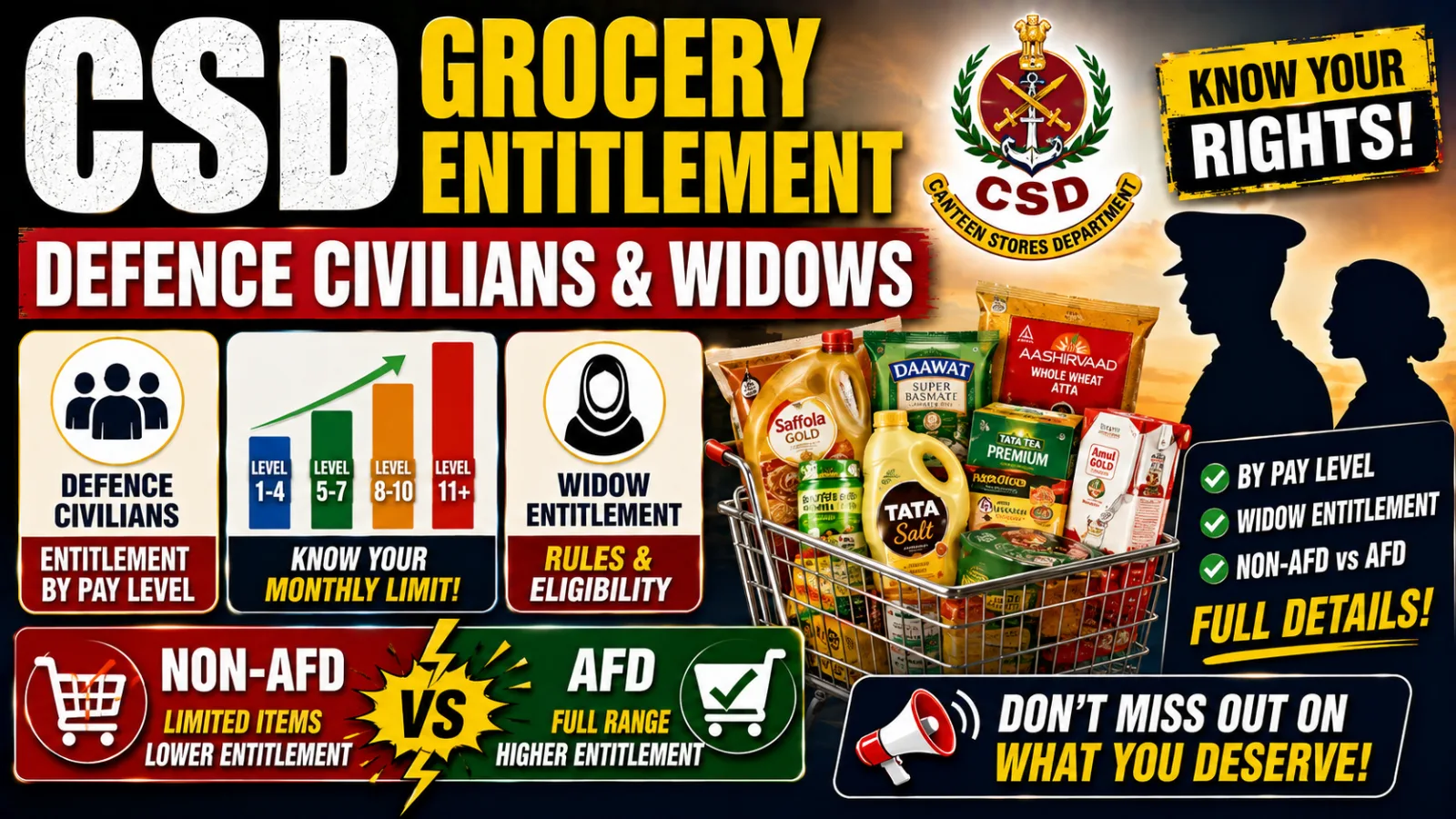
If you're a defence civilian employee or a widow drawing on a deceased card holder's CSD entitlement, the standard rank-wise CSD guides don't always spell out your specific situation clearly. This piece focuses on exactly that — what defence civilians get by Pay Level, how widow entitlement actually works, and the genuinely confusing Non-AFD vs AFD distinction that trips up even long-time CSD users.
Two Categories, One Card
Every CSD Smart Card entitlement splits into two distinct categories:
- Non-AFD items — everyday grocery and consumables, bought directly off the shelf at your Unit Run Canteen (URC), no advance booking needed
- AFD (Against Firm Demand) items — high-value goods like cars, two-wheelers, refrigerators, ACs, and televisions, which require advance booking through the CSD AFD system rather than being stocked on the shelf
Both draw against limits tied to your rank or Pay Level, but they work on very different purchase mechanics and — this is the part worth getting right — very different time periods.
The Correction Worth Knowing: Monthly vs Annual
Non-AFD grocery limits are genuinely monthly — they reset every month, and unused entitlement generally doesn't carry forward. The larger AFD figures you'll often see quoted alongside them (₹55,000, ₹75,000, ₹1,00,000, depending on category), however, are annual limits, not monthly ones. This traces back to the original Ministry of Defence circular governing CSD purchase limits, which set these AFD figures as yearly ceilings specifically because AFD items are big-ticket purchases, not everyday consumables.
If you've seen these AFD figures described as "monthly" anywhere, treat that as a labelling error — a genuine monthly allowance of ₹1 lakh for appliance-category purchases wouldn't match how AFD actually works, or how any other authoritative CSD source describes it.
Grocery Entitlement for Defence Civilians, by Pay Level
Defence civilian employees get CSD grocery access tied to their Pay Level, structured the same way as the armed forces rank-based system:
| Pay Level | Non-AFD Monthly Limit | AFD Annual Limit |
|---|---|---|
| Level 1–5 | ₹5,500 | ₹55,000 |
| Level 6–9 | ₹8,000 | ₹75,000 |
| Level 10–18 | ₹11,000 | ₹1,00,000 |
One thing that catches defence civilians off guard: liquor entitlement generally doesn't apply to this category under the standard entitlement chart. If you're a defence civilian employee expecting a liquor quota alongside your grocery card, that's typically not part of your entitlement — this benefit is specifically tied to serving and retired armed forces categories.
Widow and Family Pensioner Entitlement
If you're a widow or widower who has become an authorised CSD beneficiary after the primary card holder's death, the general rule is that you're entitled to 50% of the primary card holder's grocery entitlement, subject to the specific policy and card category that applied to your spouse.
This 50% figure is a general guideline, not a fixed universal number — the exact entitlement depends on which rank or Pay Level category your spouse fell under, and the applicable local policy. If you're unsure what your specific entitlement works out to, your parent URC or the Zila Sainik Board can confirm the exact figure based on your late spouse's card category.
What Actually Counts as a Non-AFD Item
Non-AFD covers the everyday essentials you'd expect to just walk in and buy:
- Grocery staples — rice, flour, pulses, edible oil
- Tea and coffee
- Toiletries — soap, toothpaste, shampoo
- Detergents and household cleaning supplies
- Packaged foods
- General household consumables
These are purchased directly at the URC counter using your Smart Card, with the purchase amount deducted from your monthly Non-AFD balance in real time.
What Actually Counts as an AFD Item
AFD is specifically for the bigger-ticket goods that need advance booking rather than shelf stock:
- Refrigerators
- Air conditioners
- Washing machines
- Microwave ovens
- Televisions
- Cars
- Two-wheelers
- Other significant white goods and household electronics
Because these are higher-value, lower-frequency purchases, they run on a separate booking process through the CSD AFD portal, with their own eligibility conditions, waiting periods between purchases, and documentation requirements — quite different from just picking items off a shelf.
Why These Limits Exist at All
The monthly and annual caps aren't arbitrary — they exist specifically to:
- Prevent commercial misuse of subsidised goods (buying in bulk to resell)
- Keep distribution fair across the roughly 1.3 crore-plus beneficiaries CSD serves nationwide
- Maintain stock availability at URCs for genuine household use
- Support transparent, auditable inventory planning across the network
What This Means for You
- Defence civilians: confirm your Pay Level band against the table above, and don't expect a liquor entitlement under the standard chart
- Widows and family pensioners: your entitlement is generally half of what your spouse's card category provided — verify the exact figure with your URC rather than assuming a flat number
- Everyone: remember Non-AFD limits reset monthly and don't carry forward, while AFD limits are annual — plan big-ticket CSD purchases with that yearly window in mind, not a monthly one
If you're specifically looking for the combined monthly grocery-plus-liquor ceiling for serving and retired armed forces personnel, our CSD Canteen Smart Card liquor and grocery limits guide covers that in detail, and our CSD liquor quota rules guide breaks down the rank-wise liquor entitlement separately. For big-ticket AFD purchases specifically, see our CSD AFD Online Portal guide and CSD car purchase eligibility guide.
For more CSD and defence welfare updates like this, follow our government news section.