
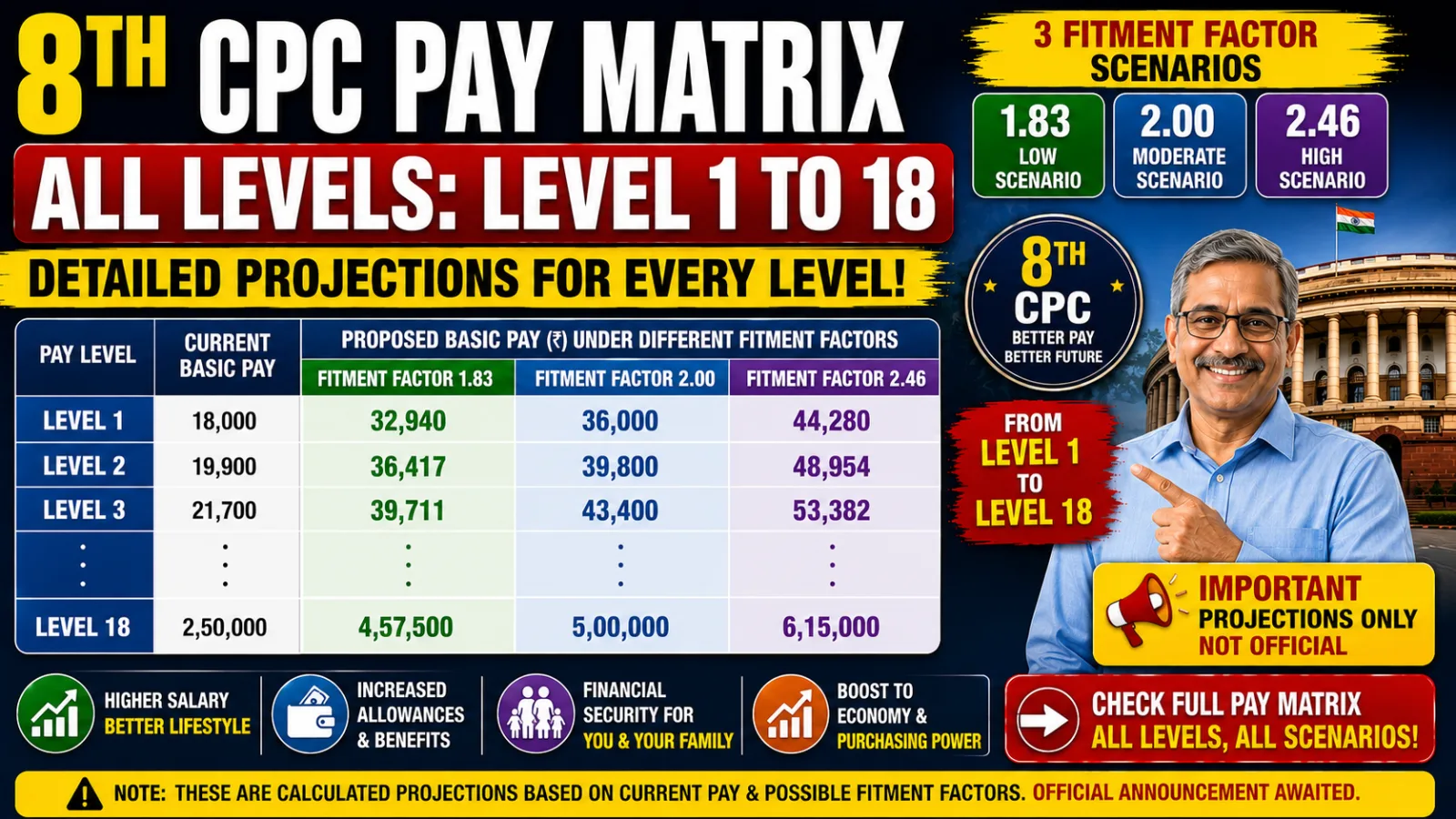
An 8th CPC pay matrix all levels table is the one thing every Central Government employee wants to see before anything else — where does your specific level land once the new fitment factor is applied? The honest answer right now: nobody outside the Commission knows for certain, because the fitment factor hasn't been finalised. What we can do is show you the actual range currently being discussed, level by level, so you can plan around realistic numbers instead of guesswork.
Why There's No Single "Confirmed" Number Yet
The 8th Pay Commission has completed its public consultation window and is now analysing submissions, but it hasn't announced a fitment factor, a finalised pay matrix, or a pension revision formula. Any salary table you see online right now — including this one — is a projection built on current 7th CPC basic pay multiplied by a possible fitment factor, not an official figure.
Multiple fitment factor estimates are currently in circulation, ranging from a conservative 1.92 to union-demanded figures as high as 2.86 or higher. Until the Commission submits its report, treat every number below as a scenario, not a promise.
Current 7th CPC Basic Pay — Your Starting Point
Before projecting anything forward, here's where you currently stand under the 7th CPC, at the entry stage of each level:
| Level | Current 7th CPC Basic Pay (Entry) |
|---|---|
| Level 1 | ₹18,000 |
| Level 2 | ₹19,900 |
| Level 4 | ₹25,500 |
| Level 6 | ₹35,400 |
| Level 8 | ₹47,600 |
| Level 10 | ₹56,100 |
| Level 12 | ₹78,800 |
| Level 13 | ₹1,23,100 |
| Level 14 | ₹1,44,200 |
| Level 16 | ₹2,05,400 |
| Level 18 | ₹2,50,000 |
This is your actual current basic pay — not a projection. Everything from here on is a scenario built on top of this.
If you want these scenarios applied to your basic pay rather than the entry stage shown above, the 8th CPC Salary Calculator works out the revised basic, DA and total salary for your own level.
Three Fitment Factor Scenarios, Side by Side
Rather than picking one number and presenting it as fact, here's how your basic pay could look under three commonly discussed fitment factors — a conservative estimate, a moderate estimate, and a higher estimate closer to what some employee organisations have pushed for.
| Level | Current Basic Pay | @ 1.92 (Conservative) | @ 2.57 (Moderate) | @ 2.86 (Higher) |
|---|---|---|---|---|
| Level 1 | ₹18,000 | ₹34,600 | ₹46,300 | ₹51,500 |
| Level 2 | ₹19,900 | ₹38,200 | ₹51,100 | ₹56,900 |
| Level 4 | ₹25,500 | ₹49,000 | ₹65,500 | ₹72,900 |
| Level 6 | ₹35,400 | ₹68,000 | ₹91,000 | ₹1,01,200 |
| Level 8 | ₹47,600 | ₹91,400 | ₹1,22,300 | ₹1,36,100 |
| Level 10 | ₹56,100 | ₹1,07,700 | ₹1,44,200 | ₹1,60,400 |
| Level 12 | ₹78,800 | ₹1,51,300 | ₹2,02,500 | ₹2,25,400 |
| Level 13 | ₹1,23,100 | ₹2,36,400 | ₹3,16,400 | ₹3,52,100 |
| Level 14 | ₹1,44,200 | ₹2,76,900 | ₹3,70,600 | ₹4,12,400 |
| Level 16 | ₹2,05,400 | ₹3,94,400 | ₹5,27,900 | ₹5,87,400 |
| Level 18 | ₹2,50,000 | ₹4,80,000 | ₹6,42,500 | ₹7,15,000 |
A few things worth noticing in this table:
- The gap widens sharply as you go up levels — a Level 1 employee's increase under the moderate scenario is roughly ₹28,300, while a Level 18 officer's increase under the same scenario is roughly ₹3,92,500. Fitment factors multiply, so higher base pay means a proportionally larger rupee jump, even at the same factor.
- This is basic pay only — none of these figures include DA, HRA, or other allowances, which get calculated on top of the revised basic pay once it's finalised.
- Actual figures will be "stepped up," not exact — under the pay matrix system, if your current basic pay × fitment factor doesn't land exactly on a matrix cell, you get moved up to the next available cell, so nobody loses money in the conversion, and your actual figure could be slightly higher than a raw multiplication suggests.
Who Falls Into Which Level, Roughly
- Level 1–5: Entry-level and Group C staff — Multi Tasking Staff, clerical roles, junior assistants
- Level 6–12: Group B and technical/specialised roles — assistants, section officers, technical officers
- Level 13–18: Senior Group A officers — Joint Secretaries, Additional Secretaries, Secretaries, and equivalent, up to Cabinet Secretary at Level 18
The DA Merger Question
One thing feeding into how "heavy" the eventual matrix might be: DA crossed 50% back in 2024, and historically a DA merger into basic pay has sometimes happened at that threshold. This time, the government chose to wait for the 8th CPC instead of merging DA separately. That decision means whatever fitment factor is eventually settled on will likely need to account for the DA that's accumulated since — one reason estimates keep climbing rather than settling near the lower end.
What You Should Actually Do With These Numbers
- Use the moderate scenario as your realistic planning baseline, not the highest number you've seen circulating — optimistic scenarios make for better headlines but aren't more likely to be accurate
- Remember these are basic pay figures only; your actual take-home will be higher once allowances are added back on the revised base
- Don't make major financial commitments assuming a specific fitment factor until the Commission's report is officially released and accepted by the government
- Revisit this table periodically — as more official signals emerge (data submission closing, consultation rounds wrapping up), the realistic range should narrow
To model your own numbers more precisely once you know your exact current basic pay, our 8th CPC pay matrix calculator lets you plug in your figures directly, and our fitment factor guide breaks down where each competing estimate comes from. For the specific gap between entry-level and senior-level increases, our earlier piece on how the fitment factor widens the salary gap between Level 1 and Level 10 goes deeper into that dynamic.
For the latest on where the Commission's process actually stands right now, see our 8th Pay Commission latest updates roundup.