
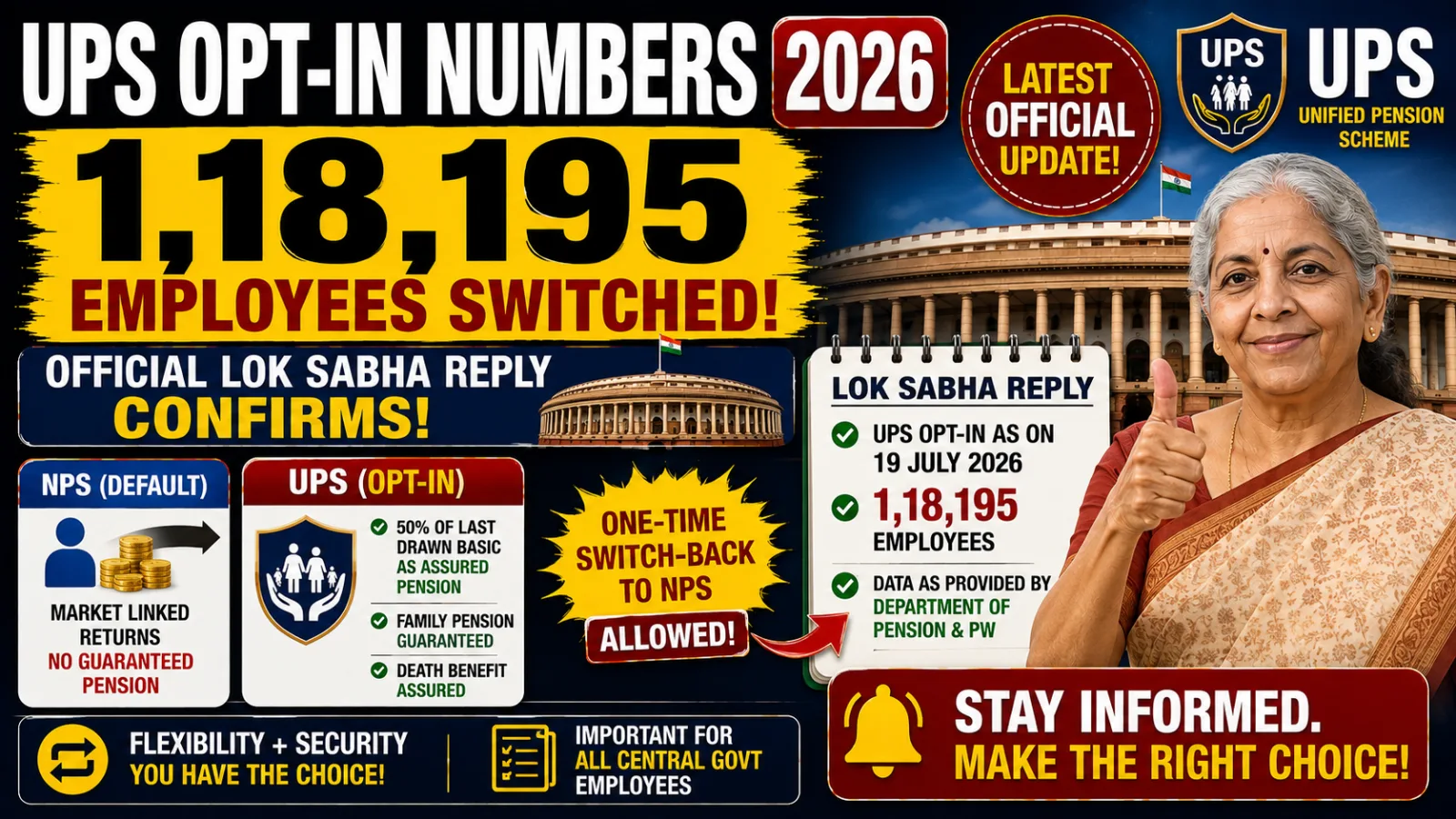
UPS opt-in numbers are finally out in black and white, and the figure is smaller than a lot of people expected. As of 19 July 2026, only 1,18,195 employees — counting new joinees, existing employees, and past retirees together — have actually opted for the Unified Pension Scheme since it launched. This came straight from Parliament, in a starred question answered by the Finance Minister herself.
This is Lok Sabha Starred Question No. 207, answered on 3 August 2026 by Smt. Nirmala Sitharaman, Minister of Finance, in response to a question by Shri Janardan Singh Sigriwal.
What Was Actually Asked
The question came in five parts, and together they cover pretty much everything an employee would want to know about how UPS is actually going:
- Has UPS been operationalised, and if so, how many employees have opted for it?
- Has the government reviewed how UPS has performed since it started?
- Has the government received demands from unions or pensioners' associations to replace, modify, or withdraw UPS?
- Has the government looked at replacing UPS with any alternative pension framework?
- Does the government plan to change or replace UPS, and if so, by when?
The Numbers and the Timeline
UPS was notified on 24 January 2025, offered as an option within the existing NPS framework — not a separate scheme replacing it, but a choice sitting alongside it. The idea was to give NPS-covered Central Government employees an assured monthly payout after retirement, something a lot of employees had been asking for, while still keeping the scheme funded and contributory rather than a return to the old guaranteed-pension model.
It became effective from 1 April 2025. The window to opt in was originally supposed to close earlier, but following representations from employees and their associations, the government pushed the cut-off date to 30 November 2025. Even with that extension, the final opt-in count as of 19 July 2026 stands at 1,18,195 — a number that includes not just serving employees but also past retirees who superannuated or retired on or before 31 March 2025 under NPS, provided they'd completed 10 years of regular service, along with legally wedded spouses of eligible deceased retirees.
Has the Government Reviewed How It's Going?
Straight answer: no. The reply states plainly that since UPS has only been rolled out from 1 April 2025, the government hasn't yet reviewed its implementation or performance. Given the scheme is barely over a year old at the time of this reply, that's not entirely surprising — but it does mean there's no official assessment yet of whether UPS is achieving what it set out to do.
What Sweeteners Came With the Scheme
Beyond the headline pension structure, the government has layered on a few additional benefits for employees who opted for UPS:
- Gratuity coverage — Retirement gratuity and death gratuity under the Central Civil Service (Payment of Gratuity under National Pension System) Rules, 2021, now extends to employees covered by UPS
- Protection in death or disability cases — employees who opted for UPS remain eligible to choose benefits under the CCS (Pension) Rules, 2021, or the CSS (Extraordinary Pension) Rules, 2023, if they die during service or are discharged due to invalidation or disablement
- Same tax treatment as NPS — UPS carries the same tax benefits that already apply to NPS, so switching doesn't create a tax disadvantage
- A genuine escape hatch — employees who opted for UPS can exercise a one-time, one-way switch back to NPS if they change their mind
That last point matters more than it might look at first glance. It tells you the government built in a safety valve, presumably anticipating that not everyone who opts in would be certain it's the right call for them long-term.
Is the Government Planning Any Changes?
For parts (d) and (e) of the question — whether an alternative framework has been examined, and whether any changes or replacement are planned — the answer is short and direct: UPS remains an option under NPS for Central Government employees covered by NPS, and there is currently no proposal under consideration to change or replace it.
So while employee associations may well have raised concerns or pushed for modifications (the reply doesn't go into detail on what representations, if any, specifically asked for UPS to be replaced or withdrawn), nothing in this answer suggests the government is actively working on an alternative.
What This Means If You're Deciding on UPS
- The relatively low opt-in number (1,18,195) suggests most eligible employees haven't switched yet, or have chosen to stay on plain NPS — worth factoring in as social proof, though not a reason on its own to decide either way
- If you're unsure, the one-time switch-back to NPS gives you a genuine safety net, but remember it's one-way and one-time — you can't flip back and forth
- The extended gratuity and death/disability protections under UPS are a real, quantifiable benefit that's easy to overlook if you're only comparing the pension payout structure
- Don't expect the scheme's rules to change any time soon — the government's position, as of this reply, is that no revision is on the table
If you're weighing this decision yourself, our NPS vs OPS comparison guide covers where UPS sits between the two, and our NPS calculator can help you run your own numbers. For the separate claims-processing data on UPS additional benefits for retirees, our earlier piece on Unified Pension Scheme claims 2026 covers that side of the picture.
For more official Parliament replies on pension policy, follow our government news section.