
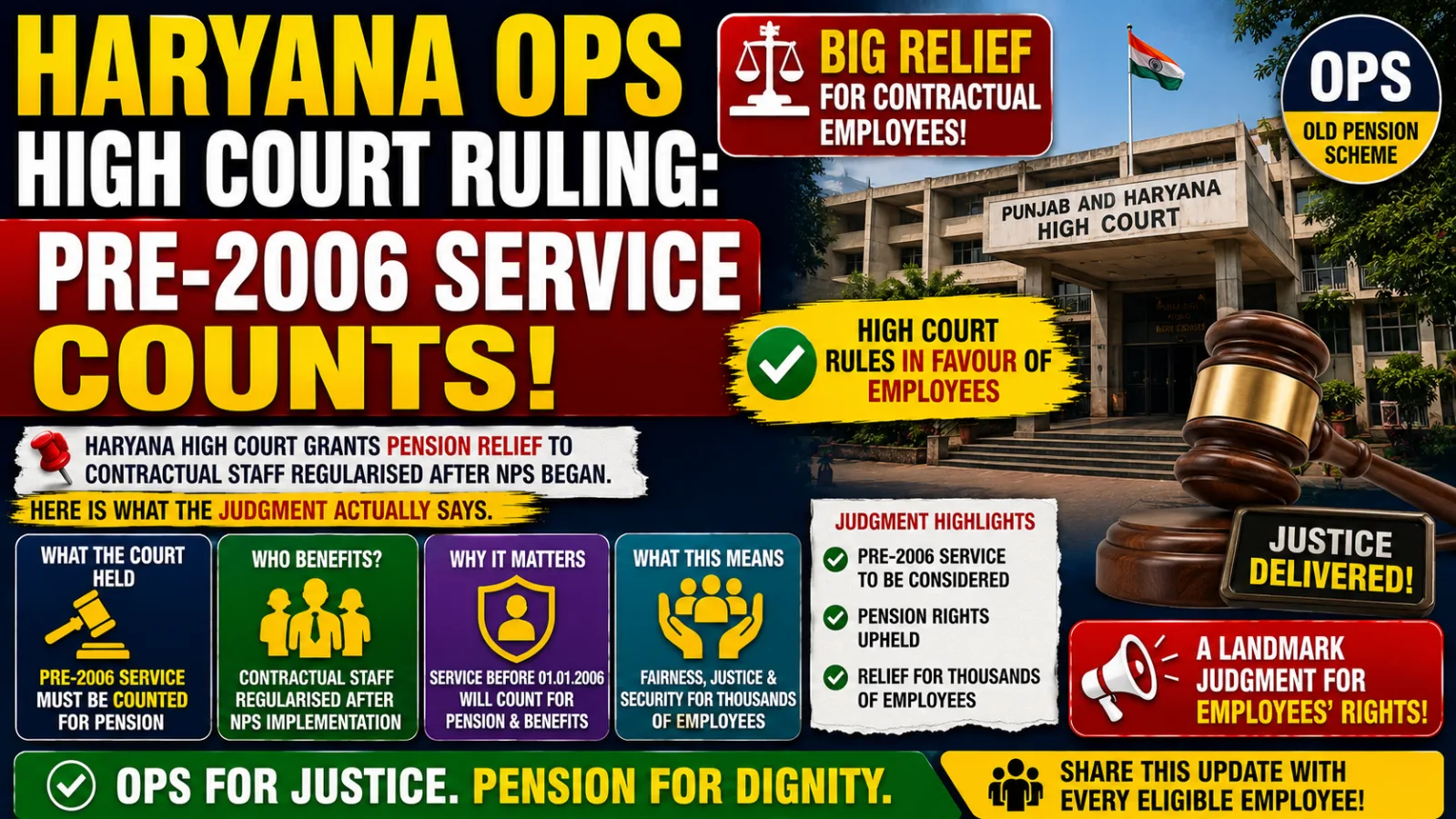
The Haryana OPS High Court ruling delivered on 26 July 2026 is a significant win for a specific group of state government employees — those who worked for years on part-time, temporary, or contractual terms before being made permanent, only to be told their earlier service didn't count toward pension. The Punjab and Haryana High Court has now said it does, and that this can qualify them for the Old Pension Scheme (OPS) even though their formal regularisation happened after NPS took over.
Justice Harpreet Singh Brar delivered the ruling while disposing of 95 writ petitions together through a single common judgment.
The Two Groups of Employees Covered
The court split the petitions into two distinct categories, each with its own basis for relief.
Category I: Long pre-regularisation service These were employees appointed on a part-time, temporary, or contractual basis before 1 January 2006, but formally regularised only afterward — meaning their permanent appointment technically fell after NPS had already replaced OPS for new recruits. They argued their years of actual, continuous service before regularisation shouldn't simply be erased when calculating pension eligibility.
Category II: Delayed appointment despite early recruitment process This group's recruitment process — the advertisement, selection, everything that starts a hiring cycle — had begun before the OPS-to-NPS cutoff date. But due to administrative delays on the government's part, their actual appointment orders came through later. They claimed OPS benefits under the Haryana Government's Office Memorandum dated 8 May 2023, arguing the delay wasn't their fault.
What the Court Actually Decided
For Category I, the ruling is direct: service rendered before regularisation must be counted as qualifying service for pension. Once that pre-regularisation period is factored in, the State cannot deny OPS benefits purely because the regularisation paperwork was finalised after NPS came into effect.
One petitioner's case, cited in the judgment, illustrates why the court took this view — the employee had worked continuously on a part-time basis from 15 February 2002 without a break for over a decade, before being regularised only on 16 May 2016. The court found it would cause real unfairness to wipe out that decade-plus of genuine service just because the person's original engagement happened to be part-time.
For Category II, the court held these employees are entitled to the benefit of the May 2023 Office Memorandum and must be given the option to switch to OPS.
Why the "You Signed the NPS Paperwork" Argument Failed
The State had argued that many employees had effectively accepted NPS by signing their regularisation or appointment orders, which typically included NPS terms. The court rejected this outright — it held that signing such documents doesn't amount to giving up a statutory or constitutional right, especially when the employee had no real bargaining power and accepting those terms was the only way to actually secure the permanent job in the first place.
This is an important legal point beyond just this case: it pushes back on the idea that an employee's signature on a form automatically forecloses a pension claim later.
The Legal Precedent Behind the Ruling
The State tried to argue that Punjab Civil Services Rules exclude part-time service from counting as qualifying service for pension. The court disagreed, holding that this question had already been settled by an earlier Division Bench ruling in State of Haryana versus Jai Bhagwan. Even though the Supreme Court, while dismissing the State's Special Leave Petition in that case, had left the underlying legal question technically open, the Division Bench judgment still stands as binding precedent on the High Court unless a larger Bench overrules or distinguishes it.
What the Court Ordered
The relief isn't just declaratory — it comes with actual deadlines:
- The impugned orders denying OPS benefits were quashed
- Authorities must count the petitioners' pre-regularisation part-time/temporary/contractual service as qualifying service for pension
- Consequential pensionary and retiral benefits under OPS, along with arrears, must be fixed and released within six weeks of receiving the certified copy of the order
- For Category II petitioners, the option to switch to OPS must be exercised within six weeks, after which authorities get a further six weeks to process claims and release benefits with arrears
What This Means If You're in a Similar Situation
This ruling applies specifically to Haryana State Government employees — it doesn't automatically extend to Central Government employees or other states. But it matters beyond Haryana for a few reasons:
- It reinforces a legal principle — that genuine pre-regularisation service can't be wiped out for pension purposes — that petitioners in other states have used, and will likely continue to use, in similar disputes
- It weakens the "you signed NPS documents, so you accepted NPS" defence that state governments have relied on elsewhere
- If you're a state or central government employee who worked long stretches on contractual or temporary terms before regularisation, and you were placed under NPS purely because your regularisation date fell after the cutoff, this judgment is worth showing to a lawyer as a reference point
If you're trying to understand the broader NPS-versus-OPS landscape, including which employees fall under which scheme and why, our NPS vs OPS comparison guide breaks that down, and the NPS calculator can help you see what your own numbers look like under NPS. For context on how the pension-scheme debate is playing out at the central level right now, our coverage of 8th Pay Commission and OPS restoration covers the national picture.
For more legal and policy updates like this, follow our government news section.