
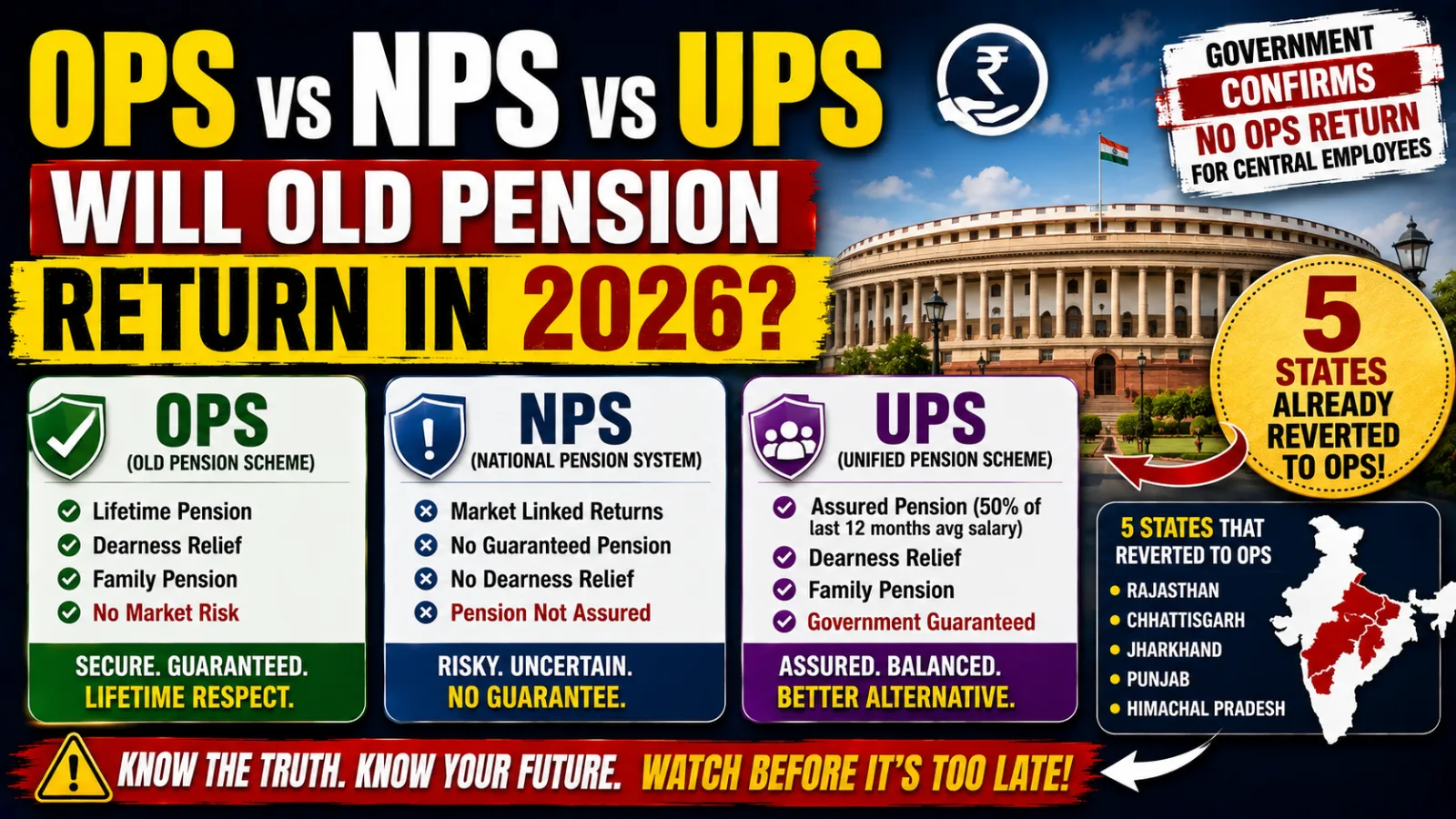
The OPS vs NPS vs UPS question keeps resurfacing because it genuinely affects how much money you'll have to live on after retirement — and the honest answer right now is more nuanced than a flat yes or no. For Central Government employees, the door on OPS is officially shut. For employees in five states, it's already reopened. Here's the full picture, with the numbers behind why states that switched back are now facing a bill they didn't fully plan for.
The Confirmed Central Government Position
Minister of State for Finance Pankaj Chaudhary has stated clearly in Parliament that there is no proposal under consideration to restore OPS for Central Government employees covered under NPS or UPS. This is a recent, direct confirmation — not a vague policy signal — and it settles the question for Central Government service, at least for now.
We've covered this specific confirmation and its implications for the 8th Pay Commission's mandate in more depth in our piece on 8th Pay Commission and OPS restoration, if you want the fuller context on where this sits within the broader pay and pension review currently underway.
The Three Schemes, Side by Side
| Feature | OPS | NPS | UPS |
|---|---|---|---|
| Pension structure | Defined benefit | Defined contribution | Assured, contributory |
| Pension certainty | High | Market-linked | Higher assurance |
| Employee contribution | No | Yes | Yes |
| Minimum pension | Traditional defined pension | No fixed assured pension | ₹10,000/month after 10 years |
| Full pension | Based on last drawn salary | Market/corpus dependent | 50% of average basic pay, for 25 years' service |
| Inflation protection | DA/DR-linked | Not guaranteed the same way | Inflation-indexed via DR |
| Status for CG employees | Not restored | Existing default framework | Operational since 1 April 2025 |
What Made OPS Financially Unsustainable
Under OPS, the government funded the entire pension itself — no employee contribution, a defined amount based on last drawn salary, and DA/DR-linked inflation protection for life. That predictability is exactly what made it attractive to employees, and exactly what made it a long-term liability for the exchequer: an unfunded, growing obligation with no corpus set aside to pay for it.
NPS replaced this with a contributory, market-linked model in 2004 — both employee and government contribute to an actual investment corpus, and your eventual pension depends on how that corpus performs, not a fixed formula. This shift traded certainty for fiscal sustainability, which is precisely the trade-off that's kept this debate alive for two decades.
What UPS Actually Offers
UPS, operational since 1 April 2025, is the government's attempt to sit between the two — contributory like NPS, but with defined-benefit-style guarantees layered on top:
- 50% of average basic pay drawn over the last 12 months before retirement, for those completing at least 25 years of qualifying service (proportionately reduced for shorter service)
- Minimum assured pension of ₹10,000/month after at least 10 years of qualifying service
- Family pension at 60% of the employee's pension
- Inflation indexation through Dearness Relief, similar in spirit to OPS
It's formally implemented through the Central Civil Services (Implementation of the Unified Pension Scheme under the National Pension System) Rules, 2025. If you're deciding between NPS and UPS as a serving employee, our earlier coverage of UPS opt-in numbers shows how few employees have actually switched so far, and our NPS exit and withdrawal rules update covers a separate, more recent regulatory change worth knowing about either way.
The State-Level Story Is Genuinely Different
This is where the picture gets more complicated than "OPS is gone." Five states — Rajasthan, Chhattisgarh, Jharkhand, Punjab, and Himachal Pradesh — have formally informed the Centre and PFRDA that they're reverting from NPS back to OPS for their own state government employees. State pension policy is entirely within state discretion; the Centre doesn't control it.
But reverting isn't as simple as flipping a switch, and here's the part that matters if you're a state government employee watching this play out:
- There's no legal mechanism to get the NPS corpus back. The government has confirmed there's no provision under the PFRDA Act, 2013, or its associated regulations, to refund the accumulated NPS corpus — employee contributions, government contributions, and accrued returns — back to a state government that reverts to OPS. Rajasthan's own 2022 attempt to withdraw roughly ₹39,000 crore of accrued NPS funds was rejected by PFRDA on exactly this basis.
- The fiscal cost is real and already showing up. Himachal Pradesh's Chief Minister has stated the state's OPS restoration covers 1.36 lakh government employees, with 5,356 already retired and drawing OPS pensions — and flagged that the Centre withdrew the state's additional borrowing limit of ₹1,600 crore in response, on top of an estimated ₹800 crore per year in added pension liability going forward.
- CAG has flagged this nationally. The Comptroller and Auditor General's recent State Finance Audit Reports have specifically highlighted the fiscal implications of states reverting to OPS, adding institutional weight to the Centre's concerns about long-term sustainability.
If you're a state government employee in one of these five states, your practical pension outcome now depends heavily on your specific state's rules and timeline — this isn't a uniform, instant switch even where it's been announced.
Why "NPS or UPS" Is the More Useful Question Right Now
For the large majority of Central Government employees, OPS genuinely isn't coming back under current policy. The more useful question — the one actually worth spending time on — is whether NPS or UPS fits your specific situation better: your years of remaining service, how much certainty you want versus how much you're comfortable leaving to market performance, and whether the UPS minimum guarantees meaningfully change your retirement math compared to staying on NPS.
Our NPS vs OPS comparison guide and NPS calculator can help you run your own numbers, and if you're closer to retirement, our commuted pension calculator is worth checking too.
For more updates on pension policy as it develops at both the central and state level, follow our government news section.