
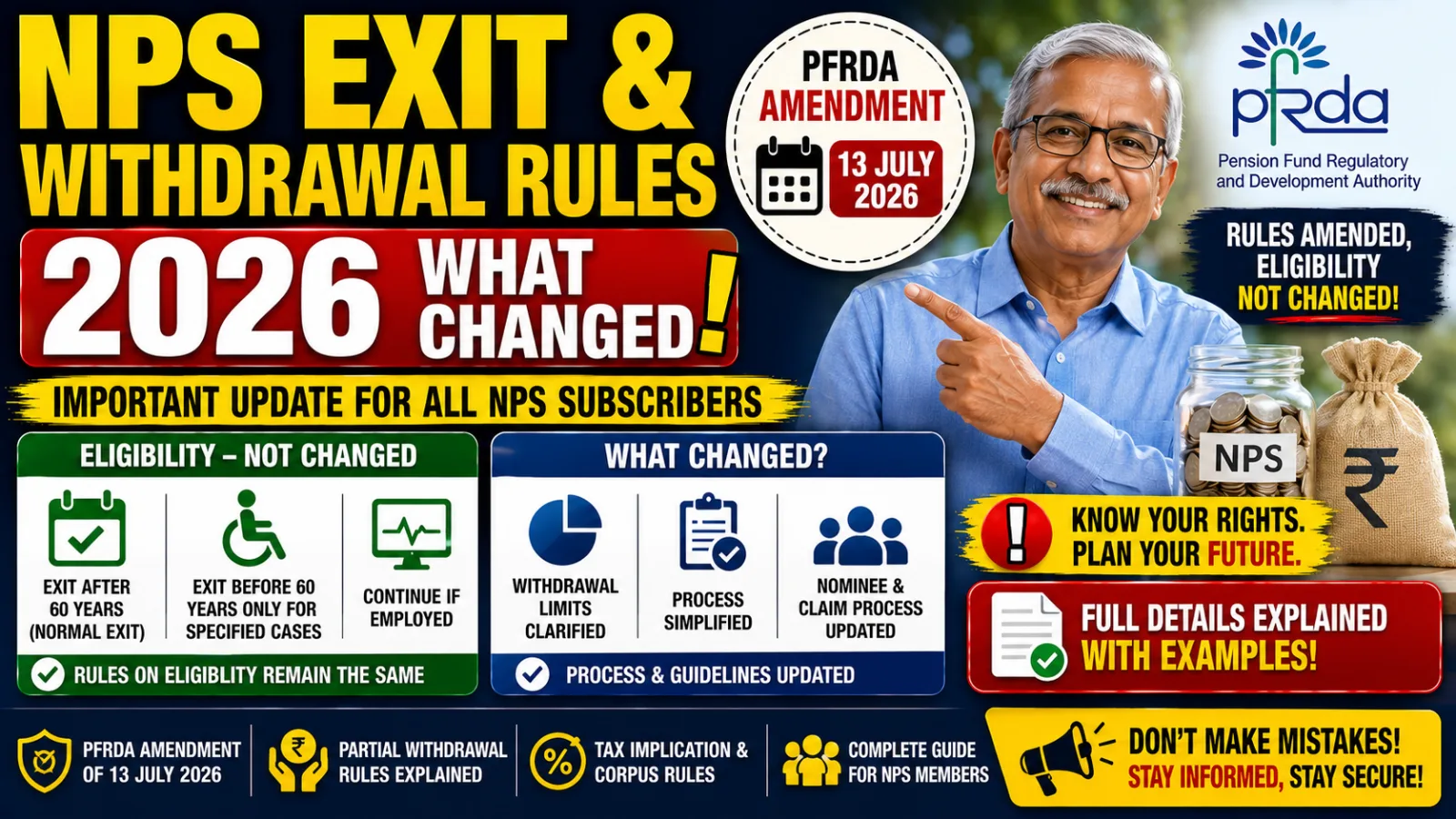
NPS exit and withdrawal rules 2026 got a fresh amendment from PFRDA on 13 July 2026 — and if you're an NPS subscriber, the first thing to know is what this amendment does not do: it doesn't change your eligibility to exit, withdraw, or take a lump sum. What it does change is who's allowed to handle certain services behind the scenes, and — this is the part that actually protects you — who stays legally responsible if something goes wrong.
The amendment was notified by the Pension Fund Regulatory and Development Authority (PFRDA) and published in the Gazette of India on 14 July 2026.
The Notification, at a Glance
| Particular | Details |
|---|---|
| Authority | Pension Fund Regulatory and Development Authority (PFRDA) |
| Regulation | Exits and Withdrawals under NPS (Amendment) Regulations, 2026 |
| Notification Date | 13 July 2026 |
| Gazette Publication | 14 July 2026 |
| Effective Date | Date of publication in the Official Gazette |
| Parent Regulation | PFRDA (Exits and Withdrawals under NPS) Regulations, 2015 |
| Previous Amendment | 16 December 2025 |
Worth noting: this is a separate, narrower amendment from the December 2025 one, which dealt with things like loans against pension corpus and relaxed partial-withdrawal rules. This July 2026 amendment is specifically about how pension funds can outsource certain operational services — not about your withdrawal entitlements themselves.
Why PFRDA Made This Change
NPS has grown fast — more subscribers, more digital transactions, higher expectations around speed and service. To keep up, PFRDA has amended Regulation 4A of the 2015 Regulations to let Pension Funds bring in specialised third-party entities to run specific-purpose schemes, rather than building every capability in-house.
The stated goals are straightforward: better operational efficiency, stronger digital integration, faster service delivery — while keeping Pension Funds fully on the hook for anything that goes wrong.
What Actually Changed — Regulation by Regulation
1. The existing rule got renumbered What used to be Regulation 4A is now Sub-regulation (1), making room for the new additions below it.
2. Pension Funds can now formally engage other entities A new Sub-regulation (2) lets a Pension Fund appoint a capable outside entity to operate a specific-purpose scheme, following PFRDA's guidelines. In plain terms: your Pension Fund can outsource certain jobs to a specialist company instead of doing everything itself.
3. But responsibility doesn't get outsourced with it This is the part that matters most for you as a subscriber. Even if a Pension Fund brings in an outside company to run a service, the Pension Fund remains fully accountable to you. If the outsourced entity messes up — a delay, an error, negligence — your Pension Fund can't point at the third party and walk away from it. Legally, they're still on the hook.
4. Technology integration is now mandatory for any engaged entity The new Sub-regulation (3) requires any third-party entity to be technically capable of integrating with:
- The Pension Fund itself
- The Central Recordkeeping Agency (CRA)
- Other PFRDA-registered intermediaries
This exists so that your data, benefit payments, exit processing, and withdrawal requests flow smoothly between systems instead of getting stuck because two platforms can't talk to each other.
5. PFRDA's oversight doesn't loosen Sub-regulation (4) makes clear that both the Pension Fund and whatever entity it engages remain fully subject to PFRDA's guidelines, regulatory instructions, and Indian law. Outsourcing a service doesn't mean stepping outside regulatory reach — it just adds another party who also has to follow the rules.
Before vs After — What Actually Moved
| Feature | Before the Amendment | After the Amendment |
|---|---|---|
| Outsourcing specific-purpose schemes | Not specifically provided for | Explicitly permitted, under PFRDA guidelines |
| Who's responsible to you | The Pension Fund | The Pension Fund — unchanged, explicitly reaffirmed |
| Technology integration | General framework, no specific mandate | Mandatory capability to integrate with CRA and intermediaries |
| Regulatory supervision | Applied to the Pension Fund | Applies to both the Pension Fund and the engaged entity |
What This Means for You as a Subscriber
If you're expecting this amendment to change how much you can withdraw, when you can exit, or your eligibility conditions — it doesn't. Your existing exit and withdrawal rules stay exactly as they were:
- Normal exit from NPS
- Premature exit
- Partial withdrawals
- Annuity purchase requirements
- Lump sum withdrawal eligibility
None of these have moved. What might genuinely improve, over time, is the experience of using NPS — faster processing on withdrawal requests, better digital platforms, and potentially more responsive customer support, as specialised entities take over specific operational pieces under PFRDA's technology-integration requirement.
Who This Applies To
This isn't limited to one category of subscriber — the amendment touches the entire NPS ecosystem:
- Central Government NPS subscribers
- State Government NPS subscribers
- Corporate NPS subscribers
- Private-sector and All Citizens Model subscribers
- Pension Funds registered with PFRDA
- The Central Recordkeeping Agency (CRA)
- Other PFRDA-registered intermediaries
Key Takeaways
- Notified 13 July 2026, effective from the date of Gazette publication (14 July 2026)
- Pension Funds can now engage specialised entities for specific-purpose schemes, with PFRDA's blessing
- Your Pension Fund stays fully accountable to you regardless of who actually delivers the service
- Any engaged entity must be technically capable of integrating with the CRA and other intermediaries
- Your existing exit and withdrawal eligibility rules are completely unchanged
What to Actually Do With This Information
For most subscribers, there's no action needed right now — this is a back-end regulatory change, not something requiring you to update paperwork or make a decision. What's worth doing is keeping an eye on whether your Pension Fund starts rolling out new digital services or partners over the coming months, since that's the practical, visible outcome this amendment is designed to enable.
If you're weighing NPS against other pension options, or want to understand where your account currently stands, our NPS calculator and NPS vs OPS comparison guide are a good starting point. If you're closer to actually exiting or withdrawing, our retirement benefits guide walks through what to expect through that process more broadly.
For more regulatory updates like this as they're notified, follow our government news section.