
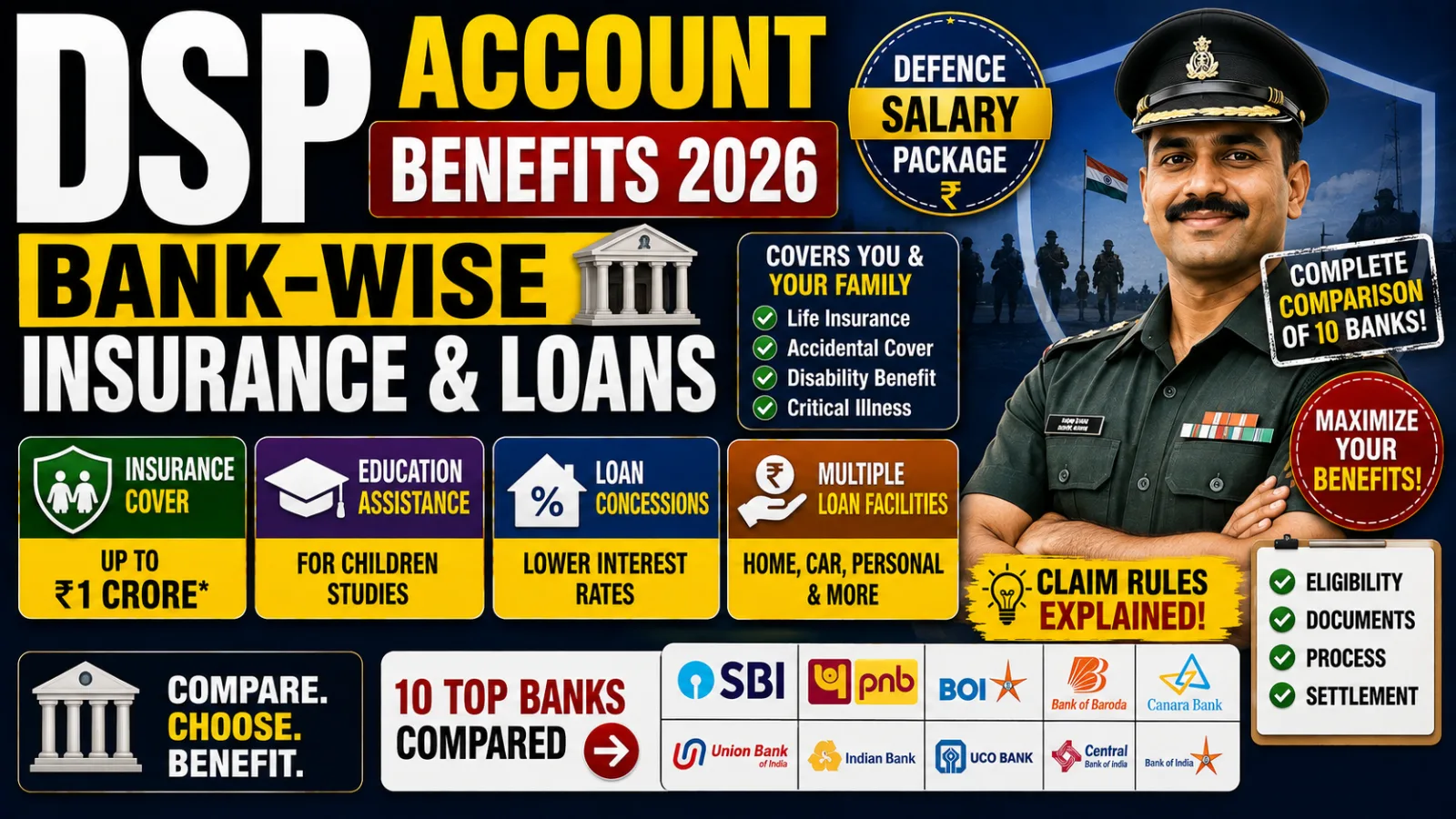
Defence Salary Package DSP benefits go a long way beyond what a normal salary account offers — accident insurance running into crores, education assistance for your children, girl-child marriage support, and preferential loan terms, all tied to which bank your DSP account sits with.
The Indian Army's AGs Branch consolidated all of this into a "Comprehensive Guide to Banking Benefits," updated on 28 April 2026, covering the Memoranda of Understanding (MoUs) signed with 10 participating banks.
One thing worth stating upfront: every figure below comes directly from that official guide, but the guide itself is explicit that benefits change whenever an MoU is renewed, revised, or terminated. Treat this as your starting reference, then confirm specifics with your bank before making any financial decision.
The 10 Banks Currently Covered
As of the April 2026 update, the Indian Army had valid MoUs with these banks:
| Bank | MoU Validity — Serving/Pensioners | MoU Validity — Agniveers |
|---|---|---|
| Bank of Baroda | Till 03 May 2029 | Till 03 May 2029 |
| State Bank of India | Till 15 Jan 2028 | Till 03 Nov 2028 |
| Punjab National Bank | Till 12 Jan 2029 | Till 12 Jan 2029 |
| Punjab & Sind Bank | Till 20 Jun 2028 | Till 20 Jun 2028 |
| ICICI Bank | Till 12 Nov 2028 | Till 12 Nov 2028 |
| Bank of India | Till 03 Mar 2028 | Till 03 Mar 2028 |
| AXIS Bank | Till 29 Oct 2028 | Till 29 Oct 2028 |
| HDFC Bank | Till 05 Jan 2029 | Till 05 Jan 2029 |
| YES Bank | Till 19 Feb 2029 | Till 19 Feb 2029 |
| IDFC First Bank | Till 05 Feb 2029 | Till 05 Feb 2029 |
What a DSP Account Actually Offers
Beyond routine salary banking, the guide groups DSP benefits into these categories:
- Personal Accident Insurance on death
- Personal Accident Insurance on disability
- Air Accident Insurance
- Add-on insurance covers (plastic surgery, imported medicine, air ambulance, and more)
- Education assistance for children
- Girl-child marriage benefits
- Loan concessions
- Overdraft facilities
- Debit and credit card benefits
- ATM transaction facilities
- Health insurance-related benefits
- Other banking concessions
Personal Accident Insurance on Death
This is the headline benefit of a DSP account — a payout to your nominee in case of accidental death.
| Bank | Serving Personnel/Agniveers | Pensioners |
|---|---|---|
| Bank of Baroda | ₹1.25 crore | ₹75 lakh |
| SBI | ₹1 crore | ₹50 lakh |
| Punjab National Bank | ₹1 crore | ₹50 lakh |
| Punjab & Sind Bank | ₹1 crore | ₹1 crore |
| ICICI Bank | ₹1 crore | ₹50 lakh |
| Bank of India | ₹1 crore | ₹10 lakh* |
| AXIS Bank | ₹1 crore | ₹50 lakh |
| HDFC Bank | ₹1 crore | ₹1 crore |
| YES Bank | ₹1 crore | ₹40 lakh |
| IDFC First Bank | Up to ₹90 lakh/₹60 lakh depending on salary-credit conditions | ₹60 lakh + ₹35 lakh for nominee, subject to pension-credit conditions |
*Bank of India also lists an additional free group insurance cover based on qualifying account balance.
Note that this is accident death cover, not general life insurance — the distinction matters a lot for claims, covered further down.
Personal Accident Disability Insurance
| Bank | Serving Personnel/Agniveers | Pensioners |
|---|---|---|
| Bank of Baroda | Up to ₹1.25 crore / ₹67.5 lakh | Up to ₹75 lakh / ₹37.5 lakh |
| SBI | Up to ₹1 crore | NA |
| Punjab National Bank | Up to ₹1 crore / ₹50 lakh | Up to ₹50 lakh / ₹25 lakh |
| Punjab & Sind Bank | Up to ₹1 crore | Up to ₹1 crore |
| ICICI Bank | Up to ₹1 crore | Up to ₹50 lakh |
| Bank of India | Up to ₹1 crore / ₹50 lakh | Up to ₹50 lakh |
| AXIS Bank | Up to ₹1 crore | Up to ₹50 lakh |
| HDFC Bank | Up to ₹1 crore | Up to ₹1 crore |
| YES Bank | Up to ₹1 crore | Up to ₹40 lakh |
| IDFC First Bank | Up to ₹60 lakh | Up to ₹60 lakh |
Conditions attached to disability claims:
- The listed amounts apply to 100% disability
- Applicable IRDAI norms must be followed
- A medical certificate is mandatory
- The disability must result from an accident covered under the scheme
- Claims must be submitted within the prescribed time
- Your specific bank's MoU conditions must be satisfied
Air Accident Insurance
| Bank | Air Accident Insurance |
|---|---|
| Bank of Baroda | No separate AAI; air accidents covered under PAI of ₹1.25 crore |
| SBI | ₹1.5 crore |
| Punjab National Bank | ₹1.5 crore serving / ₹1 crore pensioners |
| Punjab & Sind Bank | ₹1.2 crore domestic / ₹1 crore international |
| ICICI Bank | ₹1 crore |
| Bank of India | ₹2 crore |
| AXIS Bank | ₹1.5 crore |
| HDFC Bank | ₹1 crore |
| YES Bank | ₹1 crore |
| IDFC First Bank | ₹1 crore |
Whether your air ticket needs to be purchased through that bank's debit card to trigger this cover varies bank to bank — some don't require it, others do. Service or chartered aircraft and department-provided tickets are covered for AAI applicability across the guide.
Add-On Covers, Bank by Bank
Several banks stack additional covers on top of PAI/AAI:
Bank of Baroda — Term Life Insurance ₹10 lakh
State Bank of India — Plastic surgery (max ₹10 lakh), imported medicine (max ₹5 lakh), death after coma (max ₹5 lakh), air ambulance (max ₹10 lakh), family transportation (max ₹50,000), repatriation of mortal remains (max ₹50,000), ambulance charges (max ₹50,000), Xpress Credit Loan (max ₹10 lakh), Term Life Insurance ₹10 lakh
AXIS Bank — Term Life Insurance ₹10 lakh, plus an additional ₹10 lakh for death due to an act of terrorism
Punjab National Bank — Plastic surgery (max ₹10 lakh), imported medicine (max ₹10 lakh), death after coma (max ₹5 lakh), body repatriation (max ₹50,000), funeral expenses (max ₹30,000), emergency medical expenses (max ₹25,000), ambulance charges (max ₹50,000), air ambulance (max ₹10 lakh)
Punjab & Sind Bank — Plastic surgery (max ₹10 lakh), imported medicine (max ₹10 lakh), death after coma (max ₹2 lakh), body repatriation (max ₹30,000), funeral expenses (max ₹10,000), emergency medical expenses (max ₹10,000), ambulance charges (max ₹3,000 per case)
ICICI Bank — Air ambulance (up to ₹15 lakh), normal ambulance (up to ₹25,000), plastic surgery/burns (up to ₹10 lakh), imported medicine (up to ₹2 lakh), transportation of dead body (₹30,000), death after coma (up to ₹2 lakh), family transportation (up to ₹50,000)
Bank of India — Contributory health insurance cover of ₹20 lakh at an annual premium of ₹1,999, plus an additional ₹20 lakh PAI cover on subscribing, applicable to both serving personnel and pensioners
HDFC Bank — Additional PAI of ₹1 lakh, AAI cover of ₹5 lakh for a zero-balance salary family account
YES Bank — Plastic surgery (max ₹10 lakh), imported medicine (max ₹5 lakh), death after coma (max ₹2 lakh), air ambulance (max ₹10 lakh), family transportation (₹20,000), repatriation of mortal remains (₹20,000), ambulance charges (₹15,000), daily hospitalisation cash ₹1,000/day up to ₹20,000 per calendar year
Education Benefits for Children
| Bank | Education Assistance |
|---|---|
| SBI | ₹8 lakh for a male child, ₹10 lakh for a girl child, aged 18–25 |
| PNB | ₹10 lakh per child, maximum two children, subject to conditions |
| Punjab & Sind Bank | ₹6 lakh per boy, ₹12 lakh per girl, for children aged 12–22 |
| ICICI Bank | ₹5 lakh up to age 22; ₹5 lakh upfront for girl children up to 22 |
| Bank of India | Maximum ₹10 lakh for up to two children, till graduation |
| AXIS Bank | Higher education assistance up to ₹4 lakh for one child |
| HDFC Bank | Education benefit up to ₹5 lakh |
| YES Bank | ₹5 lakh each for a maximum of two children, up to age 25 |
| IDFC First Bank | Children education cover of ₹4 lakh |
Exact age brackets, number of eligible children, and other conditions vary bank to bank — check your specific bank's terms rather than assuming a figure from this table applies without conditions.
Girl-Child Marriage Benefits
- SBI: ₹10 lakh for two girl children aged 18–25
- PNB: ₹10 lakh for two girl children (₹5 lakh each)
- Punjab & Sind Bank: ₹12 lakh per girl child aged 12–22, maximum two children
- AXIS Bank: ₹5 lakh per girl child up to 22 years, ₹10 lakh maximum for two or more
- HDFC Bank: ₹5 lakh girl-child marriage cover
- YES Bank: ₹5 lakh each for two girl children aged 18–25
- IDFC First Bank: ₹2 lakh girl-child marriage cover
Loan and Other Banking Benefits, Bank by Bank
Bank of Baroda — Personal loans at attractive rates depending on loan type, overdraft up to ₹3 lakh (based on average of last two months' salary), ₹10 lakh on Debit Card, ₹20 lakh on Yoddha Credit Card, unlimited transactions at bank ATMs
SBI — 100% processing-fee waiver on loans, unlimited transactions at SBI ATMs in India, 10 free transactions per month at other bank ATMs
Punjab National Bank — Concessions on housing, car, personal, and education loans; ₹2 lakh to ₹10 lakh with POS condition on debit card; up to ₹10 lakh on credit card; unlimited transactions at PNB ATMs; 25% concession on locker rent
Punjab & Sind Bank — Home loan at 7.55% ROI, nil prepayment charges, legal and valuation charges borne by the bank, overdraft facility, ATM transaction concessions, RuPay Select debit card, 50% locker-rent concession
ICICI Bank — Unlimited free transactions at bank ATMs, free add-on debit card for joint account holders, unsecured education loan up to ₹1 crore
Bank of India — Up to 100% concession on processing fee, concessional loan interest rates, overdraft equal to one month's salary, additional PAI cover on credit card up to ₹10 lakh, additional PAI cover on debit card up to ₹10 lakh
AXIS Bank — Home loan/LAP/personal loan/gold loan/car loan/education loan at competitive rates, less documentation, 12 EMIs waived on home loans (as specified in the guide), unlimited free transactions at bank ATMs
HDFC Bank — ₹10 lakh on debit card subject to POS condition, unlimited free transactions at bank ATMs
YES Bank — Preferential loan rates, unlimited free transactions at bank ATMs
The Eligibility Conditions That Actually Decide Your Claim
Having a DSP account doesn't automatically mean every death or disability gets covered. The guide lists specific conditions:
- Your account must have been converted into the Defence Salary Account while serving
- On retirement, it must be converted into the appropriate pensioner/veteran account
- The casualty must be accidental for PAI to apply
- Natural death and suicide are explicitly not eligible for PAI benefits
- The accident or injury must not have occurred under the influence of alcohol or drugs
- The injury must not be self-inflicted
- The accident must not stem from a breach of law involving criminal intent
- Conditions vary bank to bank per the relevant MoU
How to Actually File a PAI Claim
Step 1 — Inform the bank. Notify the nearest branch where the DSP account is held. For disability, this must happen within 30 days. For death, notify as early as possible.
Step 2 — Collect the claim forms from the bank and fill them out completely.
Step 3 — Get acknowledgement for both the casualty intimation and the document submission — keep this on record.
Step 4 — Submit the disability certificate (for disability claims) within the stipulated period. The guide is specific here: a delay of more than 12 months in submitting this certificate can cause the claim to lapse or be repudiated entirely.
Why PAI Claims Actually Get Rejected
The guide lists the most common, avoidable reasons claims fail:
- Post-mortem report and FIR don't record the death as "accidental"
- Account was never converted into the bank's DSP account
- Documents submitted after the prescribed deadline
- Account held with a bank that doesn't have a valid MoU with the Indian Army
- Documents lack adequate contact details for the individual/NOK/unit personnel
- Disability not intimated to the bank and insurer within 30 days
- Claims submitted for natural death or suicide
- Salary credited into an account without the DSP account code mentioned
- Exact cause of death not established
- Post-mortem and FIR don't corroborate an accidental cause
- Death actually caused by natural or medical reasons rather than an accident
Most of these are entirely avoidable with correct paperwork at the time of the incident — which is exactly why the account-conversion and documentation steps below matter so much.
Before You Retire: What to Sort Out
The guide is specific that serving personnel should, before retirement or discharge:
- Keep mobile number, email, and permanent address updated
- Ensure retirement/discharge details are correctly recorded with the bank
- Maintain a record of loans, EMI amounts, and maturity dates
- Update KYC details
- Settle or make arrangements for outstanding loans before retirement
- Avoid undisclosed loans while changing bank accounts
The guide also recommends attending financial-management awareness sessions during the discharge process, if offered.
For Pensioners: Convert Your Account or Lose Coverage
This is a critical, easy-to-miss step. Retiring personnel must specifically change their account from DSP Account (Serving) to DSP Account (Pension) to remain eligible for PAI claims as a pensioner. Pension credit needs to continue flowing into this converted DSP account — not a separate, unrelated account.
Nominee Details: Check Them Now, Not Later
PAI and other benefits are paid only to the nominee registered with the bank/insurance company, subject to applicable terms. Regularly verify:
- Nominee name
- Relationship to you
- Contact details
- Bank records
- KYC details
An outdated nominee record is one of the most preventable reasons a family doesn't receive a benefit they were actually entitled to.
SBI's Claim Tracking Tools
SBI DSP account holders get access to a mobile app called "PAI Assist" for tracking claim status after submission and admission. There's also a WhatsApp chatbot for SBI-related claims covering initial claim intimation, required documents, downloading claim forms, claim status, pending documents, and escalation contacts. The listed WhatsApp chatbot number is 8657923021 — verify this is still active with SBI directly before relying on it, since the guide itself notes banking arrangements are subject to change.
Yes, You Can Change Your DSP Bank
The guide makes this explicit: banking is a personal choice. Regimental Centres, formations, and units are not supposed to favour any particular bank, and all participating banks should get equal opportunity to publicise their products. There's no restriction on switching your DSP account from one bank to another if you find better terms elsewhere.
Quick Checklist Before Choosing or Switching Your DSP Bank
If you're serving:
- Is the bank's MoU currently valid?
- Has your account actually been converted to DSP?
- Is your salary being credited into the DSP account specifically?
- Is your nominee correctly registered?
- What PAI and AAI cover applies to you?
- Are there debit-card/POS conditions attached to any benefit?
- What loan concessions are actually available?
If you're a pensioner:
- Has your serving DSP account been converted to the pension DSP account?
- Is your pension credited into the correct, converted account?
- Is your nominee updated?
- What PAI cover applies to pensioners specifically at your bank?
- What other insurance and banking benefits remain applicable post-retirement?
For families:
- Keep copies of DSP account details on hand
- Keep nominee information current
- Preserve relevant bank and insurance documents
- Inform the bank immediately in case of an accident
- Ensure FIR and post-mortem documentation accurately records the circumstances where an accidental death is involved
The Bottom Line
A DSP account can genuinely provide far more than routine salary or pension banking — crore-plus accident cover, education support, marriage assistance for daughters, and real loan concessions. But every benefit here is bank-specific and condition-specific, and the Indian Army's own guide states plainly that this information changes whenever an MoU is renewed, revised, or terminated. Verify current terms directly with your bank before making any decision that depends on these figures.
For more defence welfare and banking updates like this, follow our government news section, and for broader retirement planning beyond your DSP account, our retirement benefits guide is a useful next read.