
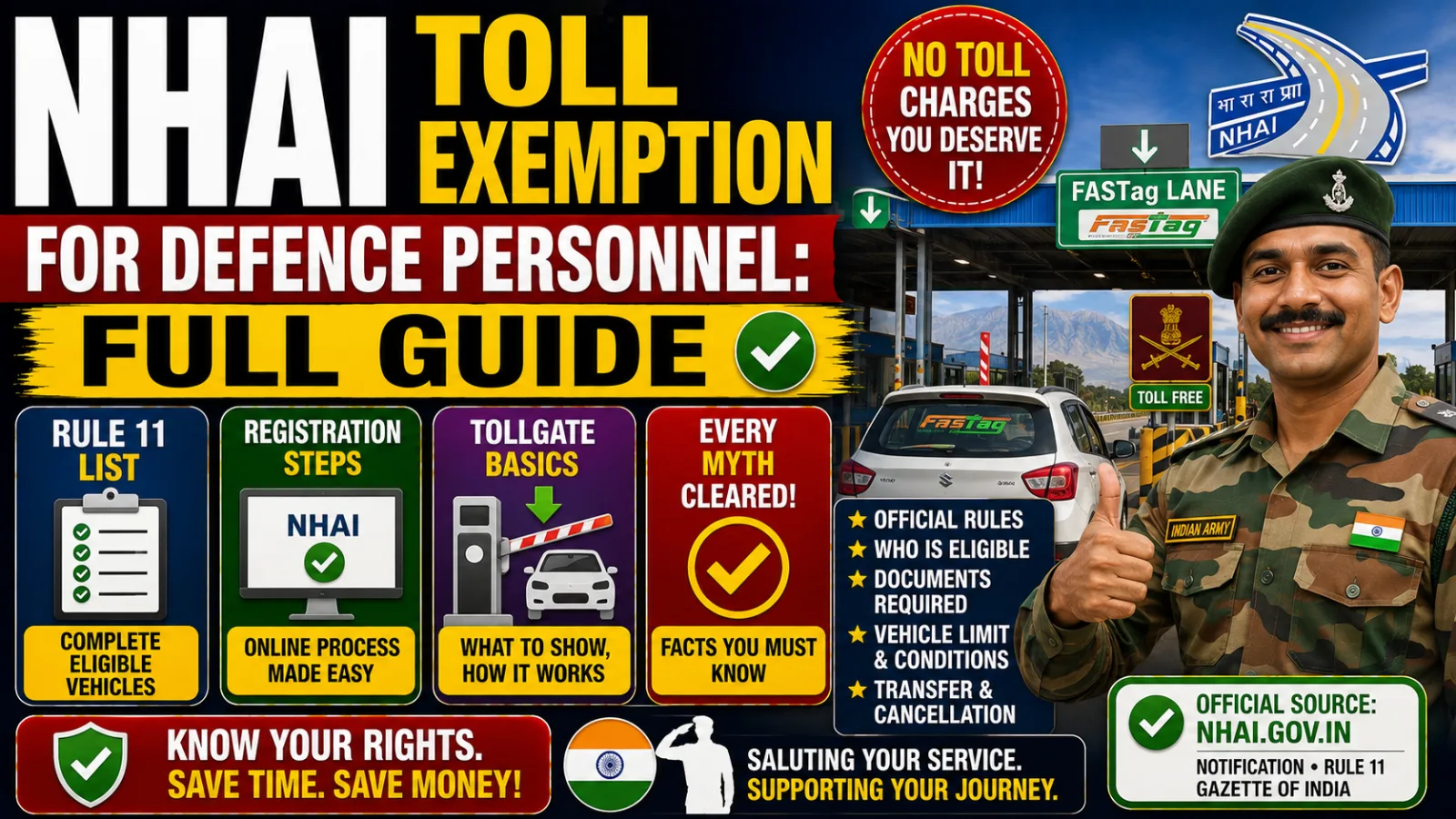
NHAI toll exemption for defence personnel is one of the most argued-about topics at Indian toll booths — and this guide is built to leave no doubt. It covers what a tollgate actually is, exactly who is legally exempt under Rule 11, exactly who NHAI has said is not exempt, and the complete registration process for an Exempted FASTag if you genuinely qualify. Everything here is drawn from NHAI's own rules, its January 2026 public clarification, and the actual application process on its official portal.
What Is a Tollgate, Exactly
A tollgate — officially a toll plaza — is a checkpoint set up on a national highway where vehicles pay a user fee for using that stretch of road. This fee funds the construction, maintenance, and operation of that highway, typically under a Build-Operate-Transfer (BOT) or Hybrid Annuity Model, where a private concessionaire builds or maintains the road and recovers costs through toll collection over a fixed concession period.
Every toll plaza in India now runs primarily on FASTag — an RFID (radio-frequency identification) sticker fixed to your vehicle's windscreen that gets scanned automatically as you pass through, deducting the toll fee from a linked prepaid account or bank account. Cash lanes still exist at most plazas but are being phased down, and several discounts and exemptions are now only available through FASTag, not cash.
The Legal Foundation
Everything about who pays, who doesn't, and who gets a discount comes down to one document: the National Highways Fee (Determination of Rates and Collection) Rules, 2008, issued under the National Highways Act, 1956. NHAI reaffirmed this explicitly in a public clarification in January 2026, after widespread confusion and disputes at toll plazas across the country.
Two rules matter most:
- Rule 11 — full exemption (zero toll) for a specific, limited list of vehicles and persons
- Rule 9 — discounted (not free) passes for local residents and certain commercial vehicle categories
Nothing outside these two rules creates a toll benefit, regardless of what you may have heard.
The Complete Rule 11 Exemption List
This is the full list of who Rule 11(1)(a) exempts, when transporting or accompanying:
- The President of India
- The Vice-President of India
- The Prime Minister of India
- The Governor of a State
- The Chief Justice of India
- The Speaker of the House of the People (Lok Sabha)
- A Cabinet Minister of the Union
- The Chief Minister of a State
- A Judge of the Supreme Court
- A Minister of State of the Union
- The Lieutenant Governor of a Union Territory
- The Chief of Staff holding the rank of full General or equivalent rank
- The Chairman of the Legislative Council of a State
- The Speaker of the Legislative Assembly of a State
- Judges of High Courts
- Members of Parliament — exempt nationwide
- Members of Legislative Assemblies and Legislative Councils — exempt only within their own state, and only on producing a valid legislature-issued identity card
- Foreign dignitaries on official state visits
Beyond this VIP list, Rule 11 separately covers:
- Vehicles of the Ministry of Defence, armed forces, paramilitary forces, and police personnel — while in uniform, on official duty
- Emergency vehicles: ambulances, fire engines, funeral vans
- Vehicles used by NHAI or authorised government agencies for highway inspection, survey, construction, operation, or maintenance
- Vehicles specially designed for persons with physical disabilities
That's the complete list. Nothing else qualifies for full exemption.
What Rule 11 Explicitly Does NOT Cover
A useful way to understand a rule is to see what it deliberately leaves out. Per legal analysis of Rule 11 and NHAI's own clarification, this rule:
- Does not exempt any of the above individuals for private, personal travel — the exemption is tied to their official capacity and movement, not to who they are as a person
- Does not extend to family members travelling separately or even together, unless the vehicle is genuinely transporting the office holder
- Does not authorise unlimited convoy vehicles just because a phrase like "accompanying" appears in the rule
- Does not reference general security categories (Y, Z, Z+, SPG) as a basis for exemption on their own
- Does not create any lifetime or retirement-linked benefit for anyone
The Defence and Police Exemption, in Full Detail
This is the part that generates the most confusion, so here is exactly what has to be true, all at once, for a defence or police vehicle to be exempt:
- The person must be serving, not retired
- The person must be in uniform
- The travel must be on official duty
- The vehicle must be an official/government vehicle, not a personal one
- The vehicle must carry a valid Exempted FASTag issued specifically by NHAI
If even one of these five conditions is missing, the exemption does not apply — including for a genuinely serving officer.
What NHAI Explicitly Confirmed Is NOT Exempt
In its January 2026 clarification, NHAI directly addressed — and rejected — several widely believed claims. According to NHAI, no exemption is available to:
- Ex-servicemen and defence veterans. Once you retire from active service, you are treated exactly like any private citizen at a toll plaza. Years of service create no residual toll benefit.
- Defence civilian employees — clerical, technical, and administrative Ministry of Defence staff who are not active uniformed personnel.
- Serving defence personnel using their own private vehicle for personal commuting — even genuinely active-duty military personnel pay toll if they're not on official duty in an official vehicle.
- Central Government officers and general government employees, of any department, with no connection to defence, police, or paramilitary service.
- Patients travelling in private vehicles
- Journalists and media vehicles
- RTI activists
- Religious dignitaries
- Recipients of civilian or police gallantry awards
- Lawyers and advocates, including for court-related travel
If you are a Central Government employee outside defence, police, or paramilitary service, there is no toll benefit tied to your employment, full stop. This is likely the single most common misconception worth correcting.
Why the Ex-Servicemen Point Causes So Much Argument
This deserves emphasis because it's the most commonly disputed point at toll plazas. A lot of veterans believe their years of service should carry a lifetime toll benefit. NHAI's position, stated plainly in its clarification, is that the exemption is tied to active, on-duty status — not to having served. Retirement ends it.
There is a genuine, ongoing public disagreement about this. When NHAI posted its clarification, some responses pushed back, citing the older Indian Tolls (Army and Air Force) Act, 1901, and referencing a court judgment arguing armed forces members should be exempt at all times. This is a real dispute between some veterans' groups and NHAI — not a settled non-issue. But for practical purposes, at any toll plaza today, NHAI's 2008 Rules and its current public position are what toll operators actually enforce. If you believe you have a stronger legal claim under the 1901 Act, that's a matter for a legal or grievance channel, not something to argue at the booth.
How to Register for an Exempted FASTag — Full Process
If your vehicle genuinely qualifies under Rule 11, here's the complete registration process through the official IHMCL portal:
Step 1: Go to the official portal Visit exemptedfastag.nhai.org — this is the only legitimate channel for an Exempted FASTag. Banks cannot issue one.
Step 2: Register or log in Create a new account, or log in if your office/organisation already has credentials.
Step 3: Select your exemption category Choose the category that applies — for example, Ministry of Defence, armed forces, paramilitary, or police.
Step 4: Complete the application form Fill in your details and the vehicle's registration number accurately.
Step 5: Upload the required documents
- Fully completed and signed application form
- The vehicle's Registration Certificate (RC)
- Valid identity proof (PAN Card, Aadhaar Card, or equivalent)
- Proof/authorisation supporting the exemption claim (official orders, unit certification, or equivalent, depending on category)
Step 6: Choose your NHAI Regional Office Select the NHAI regional centre under which your city/base falls — this is where you'll eventually collect the physical tag.
Step 7: Submit the application Once submitted, you'll receive a confirmation email with an application/reference number you can use to track status.
Step 8: Document verification NHAI verifies your submitted documents. If anything is missing or unclear, you'll be notified by email to correct or resubmit it.
Step 9: Approval and collection Once approved, you'll be notified — typically by call or email — to collect your Exempted FASTag sticker from your designated NHAI Regional Office.
Step 10: Affix and use Stick the FASTag on your vehicle's windscreen as instructed. Even exempt vehicles must display and scan the tag at toll plazas — exemption is applied automatically by the system when the tag is read, not manually waived by toll staff.
Practical Details on the Exempted FASTag
- It is issued completely free of charge
- Validity is typically up to 5 years for government-owned vehicles, and 1 year for privately-owned vehicles being used for an exempted official purpose
- It must still be scanned at every toll plaza — you cannot simply announce your status and pass through
How to Register for a Regular FASTag, If You Don't Qualify for Exemption
If your vehicle doesn't meet the Rule 11 criteria — which covers the vast majority of Central Government employees and all retired defence personnel — you'll use a standard FASTag like any other road user:
- Choose an issuing bank or NHAI's own FASTag channel (most major banks issue these, including via net banking, mobile banking apps, or in-branch)
- Provide your vehicle's Registration Certificate and your own KYC documents (PAN, Aadhaar, or another accepted ID)
- Pay the applicable joining fee and load your prepaid balance, or link it to your bank account for auto-debit
- Receive and affix the FASTag on your windscreen
- Recharge or maintain sufficient balance to avoid penalty charges for insufficient funds at a toll plaza
This is a separate, commercial process — completely different from the Exempted FASTag application above, and it does not require any defence or government status.
The Discounts That DO Exist Under Rule 9 — For Anyone
Separate from Rule 11 exemption, Rule 9 provides real discounts that any eligible citizen can use — none of these are tied to defence or government employment specifically:
- Local resident monthly pass: non-commercial vehicle owners living within 20 km of a toll plaza can apply for a discounted monthly pass, provided no service road or alternative route exists and the commute doesn't extend beyond the next toll plaza
- District-registered commercial vehicle discount: commercial vehicles registered within the same district as the toll plaza get a 50% discount
- Return trip discount: paying by FASTag and returning through the same plaza within 24 hours gets the return leg at a reduced rate — effectively 1.5 times the single-trip fare instead of double
All Rule 9 discounts are now FASTag-only — cash payments don't qualify for any of them, and resident passes are administered by the specific toll plaza's concessionaire, so you apply at that plaza's office with proof of residence and vehicle ownership.
Quick Reference: Who Gets What
| Category | Exempt (Rule 11)? | Discount (Rule 9)? |
|---|---|---|
| Serving defence/police, in uniform, on duty, official vehicle, Exempted FASTag | Yes | — |
| Serving defence personnel, personal vehicle, off duty | No | Only if otherwise eligible under Rule 9 |
| Retired defence personnel (ex-servicemen) | No | Only if otherwise eligible under Rule 9 |
| Defence civilian employees | No | Only if otherwise eligible under Rule 9 |
| Central Government employees (non-defence/police) | No | Only if otherwise eligible under Rule 9 |
| President, PM, Governors, MPs, Judges (in official capacity) | Yes | — |
| MLAs/MLCs (within own state, with valid ID) | Yes | — |
| Ambulances, fire engines, funeral vans | Yes | — |
| Local residents within 20 km of a plaza | No | Yes, monthly pass |
| District-registered commercial vehicles | No | Yes, 50% off |
What This Means for You
- Genuinely eligible (serving, uniformed, on duty, official vehicle): apply for an Exempted FASTag through the official portal — it's free and the process above is exact
- Not eligible (retired, civilian staff, personal vehicle, or general CG employment): you pay toll like any other citizen; a standard FASTag is your only route, and arguing eligibility at the booth won't change the outcome
- Living near a toll plaza, or running a locally-registered commercial vehicle: check Rule 9 discounts, which have nothing to do with your employer
For more practical guides like this for Central Government employees and defence families, follow our government news section.