
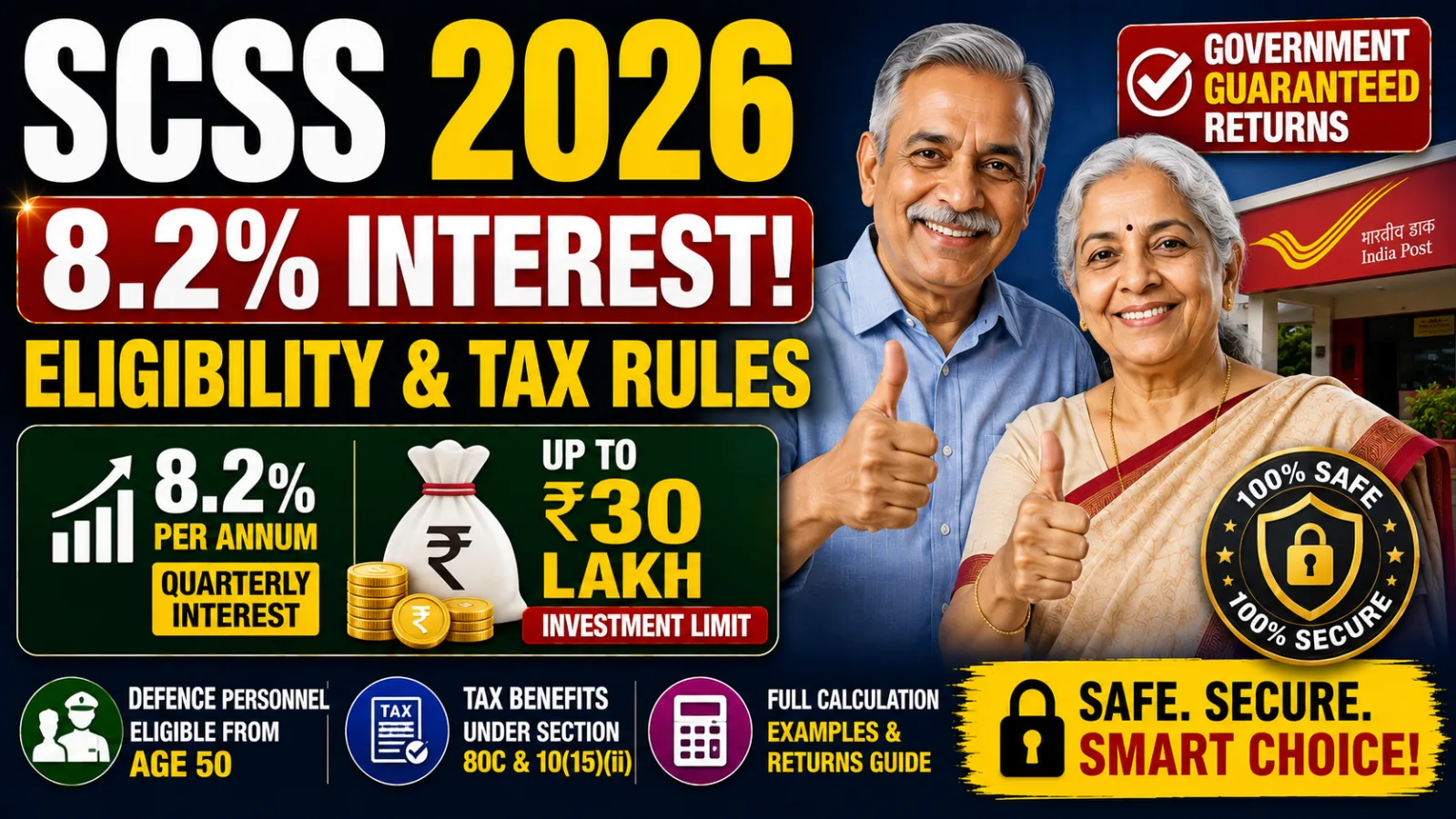
SCSS 2026 is currently paying 8.2% per annum, the highest rate on offer among government-backed small savings schemes — and if you're a retiring Central Government employee or defence pensioner with a lump sum to place, this is usually the first scheme worth comparing against a bank FD, not an afterthought. Here's exactly how it works, who qualifies, and what ₹30 lakh actually earns you over five years.
What SCSS Actually Is
The Senior Citizens Savings Scheme is a five-year, government-backed deposit run through India Post and authorised banks, built specifically to turn a retirement corpus into steady quarterly income. Unlike a bank FD, your money here is a sovereign obligation — there's no ₹5 lakh DICGC insurance cap to worry about, because the repayment itself is backed by the government, not by an individual bank's balance sheet.
SCSS at a Glance
| Particular | Details |
|---|---|
| Operated by | India Post and authorised banks |
| Interest rate | 8.2% per annum (current) |
| Interest payment | Quarterly |
| Tenure | 5 years |
| Extension | One or more 3-year extensions allowed |
| Minimum deposit | ₹1,000 |
| Maximum deposit | ₹30 lakh per individual |
| Tax benefit | Section 80C on deposit, Section 80TTB on interest |
| Premature closure | Allowed, with deductions |
Who Can Actually Open an Account
- Indian citizens aged 60 years or above
- Retired civilian employees aged 55–60, subject to prescribed conditions
- Retired defence personnel aged 50 years or above, subject to retirement benefit conditions
- Individually, or jointly with a spouse
NRIs and HUFs aren't eligible. Note that defence personnel get in earlier than civilian retirees — the 50-year threshold specifically accounts for how much sooner military service can end compared to civilian government service.
Married Couples Can Effectively Double the Limit
This is worth knowing before you assume ₹30 lakh is your hard ceiling. If both spouses are individually eligible, each can open a separate account and invest up to ₹30 lakh on their own name — meaning a retired couple can place up to ₹60 lakh combined across two SCSS accounts, both earning the same 8.2%.
How the Interest Actually Works
The formula is simple: Quarterly Interest = Principal × Interest Rate ÷ 4
On a ₹30 lakh investment at 8.2%:
- Annual interest = ₹30,00,000 × 8.2% = ₹2,46,000
- Quarterly interest = ₹2,46,000 ÷ 4 = ₹61,500
Interest is credited on 31 March, 30 June, 30 September, and 31 December each year. If you don't withdraw it, it just sits there — SCSS does not compound within the account, so uncollected interest doesn't earn further interest.
Five-Year Breakdown on a ₹30 Lakh Deposit
Here's an illustrative calculation assuming 10% TDS is deducted, since this is the scenario most retirees actually face:
| Year | Quarterly Interest (₹) | TDS @ 10% (₹) | Net Quarterly Interest (₹) | Net Annual Interest (₹) | Cumulative Interest (₹) | Total Value (₹) |
|---|---|---|---|---|---|---|
| 1 | 61,500 | 6,150 | 55,350 | 2,21,400 | 2,21,400 | 32,21,400 |
| 2 | 61,500 | 6,150 | 55,350 | 2,21,400 | 4,42,800 | 34,42,800 |
| 3 | 61,500 | 6,150 | 55,350 | 2,21,400 | 6,64,200 | 36,64,200 |
| 4 | 61,500 | 6,150 | 55,350 | 2,21,400 | 8,85,600 | 38,85,600 |
| 5 | 61,500 | 6,150 | 55,350 | 2,21,400 | 11,07,000 | 41,07,000 |
Your actual TDS may be lower or zero depending on your total income and whether you've submitted Form 15G/15H — this table assumes a flat 10% purely for illustration. At the end of five years, you'd walk away with your ₹30 lakh principal intact plus roughly ₹11 lakh in interest, before accounting for any TDS relief you're eligible for.
The Tax Side — Two Separate Benefits, Not One
On the way in: your SCSS deposit qualifies for a deduction under Section 80C, within the overall ₹1.5 lakh combined limit for that section — so if you're already using 80C elsewhere (PPF, life insurance, ELSS), your SCSS deposit competes for the same limit rather than adding a fresh one.
On the interest you earn: SCSS interest is fully taxable at your income tax slab, same as FD interest. But if you're 60 or above, Section 80TTB shields up to ₹50,000 of interest income annually from tax — and since SCSS is usually the single largest interest-earning instrument a retiree holds, this deduction often gets used up almost entirely by SCSS interest alone.
TDS applies if your interest crosses the prescribed threshold, unless you submit Form 15G or 15H where eligible.
Premature Closure Rules
| Closure Period | Deduction |
|---|---|
| Before 1 year | No interest payable; any interest already paid is recovered back |
| After 1 year, before 2 years | 1.5% deducted from principal |
| After 2 years, before 5 years | 1% deducted from principal |
Treat SCSS as a genuine 5-year commitment when you invest — the penalty structure is steep enough in the first two years that this isn't a place to park money you might need back soon.
Maturity and Extension
The original tenure is 5 years, and you can extend it once for a further 3 years — the extension request needs to go in within the prescribed window after maturity. The extended account earns whatever rate is applicable on the date you extend, not the rate you originally locked in, so a rate cut between your original term and the extension would apply going forward.
SCSS vs a Senior Citizen Bank FD
| Feature | SCSS | Senior Citizen FD |
|---|---|---|
| Government guarantee | Yes — sovereign obligation | No — bank-backed, DICGC-capped |
| Interest rate | 8.2% (current, fixed by Finance Ministry) | Varies by bank, often close but not always higher |
| Quarterly income | Yes, built into the structure | Depends on the FD option chosen |
| Tax benefit | Section 80C on deposit + Section 80TTB on interest | Only certain 5-year tax-saver FDs qualify for 80C |
| Deposit ceiling | ₹30 lakh per individual | Bank-specific, often no hard cap |
If you've already compared FD rates across banks for your retirement corpus, SCSS is worth stacking directly against those numbers — our FD interest rates guide for government employees covers the bank-by-bank comparison side of this decision.
Where SCSS Fits With Your Retirement Payout
If you're retiring soon and working out where your gratuity, commuted pension, or Seva Nidhi corpus should go, SCSS is usually a sensible first stop for a meaningful chunk of it — sovereign backing, no per-bank insurance cap to worry about, and a rate that's genuinely competitive against most bank FDs right now. The ₹30 lakh individual cap (₹60 lakh for a couple) means it won't absorb your entire corpus if it's larger than that, so you'll likely still need FDs or other instruments for the remainder.
A Note on This Being General Information
This article explains how SCSS works so you can compare it against your other options — it isn't personalised financial advice. Interest rates are revised quarterly by the Finance Ministry and can change; verify the current rate directly with India Post or your bank before investing, and consult a tax professional for advice specific to your situation.
To work out the lump sums you're actually deciding where to place, our gratuity calculator and commuted pension calculator can help, and our income tax calculator is useful for seeing how SCSS interest fits into your total taxable income after retirement.
For more retirement planning coverage like this, follow our government news section.