
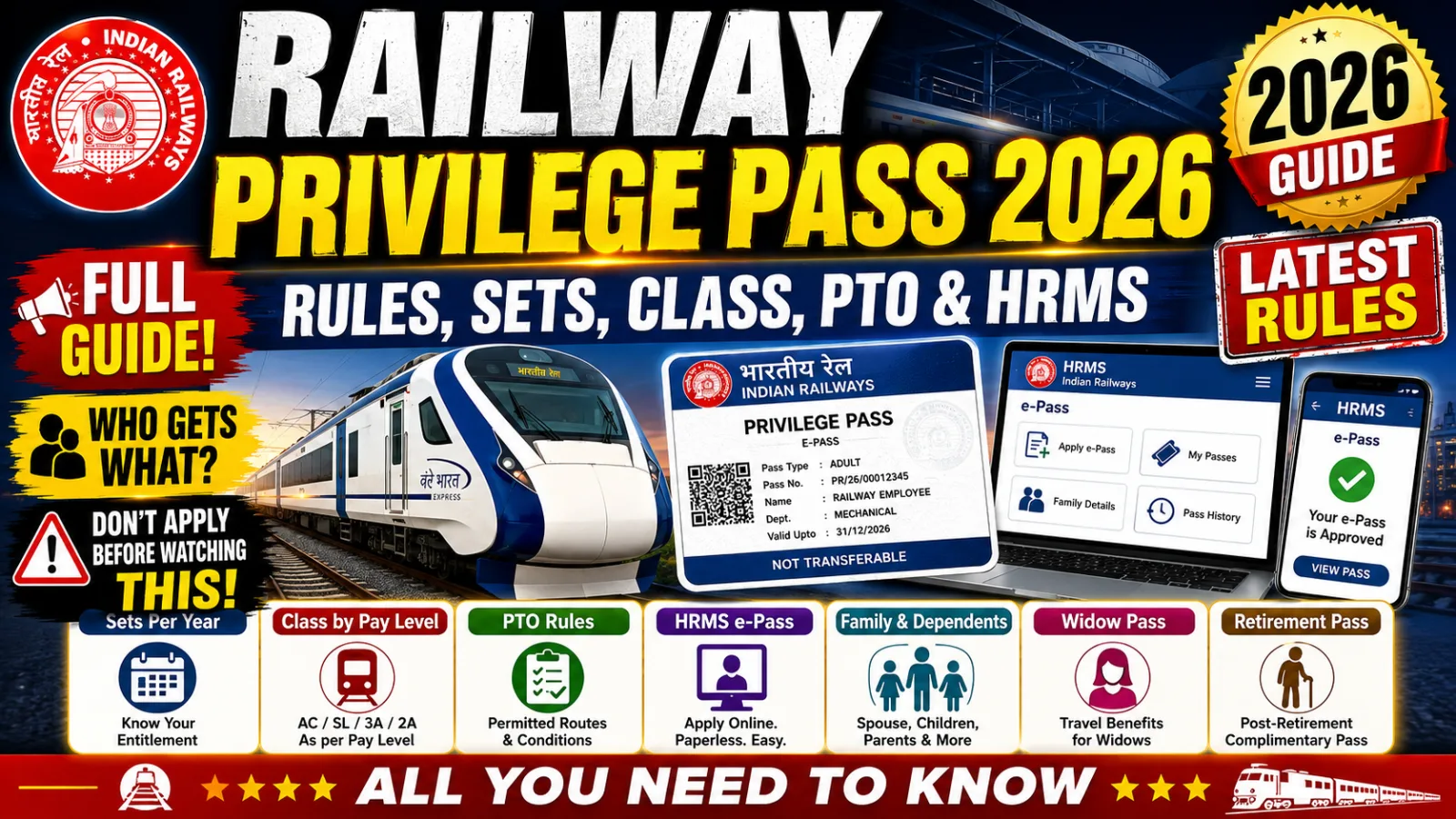
Free rail travel for the family is one of the most valued perks of railway service — and it comes through the Railway Privilege Pass. Yet many employees are unsure how many passes they get, which class they can travel in, how PTOs differ, how to apply on HRMS, and what happens to their pass after retirement. This in-depth guide explains the railway privilege pass rules with the latest details, and pairs with our guides on the UMID medical card and RELHS.
What is the Railway Privilege Pass?
A Railway Privilege Pass is a facility that allows a railway employee — and their eligible family — to travel free on Indian Railways a certain number of times each year. It is governed by the Railway Servants (Pass) Rules, 1986 (Second Edition, 1993), and is one of the defining benefits of working for the railways. Alongside the free pass, employees also get Privilege Ticket Orders (PTOs), which give a concession (not fully free) on the fare.
Think of it as two linked perks: the privilege pass for free journeys, and the PTO for concessional journeys — both drawn from your annual "privilege account."
How many privilege passes do you get per year?
The number of sets of privilege passes you are entitled to each calendar year depends on your group and length of service:
| Category | First 5 years of service | After 5 years of service |
|---|---|---|
| Gazetted officers (Group A & B) | 6 sets per year | 6 sets per year |
| Non-gazetted (Group C & erstwhile Group D) | 1 set per year | 3 sets per year |
In addition, employees are generally entitled to up to 6 PTOs (Privilege Ticket Orders) per calendar year. One "set" of a pass typically allows a return journey for the employee and eligible family members named on it. Any passes not availed in the year you retire are adjusted against your post-retirement entitlement.
Class of pass — by pay level
A very common question is which class you can travel in on a privilege pass. The class rises with your pay level/grade:
- Non-gazetted staff are generally entitled to one berth in AC 2-tier or two berths in AC 3-tier.
- Senior gazetted officers are entitled to AC First Class, with the topmost Railway Board functionaries getting additional berths.
- Lower grades travel in Sleeper/Second class as per their entitlement.
Travel entitlements on passes were revised under Railway Board order RBE 16/2019, aligning them with 7th CPC pay levels. Because the exact class-by-level mapping is detailed and updated by circulars, the simplest way to confirm your class is to check the entitlement shown against your pass in HRMS — it reflects your current pay level automatically.
Family and dependents on a pass
Under the Pass Rules, "family" for pass purposes includes:
- Your spouse,
- Dependent children (within the prescribed age/eligibility), and
- Dependent parents and certain dependent relatives, subject to the income and dependency conditions in the rules.
Every dependent who is to travel on your pass must be declared in your pass account / HRMS record. Keeping these declarations accurate matters — an undeclared or ineligible member can lead to the pass being treated as irregular during checking.
Companion / attendant
In defined situations, an attendant is permitted on the pass. Notably, retirees and widows above 70 years of age may be allowed a companion in lieu of an attendant in First Class / AC First Class, on payment of one-third of the fare difference — a welfare relaxation for elderly beneficiaries who need assistance while travelling.
How to apply — HRMS e-Pass
The old manual pass slip has largely been replaced by the HRMS (Human Resource Management System) e-Pass module. To get a pass or PTO online:
- Log in to HRMS with your railway employee credentials.
- Open the Pass / PTO (e-Pass) module and choose Privilege Pass or PTO.
- Select the family members (from your declared dependents) and the stations/route.
- Submit — the request is approved online by the competent authority.
- Use the e-pass for reservation; the digital pass carries your entitlement and class.
Because HRMS pulls your pay level and declared family automatically, it also shows your correct class and remaining balance for the year, reducing errors. Keep your HRMS family declarations and mobile number up to date.
Pass validity — 2024 update
The validity of passes was revised alongside a change to the Advance Reservation Period (ARP). From 1 November 2024, the ARP was reduced from 120 days to 60 days, and the validity of privilege passes, post-retirement complimentary passes and widow passes is now one month longer than the ARP, but not less than four months. Always go by the validity printed on your pass, and plan bookings within the current 60-day reservation window.
Post-Retirement Complimentary Pass (PRCP)
The benefit does not end at retirement. A Post-Retirement Complimentary Pass (PRCP) lets eligible retirees continue to enjoy railway passes:
- Eligibility: generally, completion of at least 20 years of qualifying service.
- Coverage: the retiree and spouse, with the number of sets per year depending on length of service.
- Class: broadly in line with the retiree's pre-retirement entitlement, subject to the rules.
This is one of the most cherished retirement perks in the railways, and pairs with RELHS medical cover to keep a retired railway family well looked after. See our RELHS guide for the health side.
Widow Pass
The Widow Pass scheme extends travel facility to the widow/widower of a railway employee, so the family's travel benefit continues after the employee's lifetime. Widow pass holders get a defined number of sets per year (with PTOs), and — as noted above — a companion in lieu of attendant is permitted for widows above 70 in the higher class on part payment. Exact entitlement is set by the rules and railway orders.
Practical tips
- Check your balance in HRMS before planning travel — it shows sets remaining and your class.
- Declare and update family in your pass account so dependents can travel without hassle.
- Book within the 60-day ARP (from Nov 2024) and note your pass validity (minimum four months).
- Carry ID with the pass — the pass is for the named employee/family, and checking staff may verify identity.
- At retirement, apply for your PRCP if you have completed the qualifying service, and settle any unused passes for the year.
- Use official channels — the HRMS portal for e-pass, and your personnel branch for pass-account queries.
Conclusion
The Railway Privilege Pass — together with PTOs, the post-retirement complimentary pass and the widow pass — is a defining benefit of railway service that keeps employees and their families travelling for life. Know your number of sets, confirm your class in HRMS, keep your family declarations current, apply through the HRMS e-Pass module, and, at retirement, claim your PRCP if eligible. Set it up right, and one of the railways' finest perks works smoothly for your whole family.
This guide is for general information based on the Railway Servants (Pass) Rules, 1986 and subsequent Railway Board orders (including RBE 16/2019 and the November 2024 validity/ARP revision). Rules and entitlements are updated from time to time — always confirm your exact entitlement in HRMS and with your railway personnel branch.