
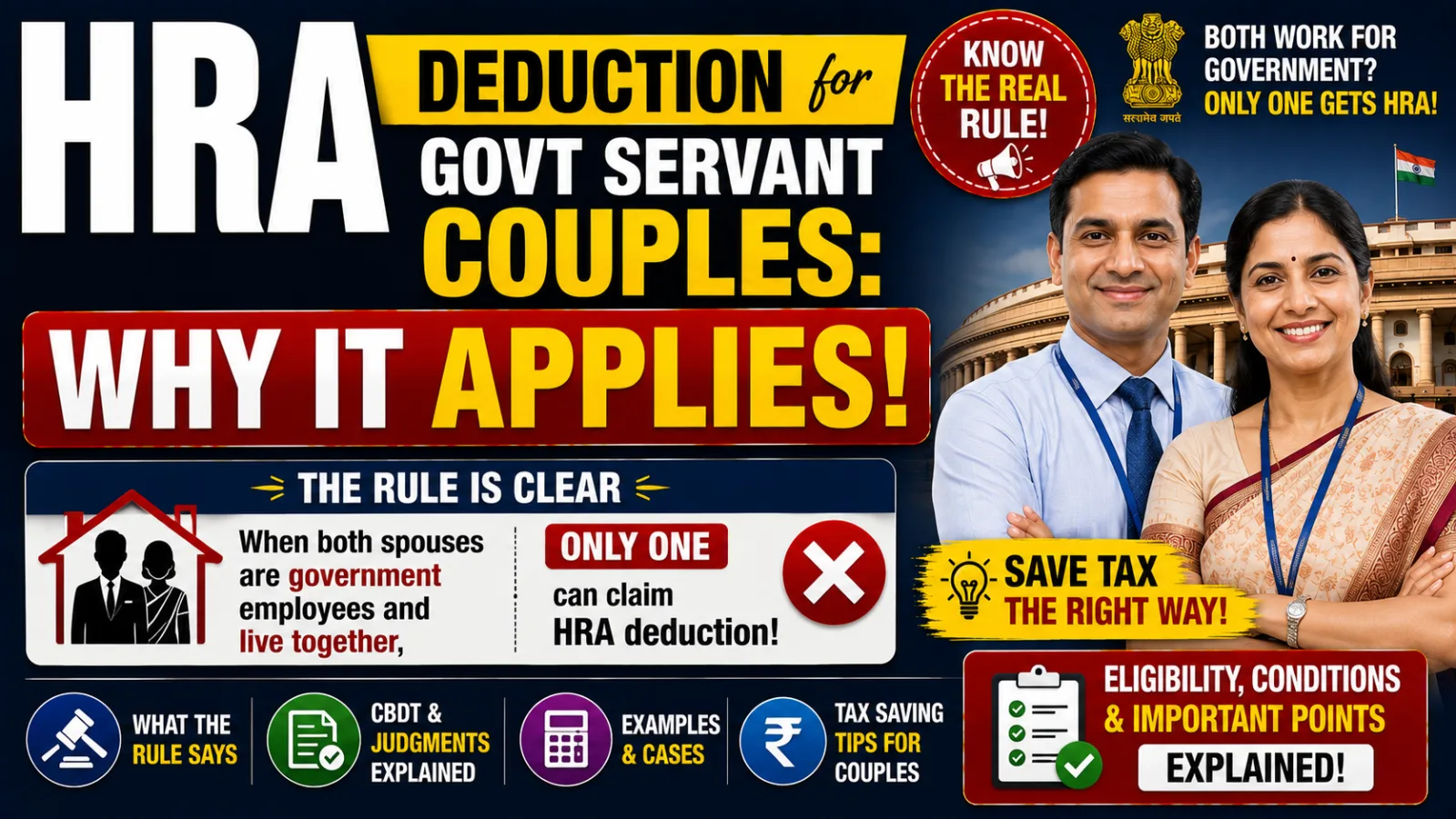
If you and your spouse are both Central Government employees stationed together, you've probably run into this question already: why does HRA deduction for government servant couples apply the way it does, with only one of you actually getting the allowance? The Government has now put its reasoning on record in Parliament, along with a clear "no" on whether this policy is under review.
This is Rajya Sabha Unstarred Question No. 1831, to be answered on 4 August 2026 by Shri Pankaj Chaudhary, Minister of State in the Ministry of Finance, in response to a question by Smt. Sumitra Balmik.
What Was Actually Asked
The question had four parts:
- What's the rationale behind deducting HRA from both spouses when both are Government servants living together in Government-allotted accommodation?
- Has the Government received representations from employees or their associations seeking a reconsideration of this policy?
- Does the Government plan to review the policy to make it more equitable for couples where both spouses are in Government service?
- If so, what are the details?
The Government's Reasoning, Explained
The answer to part (a) lays out the logic behind the rule clearly. HRA exists for one specific purpose: to compensate Central Government employees who are not provided Government accommodation, for the expenditure they incur hiring residential accommodation on their own.
Here's where it gets specific to couples: when both spouses are Government employees stationed at the same location, and either one of them is allotted Government accommodation, the Government's position is that the family as a whole is considered to have been provided accommodation — not just the spouse whose name the allotment is in. Since the family already has a roof over its head through that allotment, the other spouse isn't incurring any separate expenditure on housing. And since HRA is meant to compensate actual housing expenditure, the government's logic is straightforward: no expenditure, no HRA.
So it isn't that HRA is being "deducted" from both spouses as a penalty — it's that only one spouse was ever entitled to it in the first place, because the underlying condition for HRA (having to pay for your own accommodation) doesn't apply to the second spouse once the family has Government housing.
The Other Three Answers Were Short and Direct
- (b) Has the Government received representations on this? No.
- (c) Is the Government planning to review this policy? No.
- (d) If so, what are the details? Does not arise, since the answer to (c) was no.
There's no ambiguity here — the Government isn't signalling any openness to revisiting this rule based on this reply.
A Simple Example
Say both spouses work for the Central Government and are posted at the same station. One of them is allotted a Government quarter. Under this policy:
- The spouse who was allotted the quarter does not draw HRA (since Government accommodation is provided directly)
- The other spouse also does not draw HRA — not because they were denied something they were owed, but because the family is treated as already housed through the first spouse's allotment
If neither spouse is allotted Government accommodation, and both are eligible under general HRA rules, this restriction wouldn't apply in the first place — the rule specifically targets the scenario where at least one spouse has already been given accommodation.
Why This Rule Exists
The underlying principle is that HRA is a reimbursement-style allowance tied to actual housing cost, not a flat entitlement paid regardless of circumstance. Paying HRA to both spouses in a single-household, Government-accommodation situation would mean compensating for a housing cost that doesn't exist — the family isn't paying market rent or hiring private accommodation, so there's no expenditure to offset a second time.
What This Means If You're in This Situation
- If you and your spouse are both Government servants living together in Government-allotted accommodation, only the spouse in whose name the allotment stands is generally not eligible for HRA, and the other spouse isn't either, for the reasons above
- Don't expect this rule to change — the Government's position in this reply is unambiguous, and there's no review in progress
- If you believe your specific situation doesn't fit this pattern (for instance, if you're stationed at different locations, or neither of you has Government accommodation), the general HRA eligibility rules would apply differently — it's worth checking your specific case with your accounts or establishment section rather than assuming this restriction automatically applies
If you want to understand how HRA is calculated more broadly, including city classification and rate slabs, our HRA rates calculator and HRA city classification guide cover the mechanics in detail. For the wider picture of allowances Central Government employees are entitled to, see our Central Government allowances guide.
For more official Parliament replies like this, follow our government news section.