
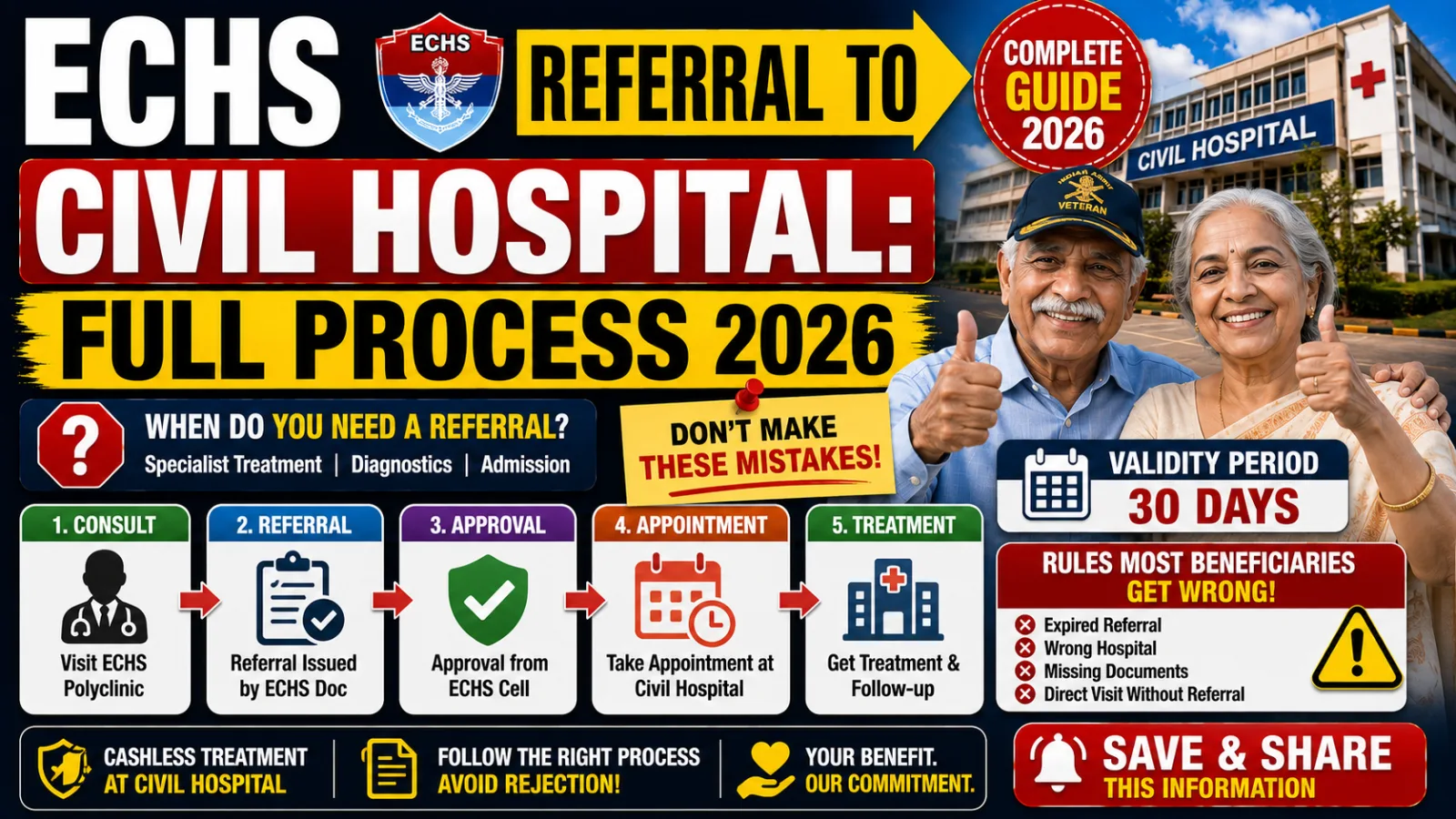
An ECHS referral to civil hospital is what stands between you and cashless treatment at an empanelled private or specialist facility — and getting it wrong, or not knowing the rules around it, is one of the most common reasons ECHS beneficiaries end up paying out of pocket for treatment that should have been free. Here's exactly when you need one, how the process actually works, and the specific rules that trip people up most often.
What an ECHS Referral Actually Is
An ECHS referral is a formal authorisation issued by a Medical Officer at your parent ECHS Polyclinic, allowing you to get treatment at an empanelled private hospital, a super-speciality facility, a diagnostic centre, or with a specialist doctor. It's the document that makes your treatment count as covered under ECHS rules — without it, planned treatment at a private empanelled hospital generally won't be processed as cashless.
When You Actually Need One
A referral is generally required for:
- Specialist consultations
- Hospital admission
- Surgery
- CT Scan, MRI, or PET Scan
- Endoscopy
- Angiography
- Other specialised investigations
- Super-speciality treatment
If you're just visiting the Polyclinic itself for routine care, this doesn't apply — the referral requirement kicks in specifically when your treatment needs to move beyond what the Polyclinic can handle.
The Step-by-Step Process
Step 1: Visit your parent ECHS Polyclinic Carry your ECHS Smart Card, Aadhaar Card (if asked), previous medical records, existing prescriptions, investigation reports, and any discharge summaries.
Step 2: Register at reception Your Smart Card gets verified, your visit is logged, and you'll get a consultation token.
Step 3: Consult the ECHS Medical Officer The Medical Officer examines your condition, reviews your history, checks whether the Polyclinic itself can handle treatment, and decides whether a referral to a specialist or hospital is actually necessary.
Step 4: Get the referral, if needed If a referral is issued, it should specify the empanelled hospital, the department, the specialist, the nature of your condition, the treatment or investigations required, and the validity period. Check every detail before you leave — an error here can cause problems later at the hospital counter.
Step 5: Contact the hospital before visiting Call ahead to confirm appointment availability and check that the hospital is currently accepting ECHS patients — empanelment status and capacity can shift, so don't assume.
Step 6: Visit the hospital and register At the registration counter, submit your referral letter, ECHS Card, Aadhaar (if required), and any previous reports. The hospital verifies your eligibility and registers you under ECHS.
Step 7: Consultation The specialist examines you, reviews your reports, prescribes medicines, recommends further tests, or advises admission or surgery if needed.
Step 8: Approval for admission, if required If admission is advised, the hospital forwards the necessary documents to the ECHS Regional Centre through the online authorisation system. Cashless treatment starts once approval comes through.
How Long Your Referral Stays Valid
A standard ECHS referral is valid for 90 days (3 months). You need to start treatment within that window — a referral that's expired by the time you show up won't be honoured.
Chronic conditions get a longer window. For illnesses like cancer, diabetes, cardiac disease, kidney disease, and neurological disorders, referral validity can extend up to 180 days (6 months), subject to ECHS policy at the time.
How Many Consultations One Referral Covers
A single referral generally covers up to 6 consultations within 3 months with the specialist you were referred to. If that specialist recommends you see a different specialty — say, an ENT referral after a Cardiology consultation — a fresh referral generally isn't required, as long as it comes from the treating specialist's own recommendation.
The Rule Around Diagnostic Tests
This is where the ₹3,000 threshold matters:
- Tests up to ₹3,000 (blood tests, X-rays, ultrasounds, routine investigations) generally don't need a fresh referral
- Tests above ₹3,000 (MRI, CT Scan, PET Scan, specialised cardiac investigations) generally do need one
One exception worth knowing: beneficiaries aged 70 and above are exempt from this referral requirement for specified investigations under ECHS policy — one of several relaxations built in for senior beneficiaries.
Hospital Admission Rules
A referral is generally mandatory for planned admissions, elective surgery, and scheduled procedures. Emergency admissions are the exception — you can be admitted without a prior referral, with the required paperwork completed afterward according to ECHS rules.
The Government Hospital Exception Most People Miss
Here's a benefit a surprising number of ECHS beneficiaries don't know about: you generally don't need a referral to get treatment at a Government hospital, including institutions like AIIMS, Central Government hospitals, State Government hospitals, and Tata Memorial Hospital where applicable. You can approach these directly with your ECHS card, subject to that hospital's own registration and treatment procedures.
If you've been assuming every ECHS treatment path requires a referral first, this is worth remembering — it can save you a Polyclinic visit when you need urgent access to a government facility.
Extra Relaxations for Beneficiaries 70 and Above
Beyond the diagnostic test exemption, senior beneficiaries get broader relaxations — including exemption from referral requirements for OPD consultations and select medical procedures, on top of certain investigations. The intent is straightforward: reduce how often elderly beneficiaries need to make repeated trips to the Polyclinic just for administrative sign-off.
Emergencies Override the Referral Requirement
In a genuine medical emergency, go straight to the nearest suitable hospital — a referral is not required before admission. Inform your parent Polyclinic as soon as reasonably possible, and complete the post-admission paperwork per ECHS guidelines afterward. The rule here is simple: your safety comes before administrative process, always.
The Medicine Mistake Almost Everyone Makes
If a specialist at an empanelled hospital prescribes medicines, don't rush out and buy them from a private pharmacy unless it's genuinely urgent. Instead:
- Take the prescription to your ECHS Polyclinic
- Show it to the Medical Officer for endorsement
- If the medicine is available in the ECHS pharmacy, it's issued free of cost
- If it isn't available, the applicable ECHS procurement or reimbursement procedure may apply
Skipping this step and buying expensive medicines out of pocket is one of the most common — and most avoidable — costs ECHS beneficiaries end up absorbing unnecessarily.
Common Mistakes That Cause Problems
- Visiting a private hospital without a referral, outside genuine emergencies
- Using a referral after its validity has expired
- Carrying incomplete documents to the hospital
- Going to a non-empanelled hospital for planned treatment
- Buying medicines immediately instead of checking ECHS pharmacy availability first
- Missing follow-up consultations within the referral's validity window
A Practical Example
Consider an Ex-Serviceman who develops chest pain. He visits his ECHS Polyclinic, where the Medical Officer suspects a cardiac issue and issues a referral to an empanelled cardiology hospital. The hospital runs an ECG and Echo, and angiography is advised. The hospital obtains the necessary authorisation through the ECHS system, and cashless treatment proceeds from there — this is the referral process working exactly as intended, start to finish.
Quick Reference
- Standard referral validity: 90 days
- Chronic disease referral validity: up to 180 days
- Consultations per referral: up to 6 within 3 months
- Diagnostic test referral threshold: ₹3,000
- Age-based exemption: 70 years and above
- Government hospitals: generally no referral needed
- Emergencies: no referral needed before admission
For the empanelled hospitals themselves, our ECHS empanelled hospitals list is a good starting point, and for the broader scheme framework, our ECHS scheme guide covering eligibility, benefits, and contribution walks through the fundamentals. If you're managing dependents on your ECHS card, our ECHS dependent addition guide covers that process separately, and if home delivery of medicines is more relevant to your situation than a Polyclinic pickup, see our piece on ECHS home delivery of medicines. For the Aadhaar-linked verification requirement that's now part of hospital treatment, our coverage of the ECHS Beneficiary Satyapan App is worth a read too.
For more ECHS and defence welfare updates like this, follow our government news section.