
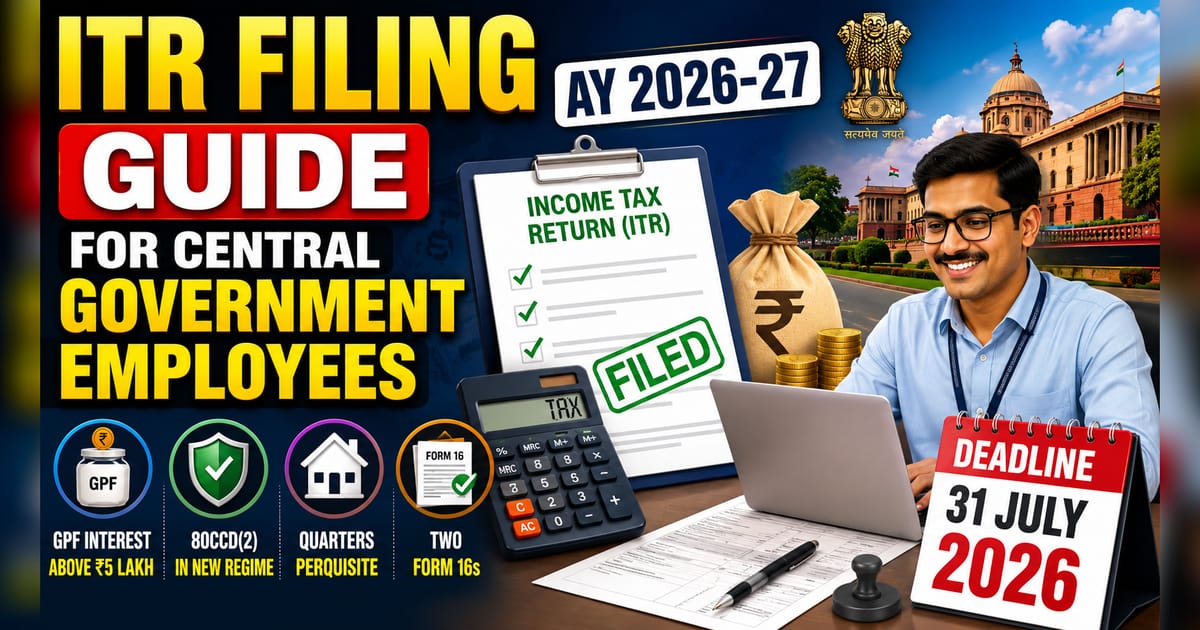
An Assistant Section Officer in Delhi filed his return last July in about eleven minutes. Form 16 from the PAO, pre-filled data on the portal, tick, tick, submit.
Fourteen months later a notice arrived. He had contributed ₹6.8 lakh to GPF that year — voluntary extra contributions, because the interest rate is good and it felt like the safest place to park money. The interest on the amount above ₹5 lakh was taxable. It was not in his Form 16, because it is not salary. He had never declared it.
The tax was small. The interest and the correspondence were not.
This is the shape of the problem for Central Government employees. Filing is genuinely simple for most of us — but the handful of things that go wrong are the things generic tax guides never mention, because GPF, licence fees and DDOs do not exist outside government.
Here is what actually matters on a government pay slip.
The Deadlines You Care About
You are filing for FY 2025-26, which the department calls Assessment Year 2026-27.
| What | When |
|---|---|
| Filing due date (salaried, ITR-1/ITR-2) | 31 July 2026 |
| Belated return (with late fee) | 31 December 2026 |
| Revised return | 31 March 2027 |
Miss 31 July and a belated return costs ₹5,000 under Section 234F (₹1,000 if total income is under ₹5 lakh), plus interest under 234A on any unpaid tax. You also lose the right to carry forward certain losses.
The revised-return window is generous — until 31 March 2027 — so a genuine mistake found in September is fixable. That is not a reason to be careless, but it is a reason not to panic.
Which ITR Form Applies to You
Most Central Government employees file ITR-1 (Sahaj). You can use it if your total income is up to ₹50 lakh and comes from salary, one house property, and other sources such as interest.
You must move to ITR-2 if any of these apply:
- You have capital gains — sold shares, mutual funds, or property
- You own more than one house property
- Your total income exceeds ₹50 lakh
- You have foreign assets or foreign income
- You are a director in a company, or hold unlisted equity shares
- You have agricultural income above ₹5,000
The trap: redeeming equity mutual funds — even a small SIP redemption — creates capital gains and pushes you out of ITR-1. Filing ITR-1 when ITR-2 was required makes the return defective under Section 139(9), and you get 15 days to fix it after the notice arrives.
Form 16 Comes From Your DDO, Not an HR Portal
Your Form 16 is issued by your DDO (Drawing and Disbursing Officer) or PAO (Pay and Accounts Office), not by a company HR system. Two parts:
- Part A — TDS deducted and deposited, generated from TRACES
- Part B — the salary breakup, allowances, deductions and taxable income
Always reconcile Form 16 against your AIS and TIS on the e-filing portal before you file. The Annual Information Statement pulls from banks, mutual funds, registrars and the TDS system. Where they disagree, the mismatch is what triggers scrutiny.
Common government-specific mismatches:
- Arrears paid in the year show in Form 16 but the AIS timing can differ
- Interest on GPF above the threshold appears in neither — you must add it yourself
- Savings and FD interest is in AIS but almost never in Form 16
- A mid-year transfer between offices can produce two Form 16s. You must combine them. Filing on one alone under-reports your income, and because each DDO applied the basic exemption separately, you will usually owe more tax.
If Part A is wrong, your DDO must file a revised TDS return — you cannot fix it from your side.
80CCD(2): The Deduction That Survives the New Regime
This is the single most valuable line for a Central Government employee, and the most misunderstood.
Under 80CCD(2), the employer's contribution to your NPS Tier-I account is deductible — and unlike almost everything else, it is available under the new tax regime.
For FY 2025-26 the limit is 14% of basic pay + DA.
The stale fact to watch for: most articles still say "government employees get 14%, private sector gets 10%." Under the new regime that stopped being true from FY 2025-26 — it is now a uniform 14% for everyone. The 14-vs-10 split survives only under the old regime.
Why it matters so much: under the new regime, 80C is gone, HRA exemption is gone, LTC exemption is gone. 80CCD(2) is effectively the only large deduction left standing. On a basic + DA of ₹9 lakh, that is up to ₹1.26 lakh off your taxable income in the new regime.
Two things people get wrong:
- This is the employer's 14%, not your own 10%. Your own mandatory contribution goes under 80CCD(1), which is inside the ₹1.5 lakh 80C ceiling and not available in the new regime. If you are still weighing the pension schemes themselves, the NPS vs OPS comparison covers that separately.
- It must actually appear in Form 16. If your DDO has not reflected the government's NPS contribution, raise it before filing rather than claiming it unsupported.
GPF Interest Above ₹5 Lakh Is Taxable
The rule that caught the ASO at the top.
Since FY 2021-22, if your own GPF contribution in a financial year exceeds ₹5 lakh, the interest earned on the excess is taxable. This is Rule 9D of the Income Tax Rules.
Three things make it easy to miss:
- It is taxed as Income from Other Sources, not as salary
- It does not appear in your Form 16, because it is not salary
- Your GPF account is notionally split in two — a non-taxable portion up to ₹5 lakh a year plus its interest, and a taxable portion above it plus its interest
The ₹5 lakh threshold applies where the employer makes no contribution to the fund — which is the case for GPF. (The lower ₹2.5 lakh threshold is the EPF figure, where the employer does contribute. Generic articles routinely apply the wrong one to government employees.)
Who this hits: anyone making large voluntary GPF contributions. It is entirely possible to cross ₹5 lakh without noticing if you raised your subscription percentage to shelter income.
What to do: ask your DDO or AG office for the taxable-interest figure for the year and declare it under Income from Other Sources. It is a small tax on a good investment — not a reason to stop contributing, just a reason to report it.
Government Quarters: No HRA, But a Perquisite
If you live in government accommodation, two separate things happen.
First, you get no HRA and therefore no HRA exemption. There is nothing to claim under Section 10(13A), because no HRA is being paid to you.
Second, the accommodation itself is a taxable perquisite. For Central and State Government employees the valuation is unusually simple — the perquisite value is the licence fee determined under service rules, minus the rent you actually pay.
Licence fee ₹4,000/month, you pay ₹1,000/month → Perquisite = ₹3,000/month, added to your taxable salary
This is far more favourable than the private-sector rule, which values accommodation as a percentage of salary based on city population. A government employee in a Delhi quarter is taxed on a modest licence fee; a private employee in comparable housing is taxed on a percentage of pay.
Because the perquisite is the licence fee, a licence fee revision changes your taxable salary directly — GPRA licence fees were revised from 1 July 2026, which will show up in next year's Form 16. If you are not in quarters and are claiming HRA instead, your city category sets the exemption ceiling — see the HRA X/Y/Z city classification guide.
Your DDO should already reflect this in Form 16. Check that it is there — an omitted perquisite is under-reported income, and it is the DDO's figure that the department will match against.
Arrears: Do Not Skip Section 89(1)
If you received DA arrears or pay-revision arrears during the year, they are taxed in the year of receipt — which can push you into a higher slab for income you should have earned across several years.
Section 89(1) relief exists precisely for this, and claiming it requires filing Form 10E on the portal before you file your ITR. File the return first and the relief is disallowed, mechanically, with a notice to follow. The full walkthrough — including the year-by-year recomputation — is in the Section 89(1) and Form 10E guide.
This matters more than usual heading into the 8th Pay Commission, where arrears are likely to be substantial. With DA confirmed at 63% from July 2026, the arrears feeding into next year's return will be larger again.
Smaller CG-Specific Items Worth Knowing
Available only under the old regime:
- LTC — fare reimbursement is exempt under Section 10(5), two journeys per four-year block. Blocks, entitled travel class and the encashment rules are in the LTC complete guide
- Children Education Allowance — ₹100/month per child, up to two children; hostel subsidy ₹300/month per child. Note the reimbursement you receive is a separate, higher figure — see CEA rates for 2026
- HRA exemption under Section 10(13A), if you are not in quarters
Available under both regimes:
- Transport Allowance for employees with disabilities — exempt up to ₹3,200/month. This is one of the very few allowance exemptions the new regime retains, and it is regularly missed
- 80CCD(2), as above
- Standard deduction — ₹75,000 in the new regime, ₹50,000 in the old
- Gratuity and commuted pension exemptions at retirement — if you have already retired, the pensioner and senior citizen ITR guide covers these along with 80TTB and the 194P filing waiver
The Slabs You Are Filing Against
New regime (default) — FY 2025-26:
| Taxable income | Rate |
|---|---|
| Up to ₹4 lakh | Nil |
| ₹4–8 lakh | 5% |
| ₹8–12 lakh | 10% |
| ₹12–16 lakh | 15% |
| ₹16–20 lakh | 20% |
| ₹20–24 lakh | 25% |
| Above ₹24 lakh | 30% |
With the Section 87A rebate of up to ₹60,000, taxable income up to ₹12 lakh attracts no tax. Add the ₹75,000 standard deduction and a salaried employee is effectively tax-free up to about ₹12.75 lakh gross.
Old regime — FY 2025-26: nil up to ₹2.5 lakh, 5% to ₹5 lakh, 20% to ₹10 lakh, 30% above. Standard deduction ₹50,000, rebate up to ₹5 lakh.
The new regime is the default. If you want the old one, you must actively choose it. A salaried employee may switch between regimes each year at filing.
Do not decide this from a rule of thumb — run your own numbers. The old vs new regime comparison works through the break-even points for government salaries specifically.
Filing, Step by Step
- Collect Form 16 (all of them, if you transferred), bank interest certificates, and your GPF taxable-interest figure
- Download AIS and TIS from the portal and reconcile them against Form 16
- File Form 10E first if you are claiming Section 89 relief on arrears
- Log in at incometax.gov.in and open the pre-filled return
- Verify the pre-filled data rather than trusting it — pre-fill is a convenience, not an assurance
- Add what Form 16 omits — GPF interest above the threshold, savings and FD interest, capital gains
- Compare both regimes before locking your choice
- Pay any balance tax and enter the challan details
- Submit
- E-verify within 30 days — via Aadhaar OTP, net banking or bank account. An unverified return is treated as never filed
The Mistakes That Actually Cost Money
- ❌ Filing on one Form 16 after a mid-year transfer
- ❌ Never declaring GPF interest above ₹5 lakh
- ❌ Filing the ITR before Form 10E when claiming Section 89 relief
- ❌ Filing ITR-1 after a mutual fund redemption, making the return defective
- ❌ Claiming HRA exemption while living in government quarters
- ❌ Assuming the new regime is better without running both — for employees with home loan interest, large 80C and HRA, the old regime frequently still wins
- ❌ Forgetting to e-verify, which silently voids the whole return
- ❌ Missing 80CCD(2) in the new regime — the biggest deduction still available
Before You Hit Submit
- ✅ Every Form 16 for the year, combined
- ✅ AIS and TIS reconciled against Form 16
- ✅ GPF taxable interest obtained from the DDO/AG and declared
- ✅ Government quarters perquisite present in Form 16
- ✅ 80CCD(2) claimed and reflected by the DDO
- ✅ Form 10E filed before the return, if claiming arrears relief
- ✅ Both regimes compared on your actual numbers
- ✅ Return e-verified within 30 days