
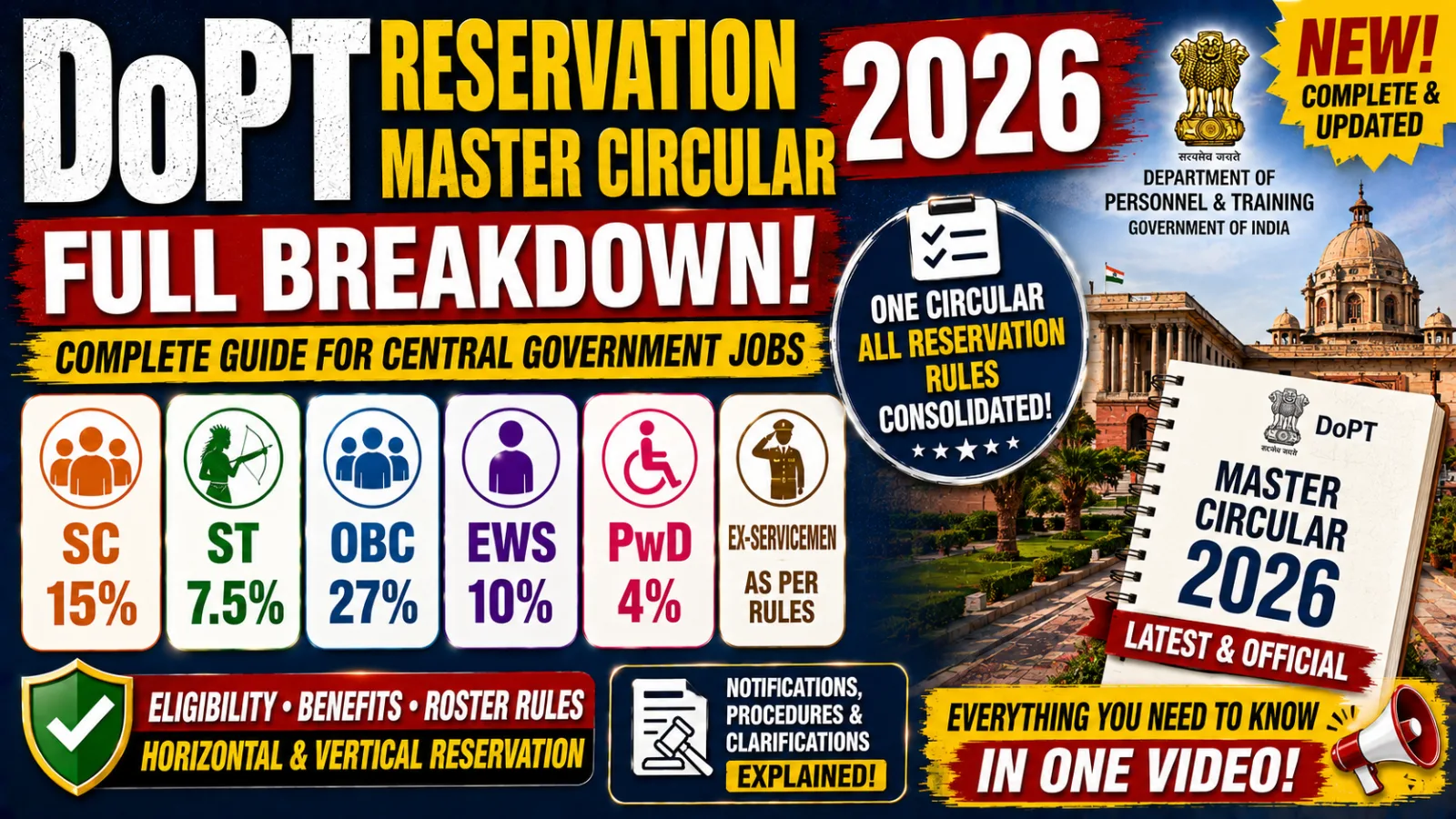
If you've ever tried to find the exact reservation rule that applies to your specific situation as a Central Government job applicant, you've probably run into the same problem everyone does — the actual rules are scattered across decades of separate Office Memorandums. The DoPT Master Circular 2026 exists specifically to fix that, pulling reservation instructions for SC, ST, OBC, EWS, PwD, and Ex-Servicemen candidates into one consolidated reference.
Issued under No. 36011/1/2022-Estt(Res-I) and dated 11 August 2026, this update replaces the previous consolidated version from 28 March 2024, which itself had updated the original October 2022 compilation.
Why This Circular Exists
Reservation and concession rules for Central Government recruitment have built up over many years through individual Office Memorandums, court judgments, and policy revisions. Locating the specific rule that governs your situation — a promotion case, a single-vacancy cadre, a creamy-layer question — often meant digging through old circulars one at a time. This Master Circular is DoPT's attempt to give Ministries, Departments, recruiting agencies, and applicants one current, consolidated document instead.
Reservation Percentages in Direct Recruitment
For All-India direct recruitment through open competition (the category UPSC exams and most written competitive tests fall under):
| Category | Reservation |
|---|---|
| Scheduled Castes (SC) | 15% |
| Scheduled Tribes (ST) | 7.5% |
| Other Backward Classes (OBC) | 27% |
For direct recruitment otherwise than through open competition, the percentages shift:
| Category | Reservation |
|---|---|
| Scheduled Castes (SC) | 16.66% |
| Scheduled Tribes (ST) | 7.5% |
| Other Backward Classes (OBC) | 25.84% |
The distinction matters because plenty of Central Government recruitment doesn't run through a competitive written exam — interview-based selection and certain other methods fall into the second category, with different percentages applying.
Local and Regional Recruitment
For Group C and Group D posts recruited on a local or regional basis — where the candidate pool is drawn from a specific locality — reservation percentages generally follow the rates prescribed for that particular State or Union Territory, rather than the standard all-India figures above.
One clarification worth knowing: SC, ST, and OBC candidates remain entitled to applicable Central Government reservation benefits in local, regional, zonal, or circle-based recruitment regardless of which State or UT they originally come from, subject to the specific rules governing that recruitment.
The OBC Creamy Layer Rule
This is one of the most consequential provisions for OBC applicants: candidates who fall within the creamy layer are not entitled to OBC reservation benefits, even if they hold a valid OBC caste certificate.
Creamy layer status is determined against detailed criteria covering constitutional posts, service category, PSU employment, Armed Forces and paramilitary rank, professional and business income, and property or agricultural holdings. The income/wealth test specifically uses a threshold of ₹8 lakh or above in gross annual income for three consecutive years, subject to detailed exclusions — for instance, income from salary and agricultural land is treated under specific separate provisions rather than being counted the same way as other income sources.
A Specific Rule for Children of Senior Defence Officers
The circular also carries forward a provision that specifically affects defence families applying under the OBC category: children of parents holding the rank of Colonel and above in the Army, or equivalent ranks in the Navy, Air Force, and paramilitary forces, may fall within the creamy layer exclusion criteria — meaning they could be excluded from OBC reservation benefits despite belonging to an OBC community, subject to the detailed conditions and exceptions in the instructions.
If you're the child of a senior defence officer applying for a Central Government post under OBC category, this is a rule worth checking carefully before you assume reservation benefits automatically apply to you.
Reservation in Promotion
For SC and ST employees already in service, reservation in promotion continues at:
- 15% for Scheduled Castes
- 7.5% for Scheduled Tribes
This applies to specified promotion routes, including Limited Departmental Competitive Examinations and promotion by selection or seniority, depending on how the specific service or cadre is structured. Before actually implementing reservation in promotion, Ministries and Departments are required to satisfy conditions laid down in DoPT instructions and relevant judicial rulings — including collecting quantifiable data on inadequate representation and maintaining the prescribed reservation roster. Promotion orders under this framework also remain subject to further directions from the Supreme Court in ongoing related cases.
Scientific and Technical Posts
Reservation for SC, ST, and OBC candidates generally extends to scientific and technical posts up to and including the lowest grade of Group A. Certain higher-level scientific and technical posts can be exempted from reservation if they genuinely involve conducting, organising, guiding, or directing research — a narrow carve-out, not a blanket exemption for anything labelled "technical." Separate provisions also apply to specific posts within the Department of Space, Department of Electronics, and training arrangements under the Department of Atomic Energy.
Single-Vacancy and Single-Post Cadres
Two related but distinct rules apply here:
- Single-post cadres: reservation doesn't apply at all, in line with Supreme Court precedent and Government instructions
- A single vacancy landing on a reserved roster point: this vacancy may initially be treated as unreserved, with the reservation instead carried forward to subsequent recruitment cycles under the prescribed carry-forward rules
These provisions matter most for small cadres with limited vacancies, where recruiting authorities need clear guidance on how reservation applies when there's only one post to fill.
What If a Candidate Can't Produce a Caste Certificate in Time?
This is a practical detail worth knowing that doesn't always get highlighted: if an SC, ST, or OBC candidate genuinely cannot produce a certificate from a prescribed authority at the time of appointment, they can still be appointed provisionally based on whatever prima facie proof they can produce, provided they furnish the proper certificate within a reasonable time. If there's a genuine difficulty obtaining the certificate, the appointing authority itself is expected to verify the claim through the concerned District Magistrate, rather than simply rejecting the candidature outright.
Equivalence With PSU, Bank, and Insurance Posts
If you're comparing reservation treatment across Central Government service and Public Sector Enterprises, this matters: the Department of Public Enterprises and Department of Financial Services have issued guidelines establishing equivalence between posts in Central Public Sector Enterprises (CPSEs), Public Sector Banks (PSBs), Public Sector Insurance Companies (PSICs), and Public Financial Institutions (PFIs) versus equivalent Central Government posts — meaning reservation-related seniority and comparability questions across these categories follow a defined mapping rather than being left ambiguous.
EWS, PwD, and Ex-Servicemen Coverage
The Master Circular doesn't stop at SC/ST/OBC — it also consolidates:
Economically Weaker Sections (EWS): covered under the separate EWS reservation framework applicable to Central Government recruitment, subject to prescribed eligibility and certificate requirements.
Persons with Disabilities (PwD): provisions covering reservation, identification of posts suitable for reservation, recruitment procedures, and applicable concessions for Persons with Benchmark Disabilities.
Ex-Servicemen: a separate reservation and concession framework, where the actual benefit available depends heavily on the specific post's nature, its Group classification, the recruitment method, whether the vacancy is covered under the Ex-Servicemen reservation framework at all, applicable age relaxation, educational qualification requirements, and re-employment/service-status conditions. This is genuinely one of the more variable categories — the benefit that applies to one Ex-Servicemen candidate for one post may not apply the same way to a different post, so checking the specific recruitment notification matters more here than for most other categories.
What This Means for You
- Don't rely on the general percentages alone — always check the specific recruitment notification for your target post, since local, technical, and single-vacancy rules can all change what actually applies to you
- If you're an OBC candidate close to the creamy layer income threshold, understand exactly how the ₹8 lakh test works for your specific income sources before assuming reservation applies
- If you're the child of a senior defence officer (Colonel and above, or equivalent), verify your OBC creamy layer status carefully rather than assuming it automatically applies
- If you're an Ex-Servicemen candidate, treat the reservation framework as post-specific — check the notification directly rather than assuming a blanket benefit
- If you're missing a caste certificate at the time of appointment, know that provisional appointment is a real option, not an automatic disqualification
This circular is a consolidated reference, not a replacement for reading your specific recruitment notification — always cross-check both together, along with any more recent DoPT instructions or court rulings that might apply to your situation.
For more official Central Government recruitment and service rule updates like this, follow our government news section.