
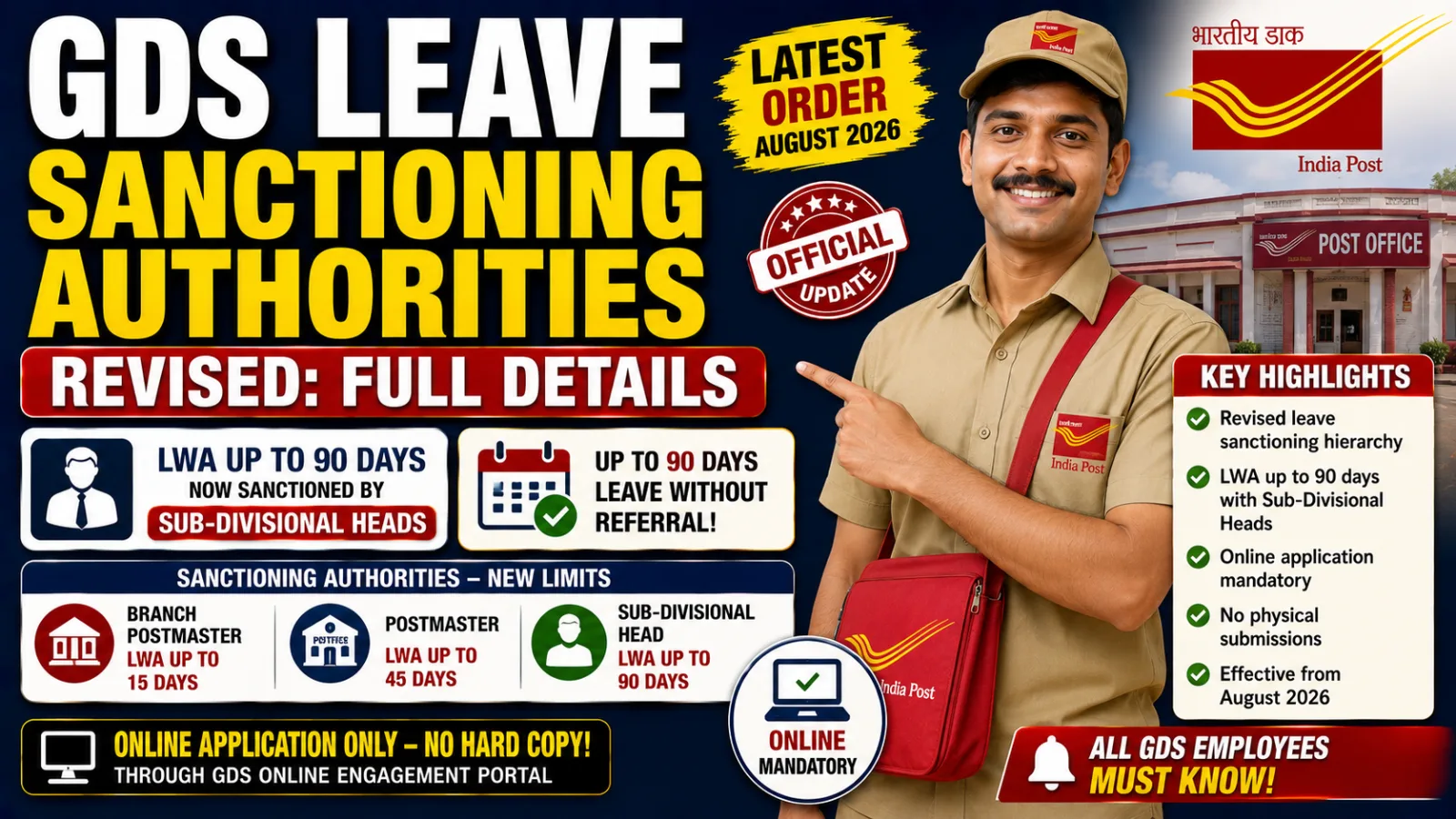
The Department of Posts has revised GDS leave sanctioning authorities across the board, decentralising several leave-approval powers and making online application mandatory for every kind of leave. The order, issued on 13 August 2026, brings leave-sanctioning powers in line with the revised Schedule of Engaging, Disciplinary and Appellate Authorities (SEDA) for Gramin Dak Sevaks, after multiple Circles sought clarification on who's actually authorised to approve what.
Why This Revision Was Needed
SEDA for Gramin Dak Sevaks was revised through an order dated 26 November 2025. After that revision, various Circles wrote in seeking clarity on which competent authorities could sanction different kinds of leave, and who was responsible for approving substitute arrangements while a GDS is on leave. Rather than answer piecemeal, the Department chose to comprehensively review the entire leave framework — this order is the result.
Your Existing Leave Entitlements, Unchanged
Before getting into what changed, here's what GDS leave entitlements actually are — these categories themselves haven't been altered by this order, only who approves them:
- Paid Leave (PL): 10 days in each half-year, accumulable up to a maximum of 45 days, with no leave encashment facility
- Leave Without Allowance (LWA): Admissible up to 180 days in a calendar year under normal circumstances, and beyond 180 days in specified cases as permitted under existing instructions
- Emergency Leave: Up to 5 days in a calendar year for urgent requirements
- Maternity Leave: 180 days of paid leave for female GDS, as per prescribed conditions. An additional 45 days can be granted in case of miscarriage, including abortion, on production of a medical certificate from a Government Medical Practitioner — and this is available irrespective of how many surviving children the GDS already has
What's Actually Changing — The 10 Key Points
1. Alignment with revised SEDA The changes bring leave-sanctioning authorities in line with the revised SEDA structure, while consolidating existing instructions on leave and substitute arrangements into one place.
2. LWA, Paid Leave, and Emergency Leave powers decentralised Sanctioning powers for these three leave types are now delegated to HSG-I Postmasters and Senior Postmasters/Deputy Chief Postmasters/Officers-in-Charge of Independent Units, for Dak Sevaks working in their offices. Where a Unit is headed by a PS Group B officer or above, that officer can further delegate down to officers not below the rank of Inspector (Posts)/HSG-I in that office.
3. LWA power for BPMs enhanced from 60 to 90 days Sub-Divisional Heads can now sanction LWA up to 90 days for Branch Postmasters (BPMs) — up from 60 days previously — bringing it on par with the existing powers already available for ABPMs and Dak Sevaks.
4. Divisional/Unit Heads get uniform power beyond 90 days Following from point 3, Divisional Heads and Unit Heads will now sanction LWA beyond 90 days and up to 180 days uniformly for all categories of GDS. Existing powers relating to LWA for recognised Union functionaries and GDS officiating as MTS/Postman remain unchanged.
5. Head of Region gets power for genuine-illness cases beyond 180 days The existing power of the Head of Circle to sanction LWA beyond 180 days on grounds of genuine illness has now been extended to the Head of Region as well, specifically to speed up disposal of such cases.
6. No change to Paid Leave, Emergency Leave, and Maternity Leave powers at Divisional/Unit level These remain with Divisional/Unit Heads as before. However, where Units or Divisions are headed by officers above the PS Group B level, these powers may be delegated to an officer not below the rank of PS Group B.
7. No change to CPMG's power for LWA beyond 180 days for recognised National-level GDS Union functionaries This authority stays exactly as it was.
8. LWA beyond 180 days continues in three specific situations
- Officiating against MTS/Postman posts
- Deputation to IPPB or any other office notified by the Department
- Cases of genuine illness
The specific authorities for each of these situations are laid out in the table attached as an annexure to the letter.
9. Leave sanctioning authority now also approves substitute arrangements Whoever holds the delegated leave-sanctioning power for a given leave type is now also competent to approve the substitute arrangement made while that GDS is on leave. This consolidates two previously separate approval steps into one authority, and existing guidelines on substitute arrangements are superseded as a result.
10. Mandatory online application — no manual approvals This is the change every GDS needs to know about directly. There's already a provision in the APT 2.0 system and its mobile app for applying for all kinds of admissible leave. Going forward, GDS must apply for all kinds of leave through online mode only — for proper record-keeping, faster approval, and end-to-end tracking. No leave will be approved in manual mode.
What This Means for You as a GDS
- If you're a BPM, your Sub-Divisional Head can now approve up to 90 days of LWA for you directly, rather than the previous 60-day cap
- For LWA beyond 90 days and up to 180 days, your Divisional or Unit Head is now the authority, regardless of which GDS category you fall under
- Stop submitting manual leave applications — apply for every category of leave through APT 2.0 or the mobile app, since manual applications will no longer be approved at all
- If your leave request involves substitute arrangements, that approval now comes from the same authority handling your leave sanction, not a separate process
- Your core entitlements — 10 days PL per half-year, 180 days LWA under normal circumstances, 5 days Emergency Leave, and Maternity Leave terms — remain exactly as they were; this order changes who approves them and how you apply, not what you're entitled to
Who Issued This and Where It Was Sent
The order is digitally signed by Gurvinder Singh, Assistant Director General (GDS/PCC), Department of Posts, and addressed to all Chief Postmasters General. Copies went to the Chief General Manager of the BD/Parcel/PLI Directorate/CEPT, all DDGs and PMGs, the Director of RAKNPA, Directors of all PTCs, the Additional Director General of Army Postal Service, all General Managers (Finance)/Director Postal Accounts/DAP, the General Manager (CEPT) Bengaluru (with a request to upload it on the India Post website), the Assistant Director CEPT Hyderabad Unit, and all Recognised Service Unions.
For more official Department of Posts and Central Government workforce updates like this, follow our government news section.