
For many years, railway employees believed that applying for Voluntary Retirement Scheme (VRS) meant a guaranteed exit after the notice period. This understanding has now changed for some. The Railway Board has updated its rules, making it clear that your VRS application might not always be approved.
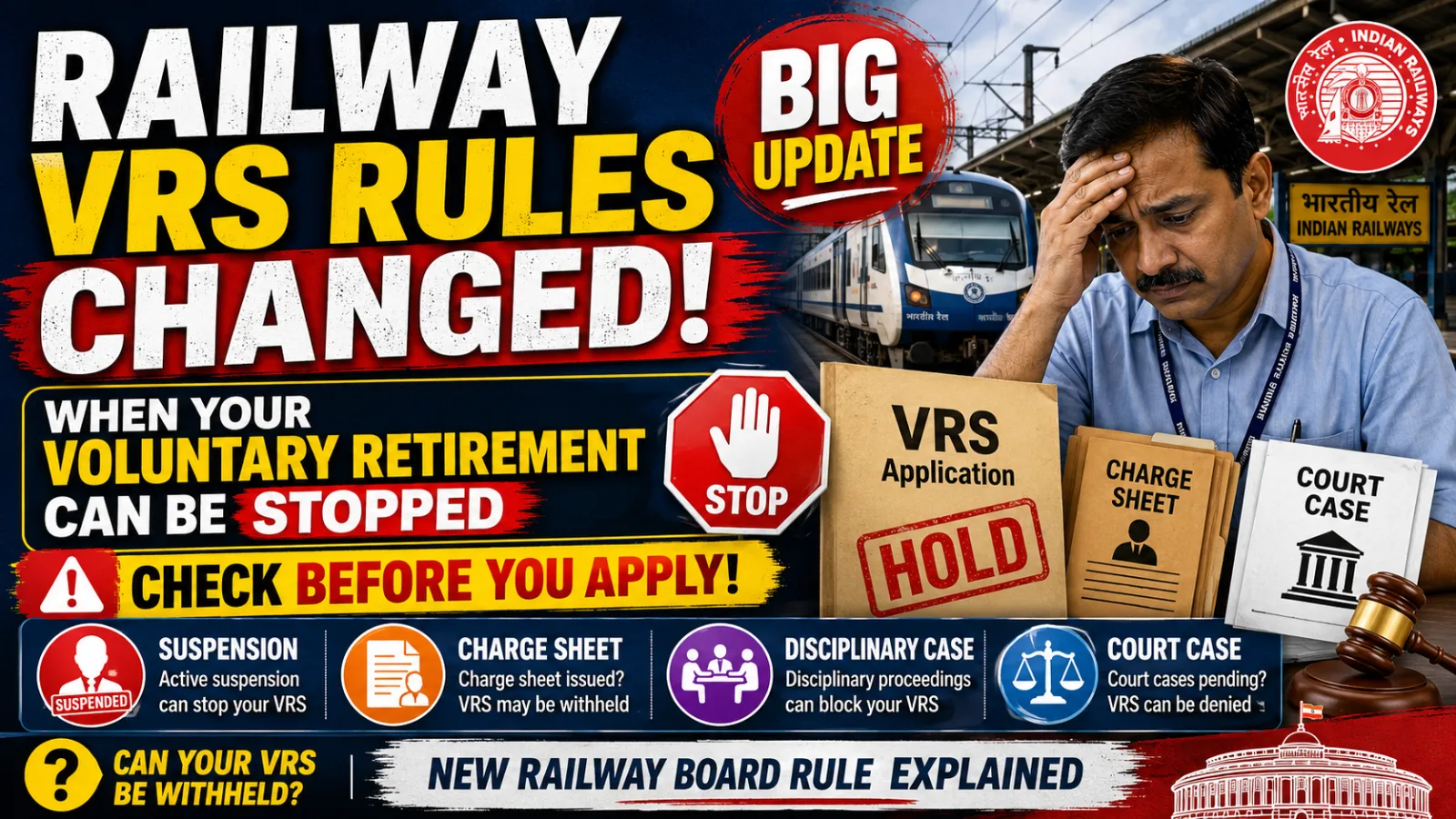
If you have an unresolved disciplinary case or a court matter pending, the Railway Board can now stop your voluntary retirement. This update aims to ensure accountability before an employee leaves service.
What the New Rule Says
The Railway Board issued RBE No. 56/2026 on July 10, 2026. This order gives the authority to withhold VRS permission in specific situations. This change brings Railway rules in line with those already followed by the Department of Personnel & Training (DoPT) for other Central Government employees.
Why These Rules Changed
This update came about because of a court case: Gopal Singh Purohit vs Union of India & Others. The Central Administrative Tribunal decided this case, which then led DoPT to change its own Fundamental Rule 56(k), 56(m), and Rule 48 of the CCS (Pension) Rules. Railways then had to update the Indian Railway Establishment Code to match these new standards.
When Your VRS Can Be Blocked
Your request for voluntary retirement can be withheld if any of these three situations apply to you:
- You are currently suspended from duty.
- A chargesheet has been issued against you, and disciplinary proceedings are actively going on.
- A court case is pending against you that involves serious misconduct.
It is important to understand what "pending" means for a court case. Judicial proceedings are considered pending when both of these conditions are met:
- A complaint or police report has actually been filed.
- A Magistrate has officially recognized the matter.
If both these points are true, your VRS permission can be withheld. You can use our retirement benefits guide to understand your entitlements better.
Which Rules Were Updated
This amendment changes three specific rules in Chapter 18 of the Indian Railway Establishment Code, Volume II:
- Rule 1802(b)(1)
- Rule 1803(b)(1)
- Rule 1804(b)
These updates make sure that the conditions for withholding VRS are consistent across all relevant Railway provisions. This closes a gap that existed between Railway rules and general Central Government service rules.
This Rule Applies to Past Cases Too
This order from the Railway Board is effective retrospectively from January 17, 2014. This is the date when the original DoPT notification came into force.
However, there is an important point to note:
- Cases that were already decided under the old rules will not be reopened. If your VRS was approved and settled, it remains settled.
- Only cases that are still pending or new cases will be subject to these amended rules.
So, this rule does not impact employees who have already retired cleanly. It only affects those whose disciplinary or legal matters are still open.
What This Means for You
If you are a railway employee with a clear record, these changes do not affect you. Your VRS application process will remain the same. You can also check our service pension guide for more details on your pension.
However, if you are currently suspended, facing an active chargesheet, or involved in a pending criminal case for serious misconduct, this update directly impacts your plan to retire voluntarily. The Railway Board's message is clear: you cannot use voluntary retirement to avoid accountability while a disciplinary or legal issue is still unresolved.
This amendment makes sure VRS is not used to escape ongoing investigations or legal processes. If your service record is clean, your plans are unchanged. If not, it is important to know where your case stands before you assume your voluntary retirement will be approved. For more general news and updates, visit our govt news hub.