
Army Wanted Smaller Military Trains. Railways Just Said Yes — For One Year
Ever wondered how the Army moves troops and equipment by rail? There's a rulebook behind it. And it just changed.
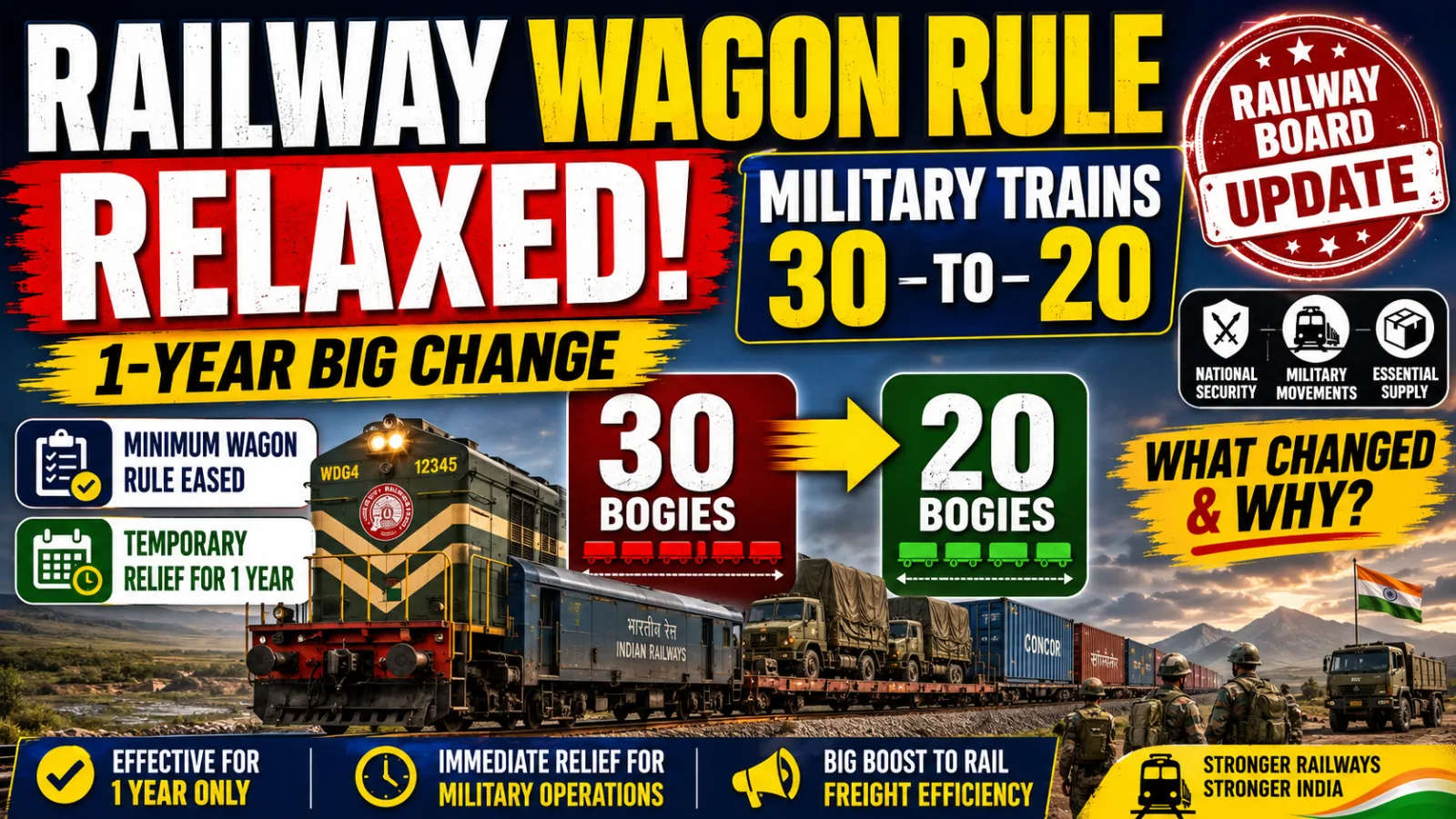
The Railway Board has relaxed the minimum wagon requirement for military mixed trains. The number drops from 30 bogie wagons to 20. This came through a Corrigendum issued on 15 July 2026.
Sounds like a small technical tweak. But for the Army's movement planners, it's a real win. And it almost didn't happen.
What Actually Changed
A Mixed Train combines coaching (passenger-type) and goods wagons in one formation.
Under the old rule — Rates Circular No. 32 of 2014 — any military mixed train had to pay for a minimum of 30 bogie wagons, including at least one coach. This applied even if fewer wagons were actually used.
The new Corrigendum No. 3, dated 15 July 2026, brings that minimum down to 20 bogie wagons. So the Army can now run a smaller formation without paying as if it were a full 30-wagon train.
But There's a Catch — It's Not Permanent
This isn't a new rulebook. It's a trial.
The relaxation runs for exactly one year — from 16 July 2026 to 15 July 2027. After that, the rule automatically goes back to 30 wagons. Unless Railways decides to extend it.
So think of this as Railways testing the idea, not committing to it.
The Backstory — This Was Rejected First
Here's the part that makes this interesting.
The Army's Movement Directorate first asked for this relaxation in June 2026. They wanted to move mixed rakes with as few as 20 wagons instead of 30.
Railway Board reviewed it and said no. On 25 June 2026, they rejected the request, saying anything below 30 wagons "may not be operationally feasible."
That should have been the end of it. It wasn't.
Three weeks later, the Board reversed its own decision. They approved the exact same relaxation — this time as a one-year trial. A useful reminder: a rejection isn't always final. Sometimes it just needs another round of talks.
Who Was Involved
This decision didn't happen in isolation.
- The Army's request came through MilRail, on behalf of the Movement Directorate at Army Headquarters
- Railway Board's Traffic Transportation Directorate reviewed it
- The Finance Directorate of the Ministry of Railways gave formal concurrence
This is Army logistics planners and Railway officials working through a real operational problem together — not a policy handed down from the top.
Why This Actually Matters
Here's the practical difference.
Before this change, if the Army needed to move just 20 wagons' worth of cargo, it still got billed for 30. That's extra cost for capacity nobody used.
Now, smaller military rakes can move at the actual size needed. No more paying for empty capacity. For a force that often needs flexible, scaled movement — not always full 30-wagon rakes — this genuinely helps.
What Happens After July 2027
Nothing beyond the trial year is confirmed yet.
Once 15 July 2027 arrives, the rule reverts to 30 wagons automatically. Railway Board will review how the trial went before deciding whether to make the 20-wagon threshold permanent.
Everything else in Rates Circular No. 32 of 2014 stays the same. Only Para 3.3 — the clause on minimum charging — was touched.
Bottom Line
This is a small, technical update. But it shows how defence and railway logistics actually get coordinated — through formal requests, reviews, an initial rejection, and eventually a trial-based compromise.
For now, military mixed trains can run with as few as 20 wagons without the old 30-wagon pricing penalty. Just for the next twelve months. What happens after that depends entirely on how this trial year goes.
For more government orders and circulars like this one, keep an eye on CGSeva's Government News section — it's updated regularly with Railway Board, DoPT, and Finance Ministry orders as they're issued.