
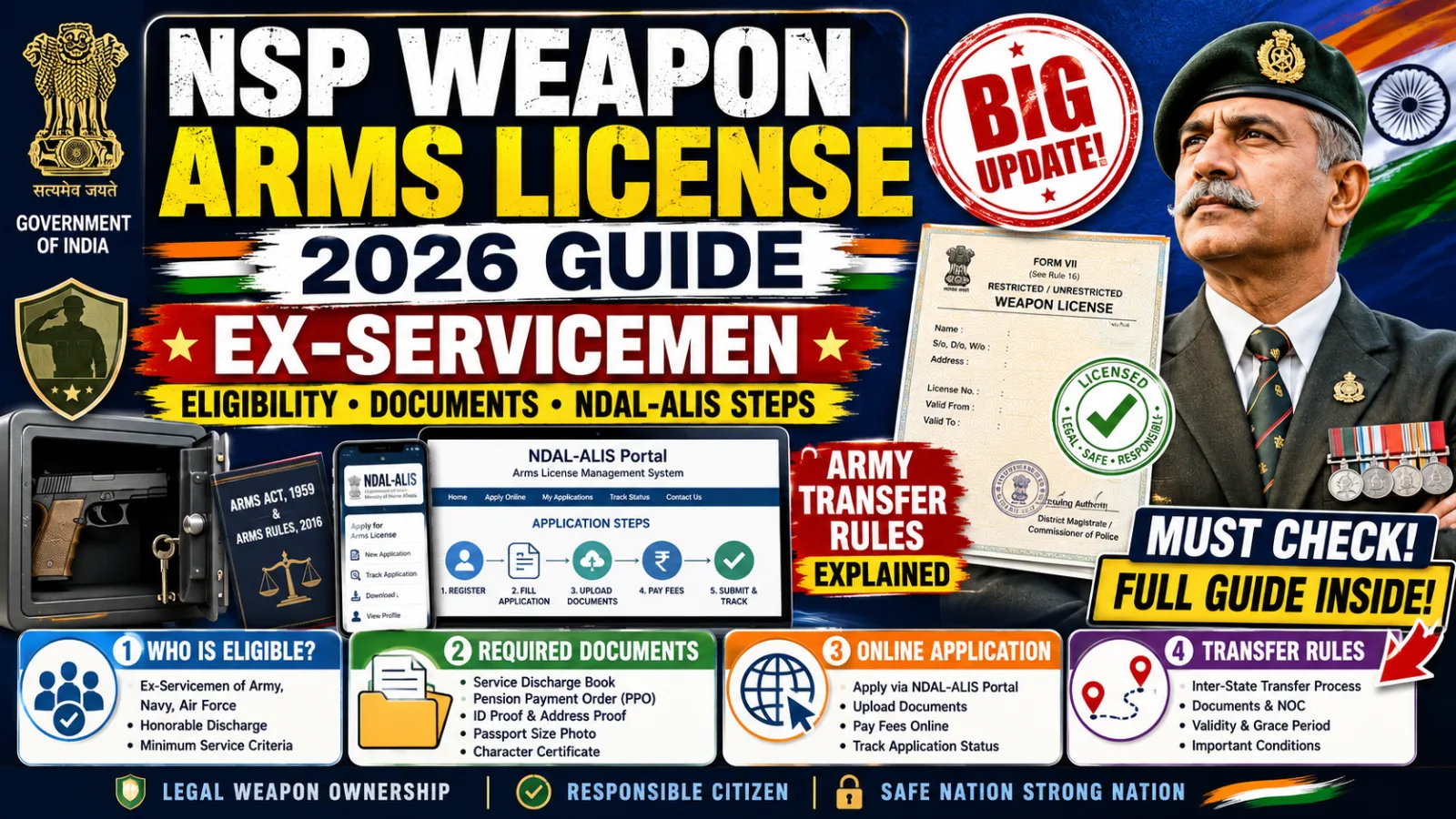
If you've served your years in uniform and now want to keep a personal weapon at home, or you're eyeing a security job that needs one, you've probably run into two confusing terms: Arms License and NSP Weapon. They are not the same thing, and mixing them up is the single biggest reason applications get stuck.
Here's the short version: a NSP weapon arms license process for ex-servicemen has two separate steps. First, you get an Arms License from your district's civil licensing authority under the Arms Act, 1959 and Arms Rules, 2016. Only after that can you buy an NSP (Non-Service Pattern) weapon, which is a personally owned firearm outside the Army's regular service inventory.
Many veterans assume being an ex-serviceman automatically opens the door to an NSP weapon. It doesn't work quite that simply, and getting the sequence wrong costs months. Here's everything you need, step by step.
What Exactly Is an NSP Weapon?
An NSP weapon is a privately owned firearm — usually a rifle or pistol from stock that is surplus to the Army's current service pattern. It is not the rifle you carried on duty; that always remains government property.
An NSP weapon can be bought only after you already hold a valid Arms License, can only move to another person through an approved Army transfer process, and stays your personal property once issued to you.
Arms License vs NSP Weapon — Don't Confuse the Two
| Arms License | NSP Weapon | |
|---|---|---|
| What it is | Legal permission to possess a firearm | The actual firearm |
| Who issues it | District Licensing Authority / DM | Purchased through Army-authorised channels once you hold a license |
| Governed by | Arms Act, 1959 and Arms Rules, 2016 | Army administrative instructions plus the Arms Act |
| Needed first? | Yes — mandatory before you buy | Cannot be bought without the license |
Think of the Arms License as your driving license and the NSP weapon as the car. You can't register the car in your name without the license first.
Who Can Actually Get an NSP Weapon?
This is where a lot of veterans get caught out. General eligibility for an Arms License under the Arms Act is fairly wide — it covers serving and retired defence personnel, CAPF and Assam Rifles personnel, judicial officers, senior government officers, MPs and MLAs, and citizens who can show a genuine security need. Retired Officers, JCOs, Other Ranks and Ex-Servicemen all fall within categories who can apply for an Arms License.
But NSP weapon eligibility specifically is narrower and depends on service-specific Army orders. Some veteran discussions around older Service Army Orders note that NSP weapon allotment through Army channels has historically been restricted mainly to serving or retired Officers and JCOs, with Other Ranks facing a much longer wait list and a lower priority category. If you served as an Other Rank, don't assume you'll get the same easy access as a retired Officer — check with your Record Office or Zila Sainik Board before you plan around it.
Before buying, you must already have a valid Arms License in hand — there's no shortcut here.
Documents You'll Need
Keep these ready before you start the application; missing even one causes delays:
Identity proof: Aadhaar, PAN, passport or voter ID
Address proof: Aadhaar, electricity bill, passport or driving licence
Defence-specific documents: Service Identity Card, Discharge Book, PPO (if you're a pensioner), and your Ex-Servicemen Identity Card
Other essentials: passport-size photos, active mobile number and email, a character verification report, a clear statement of purpose, and a self-declaration
Most veterans applying for personal protection or a security job mention Guard Duty, Personal Security Officer (PSO) work, or personal protection as the stated purpose. This helps establish a genuine need during police verification.
How to Apply: Step by Step
Applications for an Arms License go through the government's centralised online system, the National Database of Arms Licenses–Arms License Issuance System, known as NDAL-ALIS. This portal was built by the Ministry of Home Affairs to digitise the entire licensing process, and it now offers dozens of services — from fresh applications to renewals and endorsements — under the Arms Act, 1959 and Arms Rules, 2016.
Step 1 — Register and apply online. Fill in your personal details, address, service particulars, purpose, and the weapon category you need, typically on Form A-1.
Step 2 — Upload documents. Scanned identity proof, address proof, service documents and photographs go up as PDFs (usually under 1 MB each).
Step 3 — Police verification. Local police check your character, criminal record and residence. This is usually the slowest part.
Step 4 — Licensing Authority review. The District Magistrate or equivalent authority weighs your stated need, the police report and your eligibility.
Step 5 — Grant of license. Once cleared, your Arms License is issued and you can legally go and buy your NSP weapon.
Going by how the online system is designed, decision timelines for a new license generally run around 60 days, though verification-heavy cases can stretch closer to 90 days. Treat 2-3 months as a realistic wait, not a guarantee — some states move faster, some slower.
A licence, once granted, is usually valid for a few years and needs renewal (Form A-3) before expiry, so mark that date on your calendar the day you receive it. Since it's tied to your identity and address, any move within six months should be updated on the portal.
After the License: Buying Your NSP Weapon
Once your Arms License is in hand, you buy the NSP weapon through the authorised Army channel. The single most important paper you'll receive at this point is the Original Issue Voucher. This one document proves you legally own that specific weapon, and you will need it for the rest of its life — for renewals, for transfers, and if you ever want to deposit or surrender it.
Keep the Original Issue Voucher, the Arms License, your purchase paperwork, identity proof and any Army correspondence together in one place. If you ever misplace the voucher, you'll need to submit an affidavit under what's called Appendix F before any future transfer or deposit can go through.
Transferring an NSP Weapon to Family
A question that comes up a lot: can you pass your NSP weapon to your son, daughter, or another eligible family member? Yes — but only through the Army's formal process, submitted to Army Headquarters (Sena Bhawan), New Delhi, using the prescribed appendices.
| Appendix | What it covers |
|---|---|
| Appendix A | Transfer to another eligible individual |
| Appendix B | Details of the person receiving the weapon |
| Appendix C | Certificate of the transferee |
| Appendix D | Depositing the weapon back at an Ordnance Depot |
| Appendix E | Transfer to a family member or child |
| Appendix F | Affidavit if the Original Issue Voucher is lost |
| Appendix G | Judicial affidavit, where required |
| Appendix H | Declaration or affidavit in specified cases |
The person receiving the weapon must hold their own valid Arms License, and you'll need a No Objection Certificate along with the relevant appendix before Army approval comes through.
Common Mistakes to Avoid
- Applying for an NSP weapon before your Arms License is confirmed — the order matters, always.
- Losing the Original Issue Voucher and only realising it years later when you try to transfer or deposit the weapon.
- Letting the Arms License lapse — renew it well before expiry using Form A-3.
- Writing a vague purpose on the application instead of a specific, genuine reason like Guard Duty or Personal Security work.
- Assuming every Other Rank veteran gets the same NSP weapon priority as a retired Officer or JCO — verify this with your Record Office first.
State-Level Concessions Worth Checking
Some states go beyond the central rules for veterans. Madhya Pradesh, for instance, has offered stamp duty exemptions and free renewals for certain security-related licenses held by ex-servicemen, along with instructions for faster processing of applications tied to security-sector employment. Rules like these vary by state, so it's worth calling your local Zila Sainik Board or district licensing office to ask what applies where you live.
If you're also sorting out other post-retirement entitlements alongside this — pension paperwork, gratuity, or your PPO — it helps to go through the retirement benefits guide and the service pension guide side by side, since several of the same documents (Discharge Book, PPO, ESM card) get used across both processes.
If housing is next on your list once the paperwork side is sorted, our AWHO flats 2026 guide walks through eligibility and costs for veterans in a similar step-by-step way. And if you haven't yet activated your health coverage, the ECHS scheme guide covers enrolment, rank-wise contribution and benefits.