
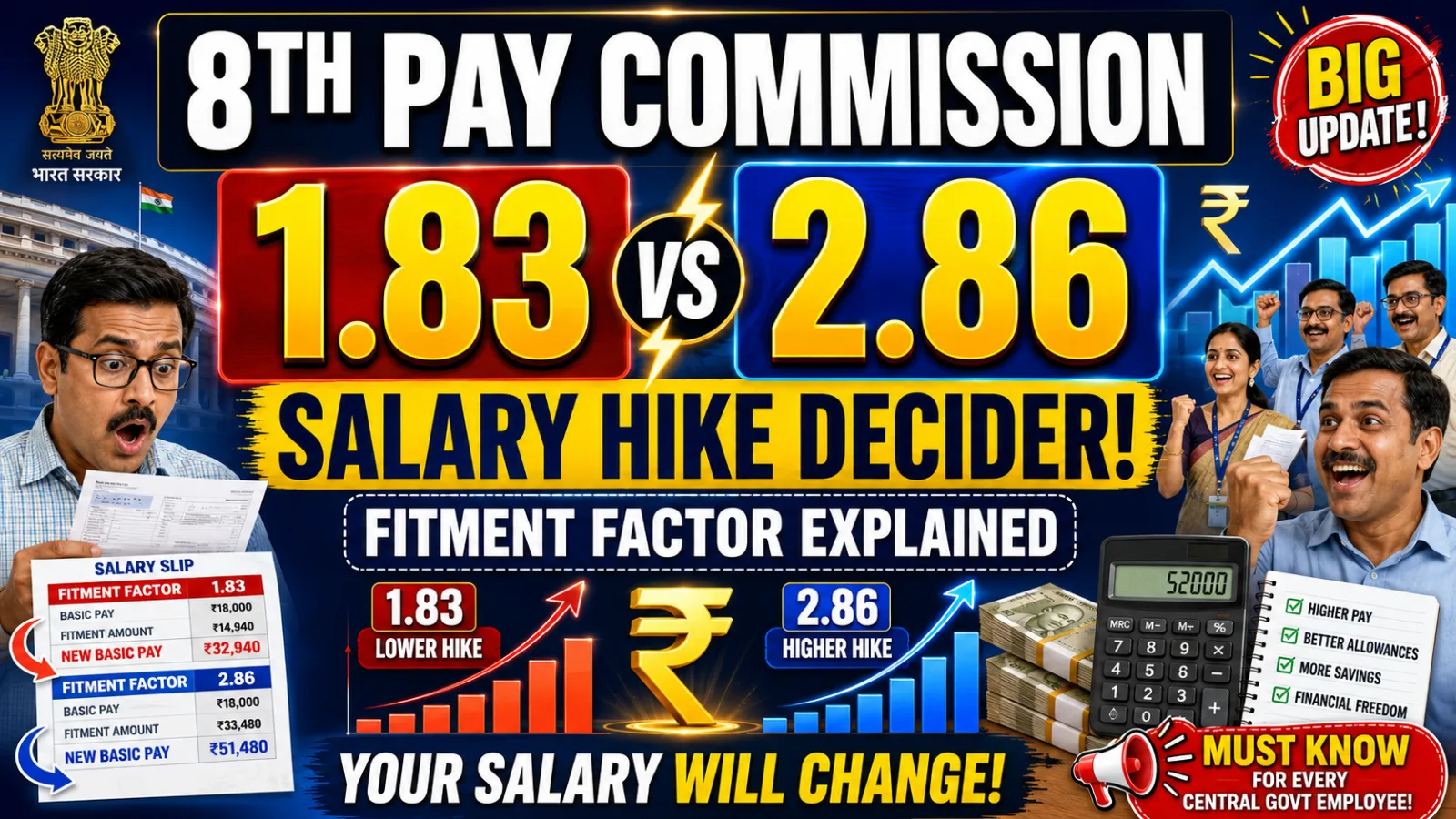
Every central government employee is asking the same thing about the pay revision — but most are asking the wrong question. It isn't "when." It's "what fitment factor?" Because the 8th Pay Commission fitment factor is the single multiplier that decides everything else: your revised basic, your DA base, your HRA, your pension. I've watched two pay commissions land, and in both, the number that actually moved lives wasn't the effective date — it was the fitment factor. So let me break down the numbers on the table right now and what each one does to your slip.
What the 8th Pay Commission fitment factor actually is
The fitment factor is the multiplier applied to your current basic pay to arrive at your revised basic under the new pay matrix.
Revised basic ≈ Current basic × Fitment factor (then fixed into the nearest cell of the new matrix)
Everything downstream — DA, HRA, NPS/pension contribution, gratuity — is calculated on that revised basic. So a swing of even 0.3 in the factor is not small. Across a 30-year career, it is lakhs.
Rather than doing that multiplication by hand, the 8th CPC Salary Calculator applies any of the factors below to your current basic and shows the revised figure straight away.
The numbers currently in play
As of July 2026, the 8th CPC has been constituted and its Terms of Reference approved, but the commission has not yet fixed the fitment factor. Here is the spread being discussed:
| Fitment factor | Who's proposing it | What it signals |
|---|---|---|
| 1.83× | Lower-end government estimate | Modest hike, close to inflation-neutral |
| ~2.00–2.28× | Mid-range analyst projections | Comparable in spirit to past cycles |
| 2.57× | The 7th CPC's actual factor (2016) | The benchmark everyone compares to |
| 2.86× | Upper-end government estimate | Strong hike |
| 3.83× | Staff-side union demand | Aspirational; historically settles lower |
The honest read: the final number will almost certainly land between the government's own estimates, not at the union demand. Every past commission has settled below what the staff side asked for.
What each factor does to a real salary
Take a current basic of ₹35,400 (Level 6, a very common band):
| Fitment factor | Revised basic (approx.) |
|---|---|
| 1.83× | ₹64,780 |
| 2.28× | ₹80,700 |
| 2.57× | ₹91,000 |
| 2.86× | ₹1,01,240 |
Same employee, same day — and the gap between the low and high scenario is over ₹36,000 a month in basic alone, before DA and HRA stack on top. That is why the fitment factor, not the date, is the real story.
Don't forget: your current DA resets
Here is the part people miss. On implementation, the DA you are drawing (currently 60%, rising to ~63% from July 2026) resets to zero — because it is effectively merged into the new higher basic. A higher DA now raises the base the fitment factor is applied to. So the July DA hike is not separate from the 8th CPC story; it feeds into it.
The realistic timeline
- Effective date: widely expected to be 1 January 2026, consistent with the 10-year cycle from the 7th CPC.
- Actual payment: likely 2027, after the commission submits its report (~18 months) and the government notifies it.
- Arrears: backdated to the effective date — so the money isn't lost, it's deferred into a lump sum.
What not to do
- Don't treat any fitment figure as final until there is a gazette notification — everything now is consultation-stage.
- Don't budget on 3.83×. Union demands set the ceiling of the conversation, not the outcome.
- Plan for the arrears tax hit. A large backdated lump sum is taxable in the year received; Form 10E / Section 89(1) relief can soften it.
The bottom line: watch the 8th Pay Commission fitment factor, not the calendar. When the notification lands, the multiplier is what will decide how much lands in your account. You can find the official commission updates at the government portal, 8cpc.gov.in.