
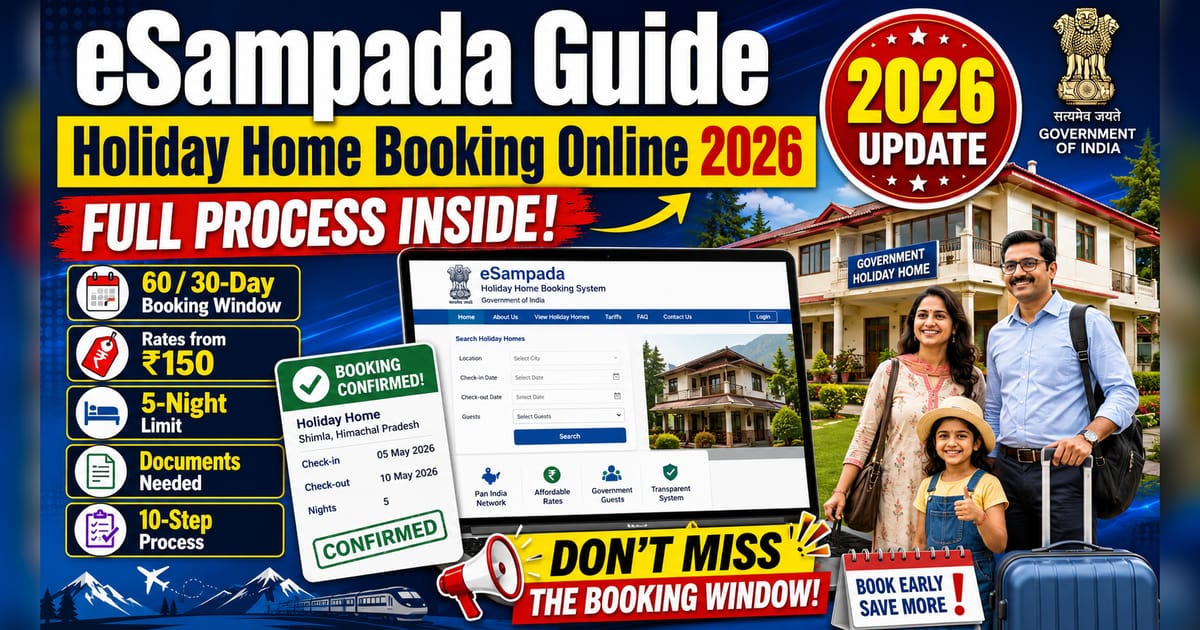
A colleague retired from the Ministry of Finance last year. That March, he took his wife to Shimla for four nights.
He stayed at the Grand Hotel — a Directorate of Estates property with a view across the valley. The room cost him a few hundred rupees a night. The private hotel across the road was quoting ₹6,000.
"Thirty-two years in service," he told me, "and I found out about holiday homes in my thirty-first."
That is the real problem with eSampada. Not that it is complicated — it isn't. It's that most Central Government employees never learn the benefit exists, and the ones who do hear about it usually find out on day 45 of a 60-day booking window, when the good rooms are gone.
This guide covers the whole thing: what eSampada is, who can book, exactly how many days ahead, what it costs, the ten steps of the booking flow, and the stay rules that catch people out.
What eSampada Actually Is
eSampada is the integrated digital platform of the Directorate of Estates, under the Ministry of Housing and Urban Affairs (MoHUA). It went live in December 2020, replacing four separate systems that had grown up independently over decades.
It now handles four things in one login:
| Service | What it covers |
|---|---|
| Holiday Homes & Touring Officers' Hostels | Short-stay accommodation for leave, LTC and duty travel |
| Government Residential Accommodation (GPRA) | Allotment of government quarters |
| Office space allotment | Government office premises (GPOA) |
| Venue booking | Vigyan Bhawan, community halls, government venues |
For most employees, only the first row matters. The portal is at esampada.mohua.gov.in, and there is a matching eSampada mobile app on Android — the same account works on both.
Worth knowing if you live in a government quarter: the same Directorate of Estates sets your licence fee, and GPRA licence fees were revised from 1 July 2026.
The important structural point: this is the government booking directly from the government. There is no agent, no aggregator, no third-party site. Any website charging you a "service fee" to book a Central Government holiday home is not affiliated with the Directorate of Estates.
Holiday Home vs Touring Officers' Hostel: The Difference
People use these interchangeably. They are not the same thing, and the distinction affects your booking.
Holiday Home — built for leisure. Located in tourist destinations: Shimla, Goa, Ooty, Nainital, Mussoorie, Udaipur, Port Blair, Kanyakumari. You book these on leave or LTC.
Touring Officers' Hostel (TOH) / Guest House — built for official travel. Located in state capitals and administrative centres. You book these when you are on duty, and duty bookings get priority over leisure bookings at the same property.
Both sit on the same portal, both use the same booking flow, and both are administered by the Directorate of Estates. The difference shows up in why you are travelling — which is a field you fill in, and which determines both your priority and your rate.
Where the Holiday Homes Are
Directorate of Estates holiday homes and TOHs operate across the country. The leisure-destination properties include:
| Region | Locations |
|---|---|
| Hills / North | Shimla, Mussoorie, Nainital, Gangtok |
| West | Goa, Udaipur, Jaisalmer, Ajmer, Mumbai |
| South | Ooty, Mysore, Kanyakumari, Madurai, Tirupati, Bengaluru, Kochi, Thiruvananthapuram |
| East / Central | Kolkata, Patna, Amarkantak, Port Blair (Andaman) |
| Metro | New Delhi (West Kidwai Nagar), Chennai, Agra |
The live, authoritative list — with room counts and caretaker phone numbers — is published on the portal itself as the Holiday Home / TOH details document. Check it before you plan, because properties open and close for renovation, and a few are seasonal.
For a station-by-station list with addresses, phone numbers, Google Maps links, city tariff category and the stay cap at each property, use the Central Government holiday home finder — it also has a calculator that counts back 60, 30 or 15 days from your check-in date so you know the exact morning your booking window opens. Duty-travel properties are listed separately under Touring Officers' Hostels.
Who Is Eligible
Eligibility is broader than most people assume. It is not restricted to serving Central Government staff.
- Members of Parliament
- Serving Central Government employees
- Retired Central Government employees (pensioners)
- Serving and retired employees of State Governments and Union Territories
- Employees of Central and State PSUs, autonomous bodies and statutory bodies
You can book for yourself, your spouse, your dependent family members, and guests. A guest booking is allowed — but guests pay a higher tariff, and a guest travelling without you must carry a self-attested photocopy of your government ID card along with their own identity proof.
Holiday homes are one of the quieter entries in the welfare package — the complete guide to Central Government allowances covers the ones that reach your pay slip each month.
The Booking Window: 60 / 30 / 15 Days
This is the single most important table in the article. Your entire chance of getting a room in Shimla in May comes down to knowing which row you are in.
| Who you are | You can book from |
|---|---|
| Serving Central Government employee | 60 days before check-in |
| Retired Central Government employee (pensioner) | 30 days before check-in |
| All other categories (State Govt, UT, PSU, autonomous/statutory bodies — serving or retired) | 15 days before check-in |
Allotment is first-come, first-served — not a lottery, not seniority-based — subject to eligibility, the time limit above, and payment of charges.
Read those two facts together and the strategy is obvious: for a peak-season property, the room is effectively decided in the first hour of day 60. Shimla in May, Goa in December, Ooty in April — these clear almost immediately. Set a calendar reminder for exactly 60 days before your intended check-in date and log in that morning.
A worked example: you want to check in at Shimla on 1 May 2026. Sixty days before that is 2 March 2026. If you are a serving employee, that is the morning to be online. A pensioner planning the same stay cannot book until 1 April 2026 — by which time a hill-station property in peak season is likely gone.
Pensioners, plan around this. Your 30-day window is a real constraint on popular properties in peak months. Two ways around it: target shoulder season (Shimla in September rather than May), or target properties that don't clear instantly — the administrative-centre TOHs rather than the marquee hill stations.
What It Costs
Room charges are calculated automatically by the portal. You do not pick a rate — eSampada derives it from three inputs:
- City category — A, B or C
- Room type — VIP suite, double/three-bedded AC, double/three-bedded non-AC, four-bedded, or dormitory bed
- Occupant category — MP, serving Central Government employee, pensioner, State/PSU employee, or private person accompanying as a guest
City categories:
| Category | Cities |
|---|---|
| A | Delhi, Mumbai, Kolkata, Chennai, Goa, Shimla, Nainital, Mussoorie, Udaipur, Agra, Mysore |
| B | Kochi, Thiruvananthapuram, Ooty, Jaipur, Bengaluru, Kanyakumari |
| C | All other cities |
Indicative rate bands (per night, Category A — the most expensive tier):
| Room type | Range |
|---|---|
| Dormitory (per bed) | ₹150 – ₹300 |
| Double / three-bedded, non-AC | ₹150 – ₹900 |
| Double / three-bedded, AC | ₹150 – ₹930 |
| Four-bedded, non-AC | ₹150 – ₹1,200 |
| Four-bedded, AC | ₹150 – ₹1,230 |
| VIP suite | ₹150 – ₹2,700 |
Category B and C cities follow the same structure at proportionally lower rates.
How to read that range: the bottom of each band is what a Central Government employee pays. The top is what a private person accompanying you as a guest pays. So a serving employee in a non-AC double room in Shimla is realistically at the ₹150–₹300 end — the ₹900 figure is the guest tariff, not yours. This is why the "₹150 a night in Shimla" headline you see circulating is broadly true for the employee, and misleading for the friend you bring along.
VIP suites have a separate eligibility bar: Grade Pay ₹8,700 and above for the VIP suite at Grand Hotel Shimla, and gazetted officers with Grade Pay ₹4,600 and above elsewhere.
What the rate does not include: food. Room charges are room rent only. Catering is handled by a contractor at the property and paid directly to them, in cash or UPI, on site. Budget separately for it.
The Booking Process, Step by Step
Have your documents ready before you start. The session times out, and re-uploading everything is tedious.
Before you begin, keep to hand:
- Aadhaar number and PAN
- A recent passport-size colour photograph (digital)
- Scanned copy of your employer-issued ID card — or, for pensioners, your PPO or Pensioner Identity Card
- Your Leave Sanction Order (for leave/LTC bookings) or Tour Order (for duty bookings)
- A working mobile number and email — OTPs go to both
- A payment method: net banking, debit/credit card or UPI
The ten steps:
- Go to esampada.mohua.gov.in — or open the eSampada app. Use the official domain; typo-squatting sites exist.
- Register as a new user if this is your first booking. Choose your correct applicant category — serving Central Government, retired Central Government, State/PSU, and so on. This choice sets your booking window, so getting it wrong costs you 30 days.
- Verify your identity — Aadhaar and PAN details are validated, and OTPs are sent to your registered mobile and email.
- Complete your profile — upload the photograph and your ID card or PPO. Do this well before your 60-day date, not on the morning of it. Profile verification is not instant.
- Log in and select "Holiday Home / Touring Officers' Hostel" from the services menu.
- Choose your station, property and dates. The portal displays live room availability by type.
- Select your purpose of visit — On Duty, Leave/LTC, or Guest. This determines both your priority and your rate, and it determines which document you must upload:
- On Duty → Tour Order
- Leave / LTC → Leave Sanction Order
- Guest → guest tariff applies
- Enter occupant details — every person staying, with their relationship to you. Names on the booking must match the IDs presented at check-in.
- Pay online. The booking is only confirmed once payment succeeds. An unpaid application holds nothing.
- Download the allotment letter. Carry a printout or the PDF on your phone, along with the original IDs of every occupant. The caretaker will ask.
Stay Rules That Catch People Out
These are the rules that generate complaints, because they are counter-intuitive if you are used to private hotels.
Maximum stay: 5 nights — except where it's 3
Accommodation is provided for a period not exceeding 5 nights.
But at the highest-demand properties the cap is tighter. Mussoorie, Goa and Udaipur are restricted to 3 nights maximum. If you were planning a five-night Goa trip on the strength of the general rule, plan again.
Check-out is 9:00 AM. Check-in is 11:00 AM to 12:00 noon.
Not the private-hotel norm of noon-to-noon. Check-out is 9 AM sharp — the room has to be turned around for the next occupant, who may arrive at 11.
This matters for travel planning. A 9 AM check-out means a late-morning departure, not a leisurely one. And if your train gets in at 4 PM, you have missed the check-in window — call the caretaker in advance to arrange late arrival rather than assuming it will be fine.
There is no refund. At all.
This is the one that stings, so read it twice:
There is no provision for refund of booking charges even if the accommodation is not occupied, partly occupied, or vacated early.
Cancellation after a confirmed booking is not permitted. If your leave gets cancelled, if the trip falls through, if you leave after two nights of a booked four — the money is gone.
The practical implication: do not book speculatively. Do not block dates "just in case" while you wait for leave sanction. Get your leave sanctioned first, then book. The 60-day window tempts people into booking before their leave is approved, and that is exactly how the no-refund rule bites.
The government can take the room back
The Director of Estates and the allotting authority are empowered to hold rooms in reserve for urgent requirements, and may reduce your booking period or cancel your reservation to accommodate VIPs or senior officers.
This is rare in practice, but it is a real term of the booking. Holiday homes exist within an official-accommodation system, and official need outranks leisure.
How This Fits With LTC
Holiday homes and LTC are complementary, and using them together is where the real money is saved.
LTC covers your travel fare — rail or air, for you and your family, reimbursed by your department. What LTC does not cover is accommodation. Hotels are entirely your expense. Blocks, home-town versus all-India entitlement and travel class by pay level are all in the LTC complete guide — and if you are flying, read the LTC air ticket booking rules first: LTC-80 no longer exists, tickets must be booked through one of three authorised agents, and there is a 21-day advance-booking expectation.
Holiday homes cover the accommodation gap at a fraction of market rates.
Run the arithmetic on an all-India LTC to Ooty for a family of four:
| Item | Private arrangement | LTC + holiday home |
|---|---|---|
| Rail fare (4 people, return) | ₹12,000 | ₹0 — reimbursed under LTC |
| 4 nights' accommodation | ₹20,000 | ~₹1,000 |
| Out of pocket | ₹32,000 | ~₹1,000 + food |
That is the case for learning this system. Add the 10 days of Earned Leave encashment you can claim alongside LTC and the trip can end up cash-positive — the accrual maths and the 60-day lifetime cap are covered in the Earned Leave guide.
One caution on documentation: your Leave Sanction Order is what you upload to eSampada. Your LTC claim goes separately to your DDO within six months of return, with original tickets. Two different processes, two different sets of paperwork — don't assume the holiday home booking evidences anything for your LTC claim.
Practical Advice for Actually Getting a Room
- Register and complete profile verification now, months before you intend to travel. On booking morning you want to be logging in, not uploading a PPO scan.
- Diarise your 60-day (or 30-day) date. Count back from your check-in date, not your travel date.
- Be online early on that day. First-come, first-served means exactly that for peak properties.
- Have a second-choice property. If Shimla clears, Nainital may not have.
- Travel shoulder season if you can. The same property that is impossible in May is available in September, and the rate is identical.
- Pensioners: favour properties that don't clear instantly. Your 30-day window is workable at TOHs and less-hyped destinations, and difficult at marquee hill stations in peak months.
- Sanction your leave before you pay. No refunds.
- Carry originals. Allotment letter plus original ID for every named occupant.
- Ring the caretaker a day ahead — for late check-in, catering arrangements and directions. The published telephone directory exists for this.
Pros
- ✅ Genuinely inexpensive — often 5–10% of private hotel rates in the same town
- ✅ Located in prime tourist destinations, frequently in prime positions within them
- ✅ Open to pensioners, not just serving employees
- ✅ Spouse, dependent family and guests can all be accommodated
- ✅ Pairs with LTC to make a family trip near-free
- ✅ Booked directly from the government — no agent, no commission
Cons
- ❌ No refund under any circumstance, including cancelled leave
- ❌ 5-night cap — 3 nights at Mussoorie, Goa and Udaipur
- ❌ 9 AM check-out is earlier than most travellers expect
- ❌ Peak-season properties clear within hours of the window opening
- ❌ Pensioners' 30-day window is a real disadvantage against serving employees' 60
- ❌ Food is extra and paid separately to the caterer
- ❌ Rooms can be reclaimed for VIP or official requirements