
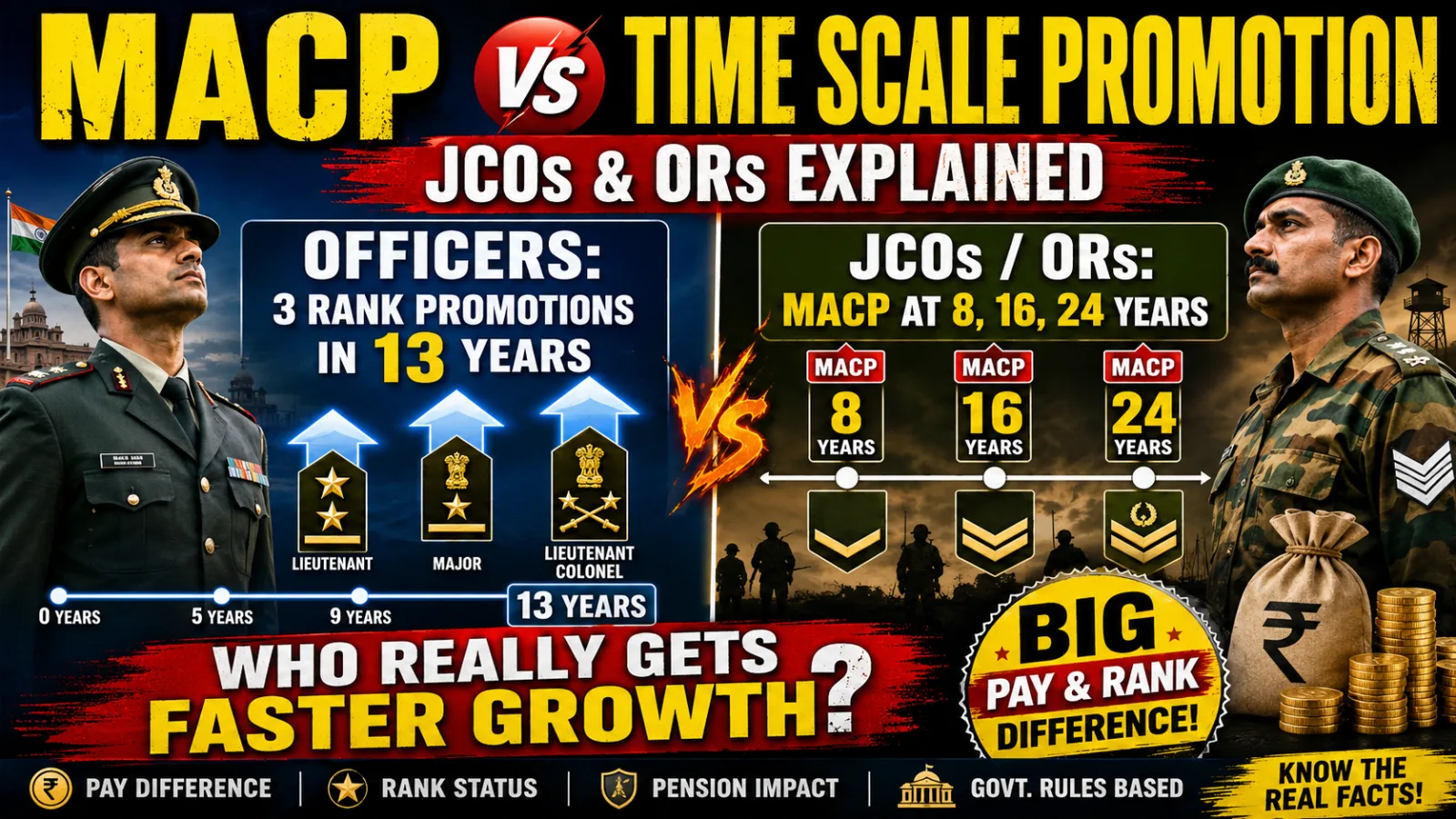
If you've ever compared notes with a friend who's a commissioned officer and wondered why his rank kept changing every few years while yours didn't, you've already run into the MACP vs time scale promotion gap. It's real, it's built into the rules, and for the first time in years, it's actually up for review. Here's the short version. Officers move through Lieutenant, Captain, Major, and Lieutenant Colonel inside 13 years, guaranteed by rules, not by luck. JCOs and Other Ranks (PBOR) don't get that. They get the Modified Assured Career Progression Scheme (MACP) — a pay bump at 8, 16, and 24 years of service, with no new rank attached. Same organisation, two very different ladders. Why officers get three promotions and PBOR doesn't This split didn't happen by accident. It traces back to the Ajay Vikram Singh Committee (AVSC), set up specifically because officers were stagnating in rank for too long, which was hurting the average age of unit commanders and, by extension, combat readiness. The government accepted the AVSC recommendations in two phases. The result is the officer career path you see today: RankTime RequiredLieutenantOn commissioningCaptain3 yearsMajor6 yearsLieutenant Colonel13 years That's three full rank promotions — new stars, more command, more pay — inside 13 years. Many officers get a fourth bump too, through Colonel (Time Scale) around the 26-year mark, even without clearing a selection board. AVSC Phase-II went further and created close to 1,900 additional posts across the Army, Navy, and Air Force just to keep this pipeline moving. No equivalent restructuring has ever been done for JCOs and ORs. What MACP actually gives you (and what it doesn't) MACP came in from 1 September 2008, on the Sixth Pay Commission's recommendation, to stop employees from losing out financially just because promotion vacancies weren't available. For the Armed Forces, it was tailored to military service conditions and runs on an 8-16-24 year cycle. Here's what a Direct Entry Sepoy actually gets: Service LengthMACP Benefit8 yearsLevel-4 pay (Naik-equivalent)16 yearsLevel-5 pay (Havildar-equivalent)24 yearsLevel-6 pay (Naib Subedar-equivalent) Notice what's missing from that table — rank. A soldier drawing Naib Subedar-level pay after 24 years under MACP is still, on his shoulder, whatever rank he last actually got promoted to. He doesn't wear the stars. He doesn't get the command authority. He just gets paid more. That's the whole distinction in one line: promotion changes your rank and authority; MACP only changes your pay slip. So is this actually unfair, or just how the system is built? Both sides have a real point here, and it's worth hearing both before picking a side. The case for reform: if career stagnation was serious enough to justify a full AVSC overhaul for officers, the same stagnation logic doesn't stop applying just because the rank is lower. Many soldiers today are more educated and more career-driven than earlier generations, and watching your rank freeze for 24 years while only your pay quietly shifts underneath doesn't do much for morale or retention. The case for the status quo: the Armed Forces run on a strict pyramid structure. You can't have an unlimited number of JCOs and Havildars without breaking the command hierarchy or blowing up the pay bill. Defence planners also point out that PBOR's 8-16-24 year MACP cycle is already faster than the civilian version — which runs on 10-20-30 years — precisely because military personnel retire earlier and need their financial upgrades sooner. The genuinely new part: the Army has proposed a fix This is where the story stops being an old, unresolved argument. As part of the ongoing 8th Central Pay Commission process, the Indian Army's AG Branch has formally submitted a proposal to restructure MACP itself, moving it from the current 8-16-24 year cycle to a tighter 6-12-18 year cycle — a financial upgrade every 6 years instead of every 8. Alongside that, the Army's submission reportedly also asks for:
Around a 130% pay increase for Jawans (OR) Around a 246% pay increase for JCOs A revised Military Service Pay structure A narrower JCO-OR pay gap Raising Ordinary Family Pension from 30% to 40% of last drawn basic pay
None of this is approved. It's sitting with the 8th CPC as a recommendation, and the Commission still has to weigh it against fiscal space and the government's final call. But it's the most concrete, numbers-backed structural proposal on PBOR stagnation in years — and it's coming from inside the Army, not just from veteran forums online. The civilian side is fighting a related battle too This isn't only a defence issue. Central Government employee unions have long argued that someone who already got MACP and then gets a genuine regular promotion should get an extra pay bump at that point too — since right now, both can land you at the same pay level with nothing extra for the real promotion. At the 49th National Council (JCM) meeting, chaired by the Cabinet Secretary, the government decided this needed proper study rather than a quick call, and referred it to the 8th Pay Commission. Separately, the NC-JCM staff side has asked the Commission to guarantee a minimum of five promotions over a career, up from the current three under MACP, with a clearer promotion hierarchy attached. Put both threads together and you can see where this is heading: the 8th CPC is being asked, from more than one direction, whether three financial upgradations across a 24-to-30-year career is really enough when officers get three real rank promotions in just 13. If you want to see how MACP would apply to your own pay level right now, run it through the MACP calculator — it's a good way to see exactly where your next upgrade lands before any of these proposed changes come into play. For the full mechanics of the scheme as it stands today, the MACP scheme guide walks through eligibility and pay fixation in detail. What happens next Nothing here is locked in yet. The Army's 6-12-18 proposal, the civilian promotion-pay-fixation demand, and the five-promotions ask are all currently sitting as recommendations before the 8th Central Pay Commission, which is still collecting data from ministries and stakeholders. You can track how these proposals move alongside the fitment factor debate on our 8th CPC latest news page, and see how your own pay level might shift once a fitment factor is finalised using the 8th CPC pay matrix calculator. FAQs What is the difference between MACP and a regular promotion? A regular promotion changes your rank, your command authority, and your standing. MACP only changes your pay level and gives one extra increment — your rank stays exactly where it was. At what years of service do JCOs and ORs get MACP? Currently at 8, 16, and 24 years of service, compared to 10, 20, and 30 years for civilian Central Government employees. Has the government approved the Army's 6-12-18 MACP proposal? No. It's a recommendation submitted to the 8th Central Pay Commission by the Army's AG Branch. It still needs Commission review and government approval before it becomes policy. Why don't officers get MACP like JCOs and ORs? The government's position is that officers already have a guaranteed time-scale promotion system, brought in through the AVSC reforms, that serves the same purpose MACP serves for PBOR — preventing rank stagnation. Will civilian employees get pay fixation after MACP plus promotion? That's still undecided. The demand has been referred to the 8th Pay Commission for detailed study rather than settled through a regular JCM meeting, so any change depends on the Commission's final recommendation.