CGHS Mounjaro & Semaglutide Guidelines: Who Qualifies
CGHS Mounjaro and Semaglutide guidelines 2026 set strict BMI, specialist approval, and monitoring rules. Here is exactly who qualifies and how.
In this article
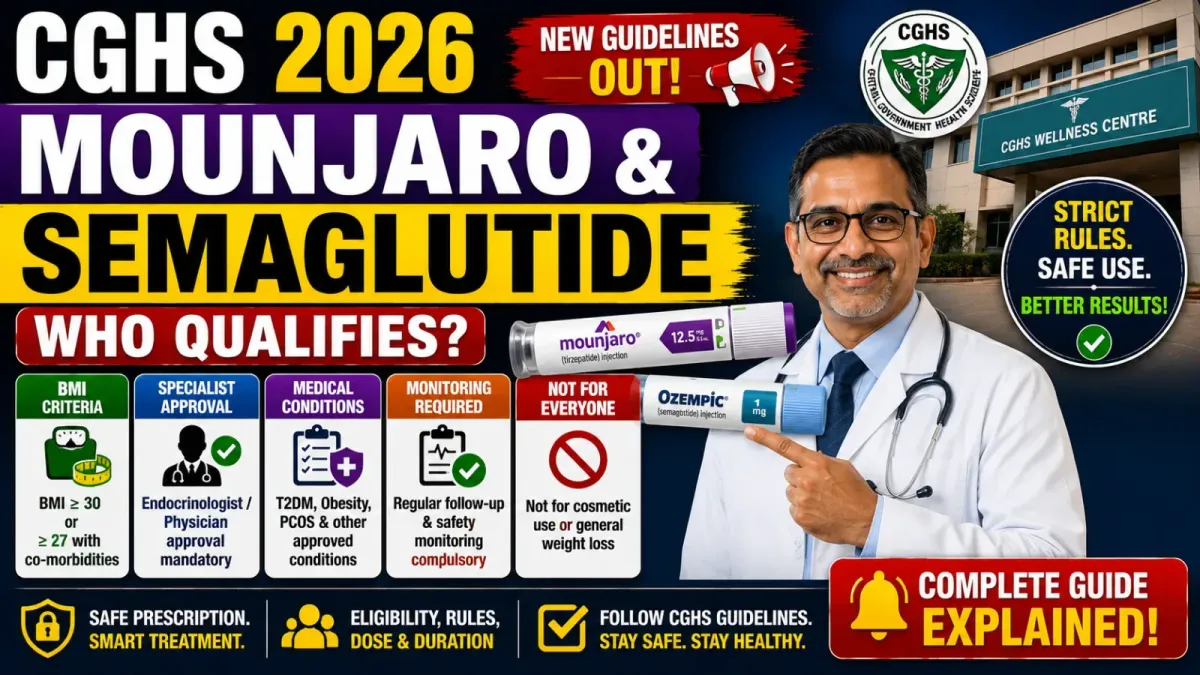
The CGHS Mounjaro and Semaglutide guidelines issued this week finally answer a question a lot of beneficiaries have been asking quietly for months: can you actually get these expensive weight-loss and diabetes injections through CGHS, and if so, how? The short answer is yes, but only under fairly strict conditions — and if you were hoping to walk into a CGHS Wellness Centre and ask for Mounjaro or Ozempic-type injections directly, that’s not how this is going to work.
The Ministry of Health & Family Welfare issued the Office Memorandum on 30 July 2026, bringing Injection Tirzepatide (sold as Mounjaro) onto the CGHS Restricted Drug List for the first time, while also laying out uniform rules for Injection Semaglutide that CGHS previously handled less formally.
Why This Guideline Exists
GLP-1 receptor agonists — the drug class Tirzepatide and Semaglutide belong to — have become genuinely popular for weight loss and Type-2 diabetes management, and they’re expensive. Without clear eligibility rules, a scheme covering lakhs of beneficiaries risks either denying the drug to people who genuinely need it or approving it too liberally for people who could manage with diet, exercise, and standard medication. This OM is CGHS drawing a clear, clinical line on both fronts.
Who Actually Qualifies
You need to meet one of two BMI-based pathways:
Pathway 1 — BMI alone A Body Mass Index of 35 kg/m² or above qualifies on its own, without needing an additional medical condition.
Pathway 2 — Lower BMI, plus a qualifying condition A BMI of 32.5 kg/m² or above, combined with at least one of the following:
- Type-2 Diabetes that remains uncontrolled despite treatment with Metformin plus at least two other oral anti-diabetic medicines
- Severe Obstructive Sleep Apnoea
- Atherosclerotic Cardiovascular Disease
- Metabolic Dysfunction-Associated Steatotic Liver Disease (MASLD)
- Chronic Kidney Disease (CKD)
If you’re below both these BMI thresholds, this route isn’t available to you under the current guidelines, regardless of other health concerns.
Who Is Explicitly Excluded
Even if you meet the BMI and condition criteria above, you’re ruled out entirely if you have:
- A history of pancreatitis
- A personal or family history of Medullary Thyroid Carcinoma (MTC) or Multiple Endocrine Neoplasia Type-2 (MEN2)
- Pregnancy or are currently breastfeeding
- Severe non-proliferative or proliferative diabetic retinopathy
- Severe GERD, gastroparesis, inflammatory bowel disease, or a history of metabolic/bariatric surgery
These exclusions exist for genuine safety reasons specific to how this drug class interacts with those conditions — this isn’t a paperwork formality.
The Three-Month Rule Nobody Can Skip
Before a specialist can even consider prescribing Tirzepatide or Semaglutide, they have to certify that you’ve already tried the non-drug route first — and stuck with it for at least three months. That means:
- Documented lifestyle modification
- Dietary counselling
- A supervised physical activity programme
This is a genuine prerequisite, not a checkbox. CGHS is positioning these injections as a next step after real effort at lifestyle change, not a shortcut around it.
Who Can Actually Prescribe It
This is tightly controlled:
- Only an Endocrinologist or an Internal Medicine Specialist at a Government Hospital can issue the prescription
- Every prescription needs sign-off from the Head of Department
- The approval is valid for six months only
- Continuing beyond six months requires a fresh specialist recommendation and a new HoD endorsement
If you’re seeing a private specialist or a non-government facility, this route isn’t available to you under CGHS — the prescribing authority is specifically restricted to government hospital specialists.
What Happens After You Start Treatment
This isn’t a one-time approval and then you’re on your own. CGHS requires structured follow-up:
- Monthly reviews for the first three months
- Reviews every three months after that
At each review, the specialist documents your weight change, clinical response, any gastrointestinal side effects, signs of pancreatitis, muscle wasting, and any other adverse reactions. Continuation depends on the specialist seeing genuine clinical benefit alongside an acceptable safety profile — this isn’t an automatic renewal.
The Certification Paperwork
Every prescription needs a standard certification recording your current weight, BMI, confirmation that none of the exclusion conditions apply, and confirmation that you’ve completed the three-month lifestyle-modification requirement. If even one contraindication is present — say, a family history of Medullary Thyroid Carcinoma — the specialist isn’t permitted to prescribe, full stop.
What This Means If You Think You Qualify
- Start with your BMI — if you’re under 32.5, this pathway isn’t open to you right now under CGHS
- If you’re in the 32.5-35 range, you’ll need one of the listed conditions clinically documented, not just self-reported
- Be ready to show three months of genuine effort on diet and exercise before a specialist can even consider prescribing
- This has to go through a Government Hospital Endocrinologist or Internal Medicine Specialist — a private prescription for these drugs won’t be reimbursed or continued under this framework
- Budget for regular follow-up visits — monthly at first, then quarterly — since continuation depends on documented results, not a one-time approval
Why This Matters Beyond Just These Two Drugs
This OM is also a signal of how CGHS is likely to handle other high-cost, high-demand drug categories going forward — clinical eligibility criteria, specialist gatekeeping, time-limited approvals, and mandatory monitoring. If you’re tracking CGHS policy generally, this pattern is worth remembering.
For the wider CGHS framework this sits within, our CGHS complete guide and list of CGHS empanelled hospitals are useful starting points. If you’re closer to retirement and thinking about how your CGHS coverage continues, our coverage of the CGHS Pensioner Card integration with Bhavishya Portal and the CGHS hospital empanelment validity extension are both relevant recent updates. For other recent expansions to CGHS coverage, see our piece on easier access to private Ayush day care centres.
For more CGHS and health-policy updates like this, follow our government news section.
Frequently asked questions
Which drugs are covered under this new CGHS guideline?
Injection Tirzepatide (brand name Mounjaro) and Injection Semaglutide. Tirzepatide has been newly added to the CGHS Restricted Drug List, while Semaglutide now follows the same uniform prescribing rules.
What BMI do I need to qualify for these drugs under CGHS?
Either a BMI of 35 kg/m² or above on its own, or a BMI of 32.5 kg/m² or above along with at least one qualifying condition such as uncontrolled Type-2 Diabetes, severe sleep apnoea, cardiovascular disease, MASLD, or chronic kidney disease.
Can any doctor prescribe these drugs under CGHS?
No. Only an Endocrinologist or Internal Medicine Specialist at a Government Hospital can prescribe them, and the prescription must be endorsed by the Head of Department.
Do I need to try diet and exercise first?
Yes. The specialist must certify that you've completed at least three months of documented lifestyle modification, dietary counselling, and a supervised physical activity programme before prescribing these drugs.
How long does the approval last?
Six months. Continuing treatment beyond that requires a fresh specialist recommendation and a new Head of Department endorsement.
Who cannot be prescribed these drugs regardless of BMI?
Anyone with a history of pancreatitis, a personal or family history of Medullary Thyroid Carcinoma or MEN2, pregnancy or breastfeeding, severe diabetic retinopathy, or specific gastrointestinal conditions including severe GERD, gastroparesis, inflammatory bowel disease, or prior metabolic/bariatric surgery.
Never miss an update
Get 8th CPC, DA, CGHS and pension news as soon as it is published.