NPS Calculator for Central Government Employees: How Much Pension Will You Get?
How much pension will NPS give you? Level-wise tables for central government staff, with the 24% contribution, 60% lump sum and 40% annuity worked out.
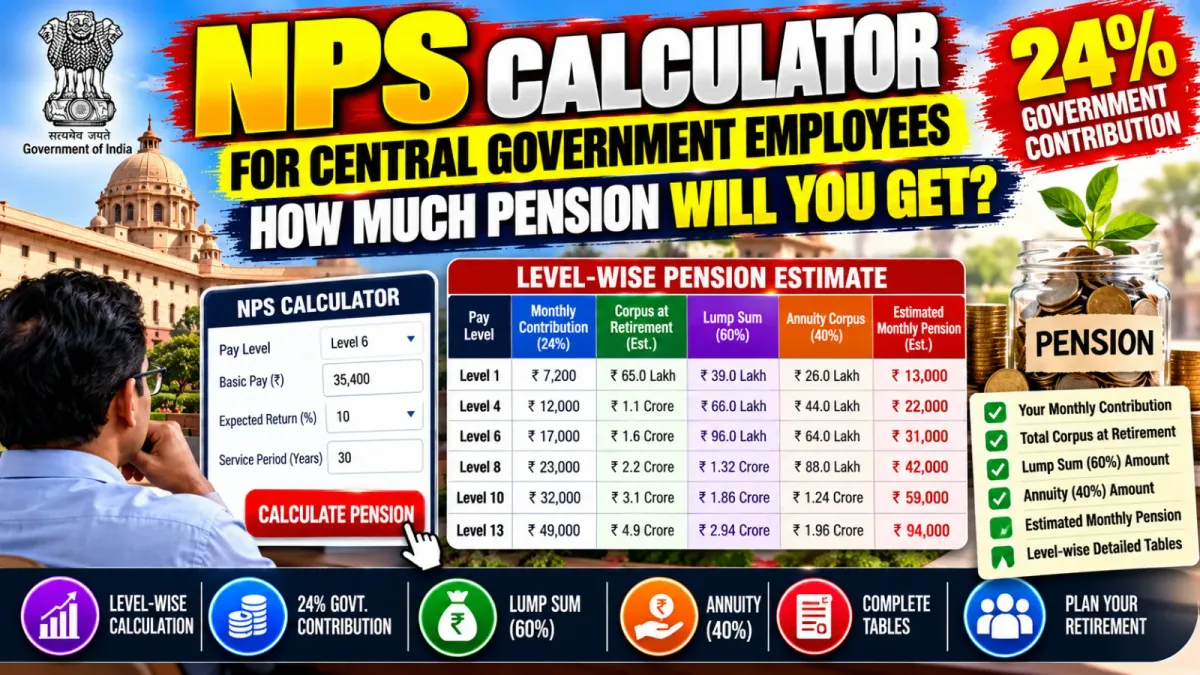
Key highlights
- Central government NPS gets 24% of basic pay plus DA every month: 10% from you, 14% from the government
- At retirement you can take up to 60% as a tax-free lump sum; at least 40% buys an annuity
- A Level 6 employee with 30 years left could build about Rs 3.8 crore at an 8% return
- That is about Rs 88 lakh in today's money, if prices rise 5% a year
- Returns are not guaranteed; the Unified Pension Scheme offers an assured payout instead
In this article
- How does NPS work for central government employees?
- How much goes into your NPS account every month?
- How much NPS corpus and pension after 30 years?
- What if NPS earns 10% a year?
- How much do the years of service matter?
- How to calculate your own NPS pension
- What these figures leave out
- Should you choose NPS or UPS?
Under the National Pension System (NPS), 24% of your basic pay plus DA goes into your pension account every month: 10% from you and 14% from the government. How much pension that buys depends on how long you invest and the returns you earn. As a rough guide, a Level 6 employee with 30 years of service left could retire with about Rs 3.8 crore at an 8% return, which is about Rs 88 lakh in today’s money.
The tables below work this out for six pay levels. You can also use the steps at the end to calculate your own figure.
How does NPS work for central government employees?
| Rule | What it means |
|---|---|
| Your contribution | 10% of basic pay plus DA, cut from salary |
| Government contribution | 14% of basic pay plus DA |
| At retirement | Up to 60% as a lump sum, tax-free |
| Annuity | At least 40% buys an annuity that pays a monthly pension |
| Annuity income | Taxable as part of your income |
In December 2025, PFRDA let non-government subscribers take up to 80% as a lump sum. That change does not apply to government employees, who stay on the 60:40 split. Our post on NPS exit and withdrawal rules covers the latest changes.
How much goes into your NPS account every month?
These figures use the entry pay of each level and today’s DA of 60%.
| Pay level | Basic pay | Basic + DA | You pay (10%) | Government pays (14%) | Total a month |
|---|---|---|---|---|---|
| Level 1 | Rs 18,000 | Rs 28,800 | Rs 2,880 | Rs 4,032 | Rs 6,912 |
| Level 2 | Rs 19,900 | Rs 31,840 | Rs 3,184 | Rs 4,458 | Rs 7,642 |
| Level 4 | Rs 25,500 | Rs 40,800 | Rs 4,080 | Rs 5,712 | Rs 9,792 |
| Level 6 | Rs 35,400 | Rs 56,640 | Rs 5,664 | Rs 7,930 | Rs 13,594 |
| Level 7 | Rs 44,900 | Rs 71,840 | Rs 7,184 | Rs 10,058 | Rs 17,242 |
| Level 10 | Rs 56,100 | Rs 89,760 | Rs 8,976 | Rs 12,566 | Rs 21,542 |
When DA rises to an expected 63% from July 2026, these amounts go up a little, because NPS is calculated on basic pay plus DA.
How much NPS corpus and pension after 30 years?
This table assumes you have 30 years of service left, your basic pay plus DA grows 6% a year, NPS earns 8% a year, and the annuity pays 6% a year.
| Starting level | Corpus at retirement | 60% lump sum | Monthly pension from 40% annuity | Corpus in today’s money |
|---|---|---|---|---|
| Level 1 (Rs 18,000) | Rs 1.94 crore | Rs 1.17 crore | Rs 38,900 | Rs 44.9 lakh |
| Level 2 (Rs 19,900) | Rs 2.15 crore | Rs 1.29 crore | Rs 43,000 | Rs 49.7 lakh |
| Level 4 (Rs 25,500) | Rs 2.75 crore | Rs 1.65 crore | Rs 55,000 | Rs 63.7 lakh |
| Level 6 (Rs 35,400) | Rs 3.82 crore | Rs 2.29 crore | Rs 76,400 | Rs 88.4 lakh |
| Level 7 (Rs 44,900) | Rs 4.85 crore | Rs 2.91 crore | Rs 96,900 | Rs 1.12 crore |
| Level 10 (Rs 56,100) | Rs 6.05 crore | Rs 3.63 crore | Rs 1,21,100 | Rs 1.40 crore |
“Today’s money” divides the future amount by 30 years of 5% inflation. It is the more honest number to compare with your salary now.
Worked example: a Level 1 employee who builds Rs 1.94 crore could take Rs 1.17 crore tax-free and get about Rs 38,900 a month from the annuity. In today’s money, that pension is worth about Rs 9,000 a month, roughly the minimum pension under the old pension scheme today.
What if NPS earns 10% a year?
Returns depend on where your money is invested. The default option for government employees invests mostly in bonds, while life-cycle options put more in shares. At a 10% return, with the other assumptions the same:
| Starting level | Corpus at retirement | Monthly pension from 40% annuity |
|---|---|---|
| Level 1 | Rs 2.74 crore | Rs 54,800 |
| Level 2 | Rs 3.03 crore | Rs 60,500 |
| Level 4 | Rs 3.88 crore | Rs 77,600 |
| Level 6 | Rs 5.38 crore | Rs 1,07,700 |
| Level 7 | Rs 6.83 crore | Rs 1,36,600 |
| Level 10 | Rs 8.53 crore | Rs 1,70,600 |
How much do the years of service matter?
Time matters more than anything else. Here is a Level 6 employee (basic Rs 35,400) with different years left to retirement.
| Years to retirement | Corpus at 8% | Pension at 8% | Corpus at 10% | Pension at 10% | Corpus at 8%, in today’s money |
|---|---|---|---|---|---|
| 10 | Rs 31.6 lakh | Rs 6,300 | Rs 35.0 lakh | Rs 7,000 | Rs 19.4 lakh |
| 20 | Rs 1.27 crore | Rs 25,300 | Rs 1.57 crore | Rs 31,500 | Rs 47.7 lakh |
| 30 | Rs 3.82 crore | Rs 76,400 | Rs 5.38 crore | Rs 1,07,700 | Rs 88.4 lakh |
With only 10 years left, NPS builds a small pension. This is why employees close to retirement often compare it with the Unified Pension Scheme.
How to calculate your own NPS pension
- Monthly contribution: take your basic pay plus DA and multiply by 0.24.
- Corpus: add up the contributions for every year to retirement, letting them grow at your expected return. An online compound interest calculator can do this step.
- Lump sum: multiply the corpus by 0.6.
- Pension: multiply the corpus by 0.4 to get the annuity amount, then by the annuity rate (say 6%), and divide by 12.
For example, an annuity amount of Rs 40 lakh at 6% gives Rs 40,00,000 × 0.06 ÷ 12 = Rs 20,000 a month.
What these figures leave out
- Pay commissions: the 8th Pay Commission will raise basic pay, which raises contributions. The tables do not include that jump, so real figures could be higher.
- Promotions and MACP: these raise pay faster than 6% in some years.
- Market risk: NPS returns are not guaranteed. A few bad years near retirement can lower your corpus.
- Annuity rates: these change over time and depend on the plan you choose.
Should you choose NPS or UPS?
Central government employees in NPS could opt for the Unified Pension Scheme (UPS) from April 2025. UPS gives an assured payout of 50% of your average basic pay of the last 12 months after 25 years of service, with a proportionate amount for shorter service and a minimum of Rs 10,000 a month after 10 years.
NPS can give more if markets do well over a long career, but UPS gives certainty. Our OPS vs NPS vs UPS comparison sets the three side by side.
Frequently asked questions
How much does the government contribute to NPS for central employees?
14% of basic pay plus DA every month. The employee contributes 10%, so 24% of basic pay plus DA goes into the NPS account each month.
How much of the NPS corpus can a government employee withdraw at retirement?
Up to 60% as a lump sum, which is tax-free. At least 40% must be used to buy an annuity, which pays a monthly pension. The 80% lump sum allowed from December 2025 applies only to non-government subscribers.
How much pension will I get from NPS?
It depends on your pay, years of service, investment returns and the annuity rate. For example, at an 8% return and a 6% annuity rate, a Level 6 employee with 30 years of service could get about Rs 76,400 a month, which is about Rs 17,700 in today's money.
Is NPS better than the Unified Pension Scheme?
UPS gives an assured payout of 50% of your average basic pay of the last 12 months after 25 years of service. NPS can give more if markets do well, but nothing is guaranteed. The right choice depends on your years of service and how much risk you can take.
Sources
Never miss an update
Get 8th CPC, DA, CGHS and pension news as soon as it is published.