8th Pay Commission Update 2026: Salary Hike Expected for 1.24 Crore Employees — DA Increase Coming in September
Big news for Central Government employees! The 8th Pay Commission is accelerating salary revision talks, and a DA hike announcement is expected in September 2026. Here is everything on fitment factor, minimum basic pay, pension reforms and how much more you could earn.

In this article
If you’re a Central Government employee or pensioner, the next few months could move real money into your salary. Here’s the complete breakdown of the 8th Pay Commission’s progress and the July 2026 DA revision expected to be announced in September.
8th Pay Commission: Where Does It Stand Right Now?
The 8th Pay Commission has completed nearly 8 months since its formation, and the activity around it is picking up pace.
The Commission has been tasked with a comprehensive review of salaries, allowances and the pension structure for all Central Government employees and pensioners, and has been granted an additional 10 months to finalise and submit its recommendations.
One major milestone was just crossed: 15 June 2026 was the last date for employees, pensioners and organisations to submit their suggestions. With that deadline passed, the Commission now holds a large database of demands and proposals from unions, associations and individual stakeholders — the raw material for its final recommendations.
What Are Central Government Employees Demanding?
The submissions cover a wide range of issues. The most critical ones:
1. Higher minimum basic pay
Employees argue the cost of living has risen sharply and the current structure no longer reflects financial reality. A significant upward revision in minimum basic pay is the top demand across most unions.
2. A better fitment factor
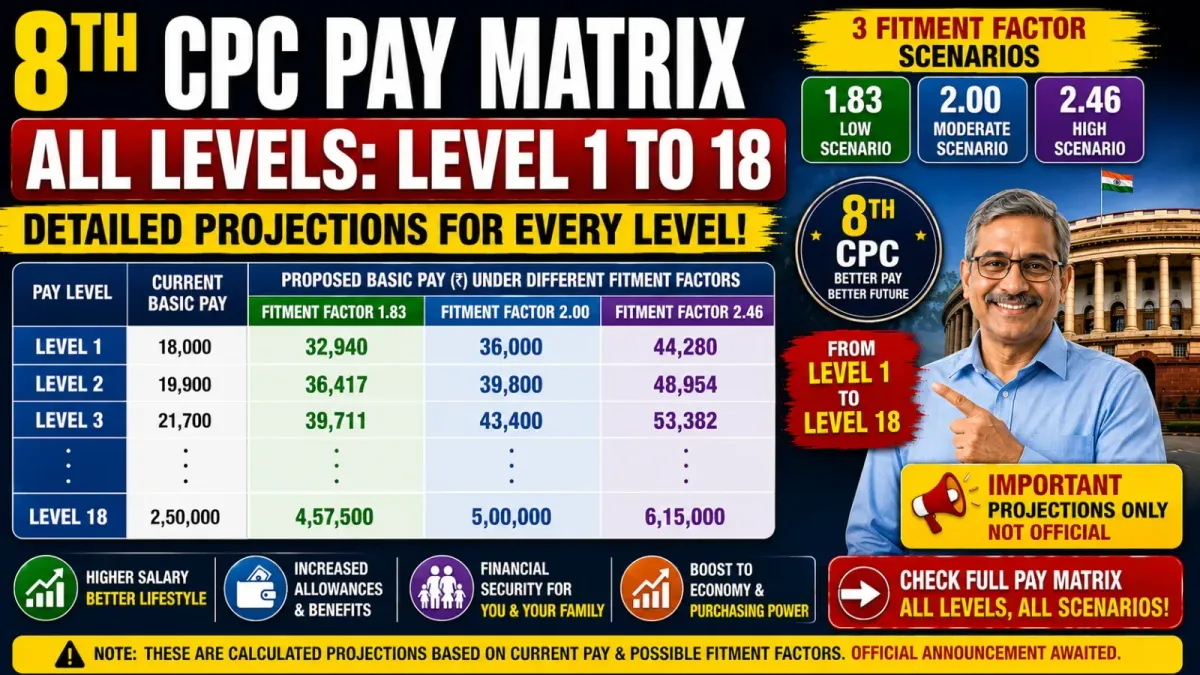
The fitment factor is the single most important variable in any pay revision — a higher factor directly raises basic pay for every employee. It is the most hotly debated demand in the 2026 submissions. (The Commission has not announced any figure yet.) You can test what different factors would mean for your own pay with the 8th CPC Salary Calculator.
3. Pension reforms for retirees
Pensioners have demanded a more robust pension structure, with the erosion of purchasing power due to inflation a central concern.
4. Old Pension Scheme (OPS) restoration
Multiple national organisations are pushing for restoration of the OPS, alongside a review of the National Pension System (NPS) and the newer Unified Pension Scheme (UPS).
5. Improved allowances
HRA, risk allowance, bonus, medical benefits and leave-related benefits all feature in the demands, with employees seeking meaningful improvements across the board.
DA Hike 2026: When Will the Announcement Come?
The government revises Dearness Allowance (DA) and Dearness Relief (DR) twice a year — effective from January and from July.
In January 2026, DA was raised by 2%, taking total DA to 60% of basic pay. All eyes are now on the next revision, effective July 2026.
Here’s how it works: DA is calculated from the All India Consumer Price Index for Industrial Workers (AICPI-IW) using a 12-month average. Data up to April 2026 is already available; the government is waiting on the May and June 2026 figures before finalising the calculation.
Once that data is in, the official announcement — widely expected in September or October 2026 — will follow. Crucially, the revised DA will be effective retroactively from 1 July 2026, so employees receive arrears along with the revised rate: a double benefit in a single month.
A Commission That’s Listening: Field Tours
Unlike earlier commissions that relied mainly on paperwork, the 8th Pay Commission is taking a hands-on approach. Its teams have already visited Delhi, Ladakh, Jammu & Kashmir, Telangana, Maharashtra and Uttarakhand, meeting employees, officials and union representatives.
Upcoming scheduled visits include:
- 22–23 June 2026 — Lucknow, Uttar Pradesh
- 6–7 July 2026 — Bhubaneswar, Odisha
- 9–10 July 2026 — Kolkata, West Bengal
The aim is to ground the final recommendations in real working conditions across states — not just what appears in reports.
Who Benefits, and By How Much?
The 8th Pay Commission covers approximately:
- 55 lakh active Central Government employees
- 69 lakh pensioners
That’s over 1.24 crore direct beneficiaries — and with family members factored in, the ripple effect reaches hundreds of millions. A revision lifts consumer spending power and demand, while improved DR cushions pensioners against inflation and healthcare costs.
Key Dates to Watch in 2026
| Event | Expected timeline |
|---|---|
| DA hike announcement (July 2026 revision) | September–October 2026 |
| 8th Pay Commission field visits | June–July 2026 |
| 8th Pay Commission final report | Early–Mid 2027 (estimated) |
| Revised salaries effective | January 2027 (estimated) |
Bottom Line
For Central Government employees and pensioners, two big financial events are converging. The DA hike announcement in September 2026 brings immediate relief with retroactive arrears from July, while the 8th Pay Commission’s work moves closer to its final stages with field visits underway.
Whether the Commission accepts the key demands on fitment factor, minimum basic pay and pension reform remains to be seen — but with over 1.24 crore people in the frame, the stakes couldn’t be higher.
Stay tuned to CG Seva for Central Government pay, DA and policy updates as they happen.
Frequently asked questions
When will the July 2026 DA hike be announced?
The July 2026 DA revision is widely expected to be announced in September or October 2026, once AICPI-IW data for May and June 2026 is available. The revised rate will be effective retroactively from 1 July 2026, so employees will receive arrears along with the new rate.
What is the expected fitment factor under the 8th Pay Commission?
The fitment factor is one of the most debated demands, but the 8th Pay Commission has not announced any figure yet. Employee unions have submitted various proposals; the actual factor will only be known when the Commission's report is finalised, estimated for early-to-mid 2027.
How many employees and pensioners does the 8th Pay Commission cover?
It covers roughly 55 lakh active Central Government employees and 69 lakh pensioners — over 1.24 crore direct beneficiaries in total.
When will revised 8th Pay Commission salaries actually be paid?
Based on the current timeline, the Commission's final report is estimated for early-to-mid 2027, with revised salaries likely effective from January 2027. These dates are estimates and not yet officially confirmed.
Never miss an update
Get 8th CPC, DA, CGHS and pension news as soon as it is published.